
Romance fraud can involve an invented relationship, a request for emergency help or a fake investment opportunity. Catfishing is a broader form of identity deception: it can cause harm without a financial transfer. Statistics about these experiences answer different questions.
This resource brings together 55 grouped findings from 13 primary-source publications or research programs. The figures are organized by reporting system, population and period. Related components stay together rather than being counted as separate discoveries. MyLittleDesire contributes source checking, accessible charts and transparent arithmetic; it did not conduct the underlying surveys or collect the complaints.
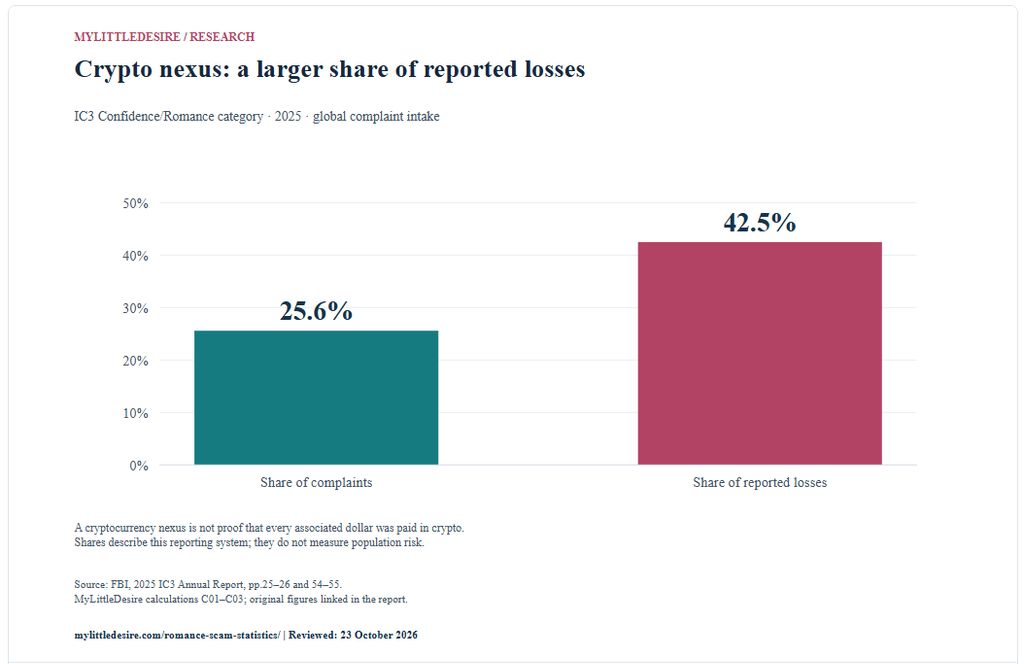
25.6% / 42.5%
Share of IC3 Confidence/Romance complaints with a crypto nexus, compared with their share of category reported losses.FBI Internet Crime Complaint Center · RS004
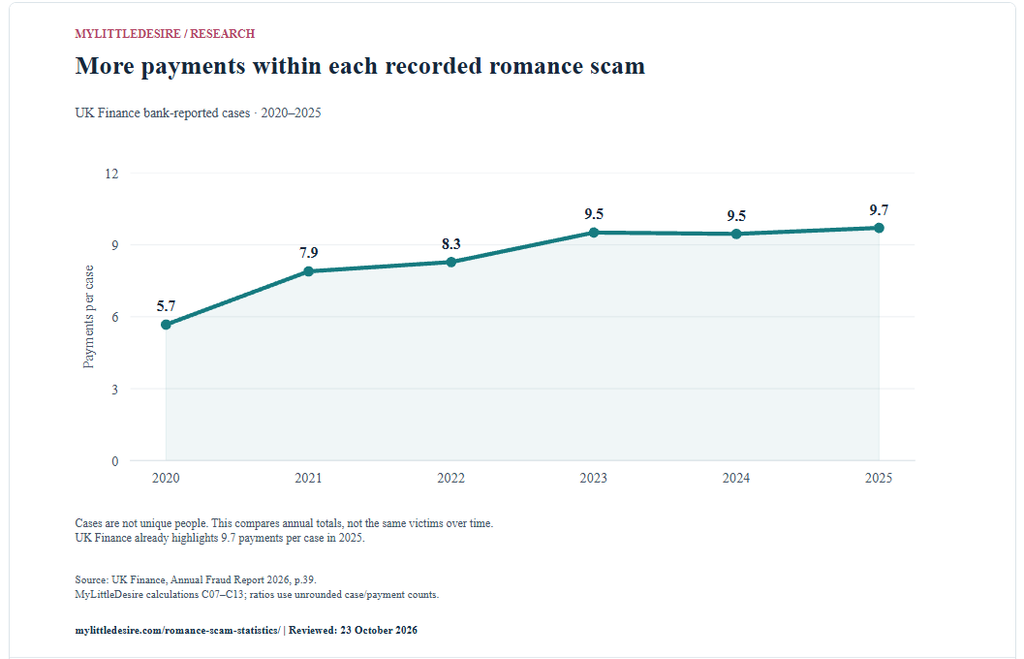
5.7 → 9.7
UK bank-reported payments per romance-scam case, 2020 to 2025. Ratios calculated from the published series.UK Finance · RS023
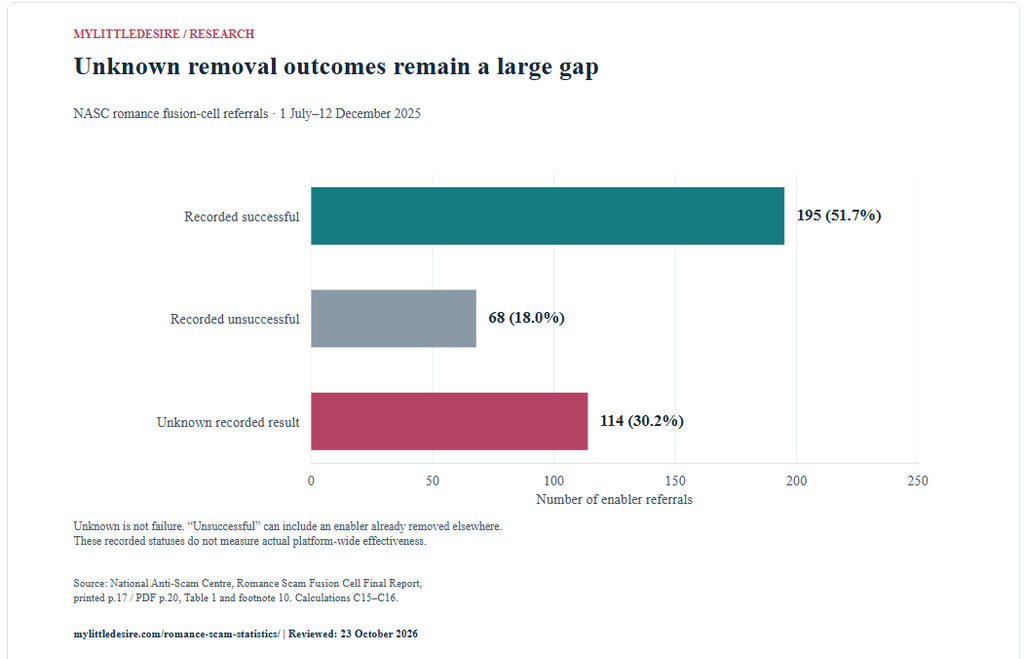
30.2%
Share of NASC scam-enabler referrals with an unknown recorded outcome. Unknown does not mean failed.National Anti-Scam Centre · RS037
What are the key romance-scam and catfishing findings?
The strongest headline depends on whether the question concerns reported money lost, a survey experience or an operational outcome.
- IC3 recorded 23,159 Confidence/Romance complaints and US$929.3 million in reported losses in 2025. Its category includes non-romantic confidence schemes. FBI Internet Crime Complaint Center · RS001.
- Complainants aged 60+ reported US$584.0 million in IC3 category losses in 2025. Missing-age records limit demographic interpretation. FBI Internet Crime Complaint Center · RS006.
- Nearly 60% of 2025 FTC romance-scam loss reports with a recognized contact method began on social media. Federal Trade Commission · RS016.
- UK Finance recorded 6,335 romance-scam cases, 61,501 payments and £39.2 million in gross losses in 2025. UK Finance · RS023.
- For April 2025–March 2026, the NCA cites 12,348 reports and £116 million in losses. This is a different period from calendar 2025. National Crime Agency · RS028.
- CAFC’s 2025 Relationship category lists C$63.3 million in reported losses, 1,093 reports and 933 victims. Canadian Anti-Fraud Centre · RS029.
- Australia’s adjusted combined romance-scam losses were A$139.9 million in 2025, down 10.8% in the source’s series. ACCC / National Anti-Scam Centre · RS030.
- Scamwatch loss reports from 2021–2025 showed an average reported duration of 171 days for romance scams versus 47 days for other scams. National Anti-Scam Centre · RS040.
- The Australian 2023 online-safety survey found that 3.05% of adults reported catfishing in the preceding year. Australian Department of Infrastructure / Social Research Centre · RS041.
- Pew found that 52% of US dating-site/app ever-users thought someone had tried to scam them. This is not a confirmed financial-loss rate. Pew Research Center · RS045.
- AARP’s November 2025 survey found 9% of adults aged 50+ reported a romantic online approach followed by a request for money or cryptocurrency. AARP Research / NORC · RS051.
- AARP’s 16% loss measure includes the respondent or someone they know; it is not a personal victimization rate. AARP Research / NORC · RS053.
Are romance scams, catfishing and scam encounters the same thing?
No. They overlap, but their definitions and denominators differ. Treating them as one measure can turn an accurate source number into a misleading headline.
| Measure | What it captures | What it cannot establish |
|---|---|---|
| Reported romance-fraud losses | Money recorded by a named reporting system in a stated period. | The full unreported loss total, population prevalence or a unique count of all victims. |
| FBI Confidence/Romance | A broader confidence category, including romantic, family and friendly relationships. | A pure count of dating-app scams or losses restricted to US residents. |
| Catfishing survey experience | Self-reported deception through a false identity under that survey’s wording. | Confirmed crime, financial loss or the number of fake accounts on every platform. |
| Suspected scam encounter | A respondent thought someone was trying to scam them. | That the suspicion was confirmed or the respondent sent money. |
| Disruption referral | A suspected account, address or site referred for action. | A conviction, unique victim, recovered funds or actual removal without outcome confirmation. |
Definitions follow IC3 Appendix B, the Australian online-safety survey, AIC Table 4 and Pew’s question wording.
How much money was reported lost to FBI confidence and romance schemes?
US$929,287,469 across 23,159 category complaints in 2025. These figures describe the FBI’s IC3 reporting system. The category includes family and friendly confidence schemes as well as romance fraud; it is not a national survey of American dating-app users.
| Finding | Statistic, period and population | Source and locator |
|---|---|---|
| RS001 | IC3 recorded 23,159 Confidence/Romance complaints and US$929,287,469 in reported losses in 2025.2025 · Complaints classified as Confidence/Romance; not a representative population sample | S01 · Original sourceThree Year Complaint Comparison and Loss Comparison, pp.25–26; Confidence/Romance row |
| RS002 | IC3 recorded 17,910 Confidence/Romance complaints and US$672,009,052 in reported losses in 2024.2024 · Complaints classified as Confidence/Romance; not a representative population sample | S01 · Original sourceThree Year Complaint Comparison and Loss Comparison, pp.25–26; Confidence/Romance row |
| RS003 | IC3 recorded 17,823 Confidence/Romance complaints and US$652,544,805 in reported losses in 2023.2023 · Complaints classified as Confidence/Romance; not a representative population sample | S01 · Original sourceThree Year Complaint Comparison and Loss Comparison, pp.25–26; Confidence/Romance row |
| RS004 | In 2025, 5,925 IC3 Confidence/Romance complaints had a cryptocurrency nexus, associated with US$394,787,515 in reported losses.2025 · Complaints classified as Confidence/Romance; not a representative population sample | S01 · Original sourceCrime Types with Cryptocurrency Nexus, pp.54–55 |
| RS005 | IC3 identified AI references in 626 Confidence/Romance complaints, associated with US$19,041,653 in reported losses in 2025.2025 · Complaints classified as Confidence/Romance; not a representative population sample | S01 · Original sourceAI References by Complaint Count and Loss, pp.41–42 |
| RS006 | Complainants aged 60+ accounted for 10,188 Confidence/Romance complaints and US$584,032,745 in reported losses in 2025.2025 · IC3 Confidence/Romance complaints with complainant age 60+; age optional | S01 · Original sourceElder Fraud Section, 60+ three-year comparison, pp.47–48 |
| RS007 | Complainants aged 60+ accounted for 7,626 Confidence/Romance complaints and US$389,312,356 in reported losses in 2024.2024 · IC3 Confidence/Romance complaints with complainant age 60+; age optional | S01 · Original sourceElder Fraud Section, 60+ three-year comparison, pp.47–48 |
| RS008 | In 2025, the IC3 age tables show 1,886 Confidence/Romance complaints and US$25,097,693 in losses for ages 20–29, versus 3,745 complaints and US$131,385,454 for ages 50–59.2025 · IC3 category complaints with ages 20–29 or 50–59 reported | S01 · Original source2025 Crime Type by Age Group: counts p.32 and losses p.33 |
Does cryptocurrency account for a larger share of losses than complaints?
Yes, within this category and reporting year. MyLittleDesire calculates that cryptocurrency-nexus complaints made up 25.6% of complaints but were associated with 42.5% of reported losses—a gap of 16.9 percentage points. The calculations divide the source’s crypto-nexus counts and losses by the corresponding category totals.
The comparison highlights a concentration in reported losses. It does not show that cryptocurrency caused those losses, or that every associated transfer used cryptocurrency. The FBI separately records crime categories and descriptors.
For additional context, category complaints increased 29.3% and nominal reported losses increased 38.3% from 2024 to 2025. These are changes in administrative reports, not measured changes in population victimization.
Where do reported romance scams begin?
Social media was the initial contact point in nearly 60% of the FTC’s 2025 romance-scam loss reports with a recognized contact method. The FTC also identifies US$298 million in losses for romance scams that originated on social media.
| Finding | Statistic, period and population | Source and locator |
|---|---|---|
| RS016 | Nearly 60% of 2025 romance-scam loss reports with a recognized contact method said the scam began on social media.2025 · Romance-scam loss reports excluding unknown and write-in other contact methods | S03 · Original sourceRomance-scam paragraph and footnote 5 |
| RS017 | Romance scams originating on social media generated US$298 million in reported losses in the FTC’s 2025 analysis.2025 · Romance-scam loss reports indicating social media as the initial contact method | S03 · Original sourceFootnote 4 |
Initial contact is different from later messaging or payment. Someone can meet a scammer on a social platform, move to a private messaging service and make a bank transfer. Those are stages of one incident, not three independent scams.
The FTC excludes missing and write-in “other” contact methods from the percentage denominator, and notes a report-collection gap during the 2025 government shutdown. The older 2022 contact findings appear in the historical section below; these snapshots should not be turned into a precise percentage-point trend without checking collection changes.
What do UK bank records and police reports show?
UK Finance recorded £39.2 million in gross romance-scam losses in 2025. Police reporting data describe a broader intake and show a different loss total. Both should be cited with their own reporting system and period.
| Finding | Statistic, period and population | Source and locator |
|---|---|---|
| RS018 | UK Finance’s 2020 romance-scam series records 2,325 cases, 13,185 payments and £17.8 million in gross losses.2020 · Bank-reported authorised push payment romance-scam cases and payments | S04 · Original sourceRomance Scam 2020–2025 table: Total rows, p.39 |
| RS019 | UK Finance’s 2021 romance-scam series records 3,270 cases, 25,814 payments and £30.9 million in gross losses.2021 · Bank-reported authorised push payment romance-scam cases and payments | S04 · Original sourceRomance Scam 2020–2025 table: Total rows, p.39 |
| RS020 | UK Finance’s 2022 romance-scam series records 3,649 cases, 30,220 payments and £31.3 million in gross losses.2022 · Bank-reported authorised push payment romance-scam cases and payments | S04 · Original sourceRomance Scam 2020–2025 table: Total rows, p.39 |
| RS021 | UK Finance’s 2023 romance-scam series records 4,160 cases, 39,578 payments and £36.5 million in gross losses.2023 · Bank-reported authorised push payment romance-scam cases and payments | S04 · Original sourceRomance Scam 2020–2025 table: Total rows, p.39 |
| RS022 | UK Finance’s 2024 romance-scam series records 5,210 cases, 49,276 payments and £31.8 million in gross losses.2024 · Bank-reported authorised push payment romance-scam cases and payments | S04 · Original sourceRomance Scam 2020–2025 table: Total rows, p.39 |
| RS023 | UK Finance’s 2025 romance-scam series records 6,335 cases, 61,501 payments and £39.2 million in gross losses.2025 · Bank-reported authorised push payment romance-scam cases and payments | S04 · Original sourceRomance Scam 2020–2025 table: Total rows, p.39 |
| RS024 | UK Finance reports £26.2 million returned to romance-scam victims in 2025, equivalent to a published rounded 67% of gross losses.2025 · Bank-reported authorised push payment romance-scam cases and payments | S04 · Original sourceRomance Scam table and Key Stats/Insights, p.39 |
| RS025 | UK Finance records £19.8 million returned to romance-scam victims in 2024.2024 · Bank-reported authorised push payment romance-scam cases and payments | S04 · Original sourceRomance Scam table: Returned to victim, Total row, p.39 |
| RS026 | Police reporting figures show 10,784 romance-fraud reports and more than £102 million in reported losses in calendar 2025.2025 · Reported romance-fraud incidents | S05 · Original sourceOpening paragraphs and 2025 reporting summary |
| RS027 | The City of London Police says calendar-year romance-fraud reports rose by 29% in 2025 compared with 2024.2025 vs 2024 · Reported romance-fraud incidents | S05 · Original source2025 versus 2024 report comparison |
| RS028 | For April 2025–March 2026, the NCA cites 12,348 romance-fraud reports and £116 million in losses; 51% of victims in the cited data were aged 50+.2025-04 to 2026-03 · Romance-fraud reports; age breakdown of victims in cited reporting data | S12 · Original sourceCampaign announcement: paragraph beginning Figures released by Report Fraud |
How many payments occur within a recorded romance-scam case?
Dividing total payments by total cases in UK Finance’s series gives 5.7 payments per case in 2020 and 9.7 in 2025, an increase of about 71.2%. The published report itself highlights the 2025 ratio. MyLittleDesire reconstructs the same measure across the full series to make the progression easier to compare.
Why are the police and banking loss totals different?
They have different reporting channels and coverage. UK Finance’s bank-reported gross-loss series should not be added to police intake or used as its denominator. The NCA’s April 2025–March 2026 figures also cover a different period from the calendar-year 2025 police release.
Similarly, the published 67% returned in 2025 is a share of UK Finance’s loss value. It does not mean that 67% of victims were fully reimbursed or that any individual claim is eligible for repayment.
How much relationship fraud was reported in Canada?
CAFC’s 2025 Relationship category lists C$63.3 million in losses. It separately records reports and listed victims. We retain the category’s original name rather than relabeling all these records as catfishing.
| Finding | Statistic, period and population | Source and locator |
|---|---|---|
| RS029 | CAFC’s 2025 Relationship category lists 1,093 reports, 933 victims and C$63.3 million in reported losses.2025 · Reports and listed victims in the Relationship category | S06 · Original sourceTop 10 frauds by frequency, Relationship row; repeated in dollar-loss table |
Administrative reports omit unreported experiences. This report does not apply a generic reporting-rate multiplier to estimate a “true” Canadian romance-scam loss total. A multiplier from all fraud, or another survey population, would not justify that calculation.
Why can Australian losses fall while Scamwatch reports rise?
The measures cover different systems. Australia’s adjusted multi-organization romance-scam losses fell from A$156.8 million to A$139.9 million in 2025. Over the same calendar years, Scamwatch romance-scam reports rose from 3,204 to 3,432.
| Finding | Statistic, period and population | Source and locator |
|---|---|---|
| RS030 | Australia’s adjusted combined romance-scam losses were A$139.9 million in 2025 versus A$156.8 million in 2024, a source-reported decrease of 10.8%.2024–2025 · Consolidated romance-scam losses; separate Scamwatch demographic subsets | S07 · Original sourceTable 3: Combined losses by category; printed p.5/PDF p.8 |
| RS031 | The 2025 Australian romance-loss table lists A$28.7m from Scamwatch, A$44.9m ReportCyber, A$50.9m AFCX and A$68.7m IDCARE, with A$53.3m in overlap adjustments.2025 · Consolidated romance-scam losses; separate Scamwatch demographic subsets | S07 · Original sourceTable 3, Romance row and footnotes 6–8; printed p.5/PDF p.8 |
| RS032 | Scamwatch’s 2025 CALD romance-scam subset contained 112 reports with loss, A$4.2 million total loss and a median loss of A$2,000.2025 · Scamwatch reporters indicating they speak a language other than English; romance category | S07 · Original sourceTable 4 and footnote 91; printed p.38/PDF p.41 |
| RS033 | The 2025 Scamwatch romance-scam subset for reporters with disability had 227 reports with loss, A$6.6 million total loss and a median of A$2,000.2025 · Scamwatch romance-scam reporters self-identifying disability | S07 · Original sourceTable 5; printed p.39/PDF p.42 |
| RS034 | First Nations reporters to Scamwatch recorded A$399,220 in dating/romance losses in 2025, compared with about A$1.4 million in 2024.2024–2025 · Scamwatch reporters self-identifying as First Nations | S07 · Original sourceFirst Nations discussion continuing onto printed p.38/PDF p.41 |
| RS035 | Scamwatch reporters aged 55–64 recorded A$7.1 million in romance-scam losses in 2025, a source-reported increase of 7.8%.2025 · Scamwatch romance-scam reporters aged 55–64 | S07 · Original sourceAge discussion, printed p.39/PDF p.42 |
| RS036 | Scamwatch received 3,432 romance-scam reports in 2025 compared with 3,204 in 2024.2024–2025 · Scamwatch dating/romance reports and fusion-cell disruption referrals | S08 · Original sourceFigure 1 discussion, footnote 5; printed p.6/PDF p.9 |
How does the consolidated loss calculation avoid overlap?
The source’s rounded components sum to A$193.2 million before an A$53.3 million overlap adjustment, leaving A$139.9 million. This is a reconciliation of the published table, not a new estimate of hidden losses. Adding raw contributor figures would overstate the consolidated total.
The separate Scamwatch report-count increase is 7.1%. A change in reports can reflect awareness, willingness to report, classification and actual experiences. It does not by itself measure the change in the number of Australians victimized.
CALD, disability, First Nations and age findings describe reporters who supplied the relevant identity information. They are not population rates. The later annual report’s A$28.7 million Scamwatch component is used here; earlier releases used slightly different rounded wording.
What do disruption results and reporting delays reveal?
Recorded outcomes remain incomplete. The NASC fusion cell’s table records 195 successful, 68 unsuccessful and 114 unknown outcomes among 377 enabler referrals. It also documents long average durations before romance-scam losses were reported.
| Finding | Statistic, period and population | Source and locator |
|---|---|---|
| RS037 | The fusion cell referred 377 online scam enablers for disruption: 195 had recorded successful outcomes, 68 unsuccessful outcomes and 114 unknown outcomes.2025-07-01 to 2025-12-12 · Enablers referred for removal/blocking by the fusion cell | S08 · Original sourceTable 1 and footnote 10; printed p.17/PDF p.20 |
| RS038 | All 82 WhatsApp referrals in the fusion-cell outcomes table had an unknown recorded result.2025-07-01 to 2025-12-12 · WhatsApp enablers referred by the fusion cell | S08 · Original sourceTable 1 and feedback explanation; printed p.17/PDF p.20 |
| RS039 | Blockchain analysis led to referrals involving 1,004 suspected scam transactions and 168 suspected scammer wallet addresses.2025 fusion-cell operations · Transactions and wallet addresses referred for investigation | S08 · Original sourceOutcomes section; printed p.17/PDF p.20 |
| RS040 | For Scamwatch loss reports from 2021–2025, average reported scam duration was 171 days for romance scams versus 47 days for other scam types.2021–2025 · Scamwatch reports with funds stolen and duration information | S08 · Original sourceFigure 7, discussion and footnote 16; printed p.33/PDF p.36 |
Did unknown WhatsApp outcomes mean no accounts were removed?
No. All 82 WhatsApp referrals had an unknown recorded result, and NASC says it generally received no feedback for these referrals. A missing outcome is not evidence of no action. Even the source’s “unsuccessful” category can include an enabler already taken down through another referral.
How long did reported romance scams last?
The source’s duration comparison is 171 days versus 47 days, about 3.64 times. NASC already describes this as roughly 3.6 times longer. The analysis uses 2021–2025 loss reports and excludes durations over ten years. It is not a prediction for every new scam or proof of why people delayed reporting.
What percentage of people report catfishing?
There is no single cross-country rate in the verified evidence reviewed here. The Australian 2023 online-safety survey directly asked about catfishing and found a 3.05% past-year adult experience rate under its definition. Financial-fraud statistics answer a different question.
| Finding | Statistic, period and population | Source and locator |
|---|---|---|
| RS041 | In the Australian 2023 online-safety survey, 3.05% of adults reported experiencing catfishing in the preceding 12 months.2023 survey; past 12 months · Australian adults in weighted blended survey | S09 · Original sourceTable 1, printed pp.9–10/PDF pp.19–20; adult base in note |
| RS042 | In the same Australian survey, 0.26% of adults reported creating a false identity online to upset or lead someone on in the preceding 12 months.2023 survey; past 12 months · Australian adult respondents | S09 · Original sourceTable 9, printed p.29/PDF p.39 |
| RS043 | Among parents of children aged 13–17 in the Australian 2023 survey, 3.79% reported personally experiencing catfishing in the preceding 12 months.2023 survey; past 12 months · Parents of at least one child aged 13–17; the parent’s own experience | S09 · Original sourceTable 11, printed p.43/PDF p.53 |
| RS044 | In AIC’s 2025 survey, 0.5% of adult online respondents reported a romance scam in the past year; romance scams represented 3.2% of the most recent fraud/scam incidents described by victims.2025 survey; past 12 months · 0.5%: weighted adult online respondents; 3.2%: fraud/scam victims describing their most recent incident | S10 · Original sourceTable 4, printed pp.13–14/PDF pp.29–30; methodology section |
The 3.79% parent finding describes parents’ own experiences, not children’s experiences. The AIC’s 0.5% and 3.2% measures also need separate labels: the former is past-year romance-scam prevalence among weighted adult online respondents; the latter is a share of most-recent incidents among fraud/scam victims.
The online-safety survey used 2,922 adult respondents and a separate parent sample of 1,055, blending probability-panel respondents with nonprobability boosts. AIC’s later survey used 10,593 adult online respondents and nonprobability quota panels with weighting; its most-recent fraud/scam incident base was 1,206. Different wording, samples and outcomes prevent a clean 2023-to-2025 catfishing trend comparison.
How often do US online daters think they encounter scammers?
Pew found 52% of dating-site/app ever-users thought they had encountered someone trying to scam them. The survey was fielded in July 2022 and published in February 2023. Suspicion should not be relabeled as confirmed identity fraud or money lost.
| Finding | Statistic, period and population | Source and locator |
|---|---|---|
| RS045 | Pew found that 52% of US adults who had ever used a dating site or app thought they had encountered someone trying to scam them.2022-07 survey · US adults who had ever used a dating site or app | S11 · Original sourceSection: About half of those who have used dating sites or apps think they have come across a scammer |
| RS046 | Among men under 50 who had ever used a dating site or app, 63% thought they had encountered someone trying to scam them.2022-07 survey · Male ever-users under age 50 | S11 · Original sourceScammer-experience section, age/gender paragraph |
| RS047 | Suspected scam encounters were reported by 62% of current/recent online daters and 47% of those who had used the platforms longer ago.2022-07 survey · Ever-users grouped by dating-site/app use in past 12 months versus longer ago | S11 · Original sourceScammer-experience section, recency paragraph |
| RS048 | The shares of ever-users who thought they encountered a scammer were 56% for lower-income, 54% for middle-income and 41% for higher-income respondents.2022-07 survey · US dating-site/app ever-users by Pew household-income group | S11 · Original sourceScammer-experience section, household-income paragraph |
| RS049 | On finding and removing bots/fake accounts, 40% of ever-users rated dating companies badly, 20% positively and 28% were unsure.2022-07 survey · US adults who had ever used a dating site or app | S11 · Original sourceSection assessing online-dating companies, bots/fake-account paragraphs |
| RS050 | Among men currently or recently using dating sites/apps, 72% thought they had encountered someone trying to scam them at some point.2022-07 survey · Male dating-site/app users active in the past 12 months | S11 · Original sourceScammer-experience section, final sentence on male current/recent users |
Pew’s full survey included 6,034 US adults, with 3,128 dating-site/app ever-users. “Current or recent” describes platform use in the past year; it does not turn Pew’s ever-encounter question into an annual victimization measure. The company-performance responses measure users’ opinions, rather than an audited fake-account removal rate.
What does recent research show about adults aged 50+?
AARP’s November 2025 probability-panel survey found 9% reported an online romantic connection followed by a money or cryptocurrency request. This adds an exposure measure beyond administrative complaints, while keeping solicitation separate from financial loss.
| Finding | Statistic, period and population | Source and locator |
|---|---|---|
| RS051 | AARP’s November 2025 survey found that 9% of US adults aged 50+ had an online romantic connection followed by a request for money or cryptocurrency.2025-11-13 to 2025-11-17 · Household adults aged 50+ | S13 · Original sourceOriginal AARP press release, 2026-02-03, Where Criminals Operate; methodology PDF p.4 |
| RS052 | The online romantic money/cryptocurrency approach measure was 13% for ages 50–64 and 5% for ages 65+.2025-11-13 to 2025-11-17 · US household adults aged 50–64 versus 65+ | S13 · Original sourceOriginal AARP press release, age comparison; research landing page corroborates direction |
| RS053 | Sixteen percent of adults aged 50+ said they or someone they knew had lost money to a romance scam.2025-11-13 to 2025-11-17 · Household adults aged 50+ | S13 · Original sourceOriginal research landing page, self-or-known-person loss paragraph |
| RS054 | Forty-five percent of surveyed adults aged 50+ said they did not feel knowledgeable about romance-scam tactics.2025-11-13 to 2025-11-17 · Household adults aged 50+ | S13 · Original sourceOriginal research landing page, knowledge paragraph; original press release Knowledge gap |
| RS055 | AARP reports that 62% viewed romance-scam victims as targets of crime, while 60% also assumed victims had been naive or too trusting.2025-11-13 to 2025-11-17 · Household adults aged 50+ | S13 · Original sourceOriginal research landing page, social-stigma paragraph |
AARP’s survey included 1,008 household adults aged 50+ and was fielded November 13–17, 2025 through NORC’s Foresight 50+ panel, using English web/phone interviews and weighting. A useful comparison emerges when the measures stay distinct: AARP’s solicitation measure was higher for ages 50–64 than for ages 65+, while IC3 records substantial reported loss value for complainants aged 60+. These findings concern different age groups, populations and outcomes. They cannot establish which age group is intrinsically more susceptible.
The attitudes findings can overlap: a respondent may view someone as the target of a crime and still hold a blaming assumption. They should not be added into a single distribution. This resource uses nonjudgmental language because a deception’s success does not make the person responsible for the scammer’s actions.
What do historical FTC findings show about payment methods?
The FTC’s detailed 2022 analysis reported higher median losses for cryptocurrency and bank transfers/payments than for gift cards or payment apps. The data remain useful historical context, with their year shown prominently.
| Finding | Statistic, period and population | Source and locator |
|---|---|---|
| RS009 | The FTC’s 2022 analysis described nearly 70,000 romance-scam reports and US$1.3 billion in reported losses.2022 · Romance-scam reports; analysis bases vary by contact method, payment method and narrative detail | S02 · Original sourceOpening paragraph and footnote 1 |
| RS010 | The median individual reported romance-scam loss in the FTC’s 2022 analysis was US$4,400.2022 · Romance-scam reports; analysis bases vary by contact method, payment method and narrative detail | S02 · Original sourceOpening paragraph and footnote 2 |
| RS011 | Among 2022 romance-scam loss reports that identified a contact method, 40% began on social media and 19% on a website or app.2022 · Romance-scam loss reports with a contact method recorded | S02 · Original sourceContact-method paragraph and footnote 3 |
| RS012 | About 40% of detailed 2022 romance-scam report narratives mentioned WhatsApp, Google Chat or Telegram.2022 · Romance-scam reports with narrative of at least 2,000 characters | S02 · Original sourceMessaging-platform discussion and footnote 4 |
| RS013 | Median individual 2022 romance-scam losses were US$10,079 for cryptocurrency, US$10,000 for bank transfer/payment, US$700 for gift cards and US$650 for payment apps/services.2022 · Romance-scam loss reports identifying the specified payment method | S02 · Original sourcePayment-method discussion; footnotes 9–11, especially footnote 10 |
| RS014 | Gift cards appeared in 24% of 2022 romance-scam loss reports with a payment method recorded.2022 · Romance-scam loss reports identifying a payment method | S02 · Original sourcePayment-method paragraph and footnote 11 |
| RS015 | Cryptocurrency and bank transfers/payments together accounted for more than 60% of reported romance-scam losses in 2022.2022 · Romance-scam reports; analysis bases vary by contact method, payment method and narrative detail | S02 · Original sourcePayment-method paragraph and footnote 9 |

For example, the cryptocurrency median was approximately 14.4 times the gift-card median. This is a ratio of two reported medians. It does not mean choosing cryptocurrency makes any given person that many times more likely to lose money.
How were the statistics selected and checked?
MyLittleDesire reviewed original government, law-enforcement, industry-reporting and survey publications accessible by October 23, 2026. Each finding records its source, publication date, observation period, population, available sample size, table or passage locator and limitations. PDF links use the physical PDF page number; the accompanying notes identify printed page numbers where they differ.
The 55 findings contain grouped components and comparisons. The supporting numeric table has 115 observations; these are not 115 independent studies. The 13 source programs also overlap: FTC and IC3 data can share reports, and the Australian consolidated report incorporates Scamwatch. They should not be summed or treated as independent replications.
What did MyLittleDesire calculate?
The accompanying research files show 21 calculations: shares, percentage-point differences, ratios, annual changes and a reconciliation of Australia’s overlap adjustment. Inputs and formulas are disclosed. Some restate results discussed by the original researchers, including the UK 2025 payments-per-case ratio and NASC’s duration comparison. They are presented as convenient synthesis and reproducible arithmetic, not new scientific discoveries or original fieldwork.
What are the main limitations?
- Administrative records capture reported experiences, with reporting, classification and revision effects.
- Survey reports are self-reported and use different definitions, time windows and sampling methods.
- Historical findings remain labeled with their actual data year; a 2027 title does not make them new measurements.
- Missing demographic, payment or contact information changes denominators. Unknown outcomes are not zeros.
- Amounts stay in original currencies. No worldwide total, exchange-rate comparison or country risk ranking is inferred.
- All sums, changes and ratios are descriptive. They do not establish causes, individual risk or the effectiveness of a prevention intervention.
The review did not independently obtain a reproducible full-year 2025 FTC romance-loss dashboard export. Conflicting or annualized third-party totals are excluded. AARP’s annotated questionnaire was inaccessible, so only clearly described original research-page and press-release findings are included, supported by its accessible methodology report.
Where can someone report a suspected romance scam?
If money has been sent, contact the financial institution or payment provider promptly and preserve messages, receipts and account details. Report the profile to the platform and use the relevant official reporting route. Recovery is not guaranteed.
- United States: FTC ReportFraud.
- Internet-enabled crime reported to the FBI: FBI IC3.
- England, Wales and Northern Ireland: Report Fraud; its guidance directs Scotland residents/incidents to Police Scotland.
- Canada: CAFC reporting guidance and local police.
- Australia: Scamwatch reporting guidance, including the separate police-report route.
Complete original sources
- S01 · FBI Internet Crime Complaint Center. 2025 IC3 Annual Report.Publication: 2026-04-06. Data: 2023–2025. Checked: October 23, 2026.
- S02 · Federal Trade Commission. Romance scammers’ favorite lies exposed.Publication: 2023-02-09. Data: 2022. Checked: October 23, 2026.
- S03 · Federal Trade Commission. Reported losses to scams on social media eight times higher than in 2020.Publication: 2026-04-27. Data: 2025. Checked: October 23, 2026.
- S04 · UK Finance. Annual Fraud Report 2026.Publication: 2026-06. Data: 2020–2025. Checked: October 23, 2026.
- S05 · City of London Police. Romance fraud costs UK victims £102 million in a year as reports surge by nearly a third.Publication: 2026-05-05. Data: 2025. Checked: October 23, 2026.
- S06 · Canadian Anti-Fraud Centre. Fraud Prevention Month 2026: 2025 top reported frauds.Publication: 2026; page modified 2026-04-01. Data: 2025. Checked: October 23, 2026.
- S07 · ACCC / National Anti-Scam Centre. Targeting scams: Report on scams data and activity 2025.Publication: 2026-03-30. Data: 2024–2025. Checked: October 23, 2026.
- S08 · National Anti-Scam Centre. Romance Scam Fusion Cell Final Report.Publication: 2026-03. Data: 2021–2025; operational referrals 2025-07-01 to 2025-12-12. Checked: October 23, 2026.
- S09 · Australian Department of Infrastructure / Social Research Centre. 2023 Online Safety Issues Survey: Summary Report.Publication: 2023-06-19. Data: 2023 fieldwork; past-12-month questions; exact field dates not established in this review. Checked: October 23, 2026.
- S10 · Australian Institute of Criminology. Cybercrime in Australia 2025.Publication: 2026-06-30. Data: 2025-05-27 to 2025-07-01; past-12-month questions. Checked: October 23, 2026.Methodology / publication record.
- S11 · Pew Research Center. From Looking for Love to Swiping the Field: The experiences of U.S. online daters.Publication: 2023-02-02. Data: 2022-07-05 to 2022-07-17. Checked: October 23, 2026.Methodology / publication record. Topline questionnaire.
- S12 · National Crime Agency. Campaign to protect viewers from romance fraud launched by NCA and Great! Romance.Publication: 2026-07-29. Data: 2025-04 to 2026-03. Checked: October 23, 2026.
- S13 · AARP Research / NORC. Adults 50+ Perspectives on Romance Scams / Love, Trust & Online Deception.Publication: 2026-02-02; press release 2026-02-03. Data: 2025-11-13 to 2025-11-17. Checked: October 23, 2026.Methodology / publication record. Original press release with 9% and 13% versus 5% figures.
How to cite this report
Suggested citation: MyLittleDesire. Romance Scam & Catfishing Statistics 2027: 2027 planning edition. .https://mylittledesire.com/romance-scam-statistics/.
Permanent HTML report: MyLittleDesire’s Romance Scam & Catfishing Statistics resource.
When quoting an underlying survey or administrative count, cite its original organization and data year as well. Credit MyLittleDesire for its charts or calculated comparisons, and retain the linked original source and the relevant limitations. Chart reuse should respect the underlying source’s terms; a credit is appreciated, with no paid or reciprocal link requirement.