
Zola reports that 54% of its 2026 wedding cohort uses AI in some way for planning. The Knot’s separate late-2025 AI survey reports 36% actively using it. These results come from different audiences and questions; they do not establish one national adoption rate. Zola [S01]; The Knot Worldwide [S05].
This collection contains 60 published numerical observations in 18 grouped findings, four charts and ten reproducible comparisons. Eight numerical source records represent four publisher labels and seven report/study programs. Response categories, repeated coverage and annual cohorts are not 60 independent studies. The evidence distinguishes actual use, planned support, task profiles, acceptable use, trust and personal-writing boundaries.
54%
36%
Reported wedding-planning AI use.Zola’s 2026 wedding cohort; exact item base unavailable. Zola [S01]
Actively using AI in wedding planning.The Knot’s separate late-2025 AI study, full n=228. The Knot Worldwide [S05]
32%
63%
Used AI at some point in the planning journey.Easy Weddings’ Australian 2026 annual research. Easy Weddings [S04]
Rejects AI writing wedding vows.Zola’s 2026 cohort; an attitude, not observed avoidance. Zola [S01]
What do AI wedding-planning statistics measure?
A useful statistic identifies its question before its percentage. Current use, ever-use, willingness, acceptable use and trust describe different decisions. A task rate also needs an eligible denominator: all respondents, AI users, or another group. When a publisher leaves that unclear, this resource retains the published figure with an explicit qualification instead of assigning a convenient base.
| Measure | What it describes | What it cannot establish |
|---|---|---|
| Current / active use | Self-reported use at the time described | Daily frequency, causal benefit or a national rate |
| Used at some point | Any reported use during the planning journey | Still using it or completing a task with AI |
| Has or will support | Experience combined with intention | A current-use-only share |
| Acceptable / trusted | A stated attitude | Adoption, accuracy or future conversion |
| Published task profile | Source-defined task percentages | All-couple prevalence when routing/base is unstated |
How many couples use AI to plan a wedding?
The following levels retain their own audience, wording and date. They are reference points, not a cross-publisher ranking or a harmonized growth series. In particular, The Knot’s 2025-titled release was based on September 2024 planning research, while its 2026-titled AI result came from late 2025. The Knot Worldwide [S05]; The Knot Worldwide [S06].
F01 Source reports use of AI in some way for the wedding. 2026 wedding cohort; exact fieldwork, item base and instrument unavailable. Not a measured 2027 rate.
| Measure / response | Published result | Actual cohort or report period | Source |
|---|---|---|---|
| Uses AI in some way to plan the wedding | 54% | Couples getting married in 2026; exact survey fieldwork dates not supplied in checked original page | Original source [S01] AI wedding support section, 2026 First Look Report, opening paragraph |
F13 Two separately worded AI-study measures. Full separate study n=228; exact item bases unavailable. Image-based 3 in 10 is approximate. Do not use the main newlywed study or another study’s sample.
| Measure / response | Published result | Actual cohort or report period | Source |
|---|---|---|---|
| Actively uses AI in wedding planning | 36% | Late 2025 AI survey; exact AI-study dates unavailable | Original source [S05] The Rise of AI; methodology |
| Used image-based AI for inspiration or planning | 3 in 10 (about 30%) | Late 2025 AI survey; exact AI-study dates unavailable | Original source [S05] The Rise of AI; methodology |
F14 Original release reports couples now using AI tools. Actual engaged-couple research was September 2024. Approximate full sample is not an exact item base. No cross-report growth or causal trend inferred.
| Measure / response | Published result | Actual cohort or report period | Source |
|---|---|---|---|
| Using AI tools, historical planning cohort | 20% | September 18–30, 2024 engaged-couple research; planning weddings through December 31, 2025 | Original source [S06] #5 AI use; Methodology |
F09 Used AI at some point in the planning journey. Same 2026 report program as S03. Exact item n unknown; ever-use is different from active or daily use.
| Measure / response | Published result | Actual cohort or report period | Source |
|---|---|---|---|
| Used AI at some point in wedding planning | 32% | 2026 annual-report research; exact AI-item fieldwork dates not supplied | Original source [S04] Fact: AI is the new admin assistant, original companion article |
F15 Self-reported wedding-planning use in a small platform sample. Full n=120 platform users, not a national UK estimate. Exact valid item n unavailable; respondent weddings September 2024–August 2025.
| Measure / response | Published result | Actual cohort or report period | Source |
|---|---|---|---|
| Used AI to help plan their wedding | 32% | Respondents married September 2024–August 2025; exact survey interview dates not supplied | Original source [S07] Opening findings; original methods footnote |
Keep the AI-study sample attached: The Knot identifies 228 engaged couples in its separate AI survey. The report’s economic and dating/single studies, and its larger annual newlywed survey, supply different evidence. Their sample sizes are not substituted for the AI questions. The Knot Worldwide [S05].
Also Read:-
Engagement Ring Buying Statistics 2027
Wedding Guest Count Statistics 2027
Premarital Counseling Statistics 2027
Relationship Arguments And Conflict Statistics 2027
First Date Safety Statistics 2027
How do couples approach AI support?
Zola’s daily-use measure provides context about AI outside wedding planning. Its approach preferences and human-side response ask separate questions. None demonstrates that AI caused a better or worse planning experience.
F02 Personal or professional daily use provides related context. Not a wedding-specific adoption measure or evidence of the cause of wedding use. Exact item base unavailable.
| Measure / response | Published result | Actual cohort or report period | Source |
|---|---|---|---|
| Daily personal or professional AI use | 53% | Couples getting married in 2026; exact survey fieldwork dates not supplied in checked original page | Original source [S01] AI wedding support section, 2026 First Look Report, daily-life paragraph |
F03 Two selected preference responses in the published narrative. Selected options only; no complete distribution reconstructed. Preference is not task completion or effectiveness.
| Measure / response | Published result | Actual cohort or report period | Source |
|---|---|---|---|
| Excited to use AI for anything it can help with | 23% | Couples getting married in 2026; exact survey fieldwork dates not supplied in checked original page | Original source [S01] AI wedding support section, 2026 First Look Report, cautious-optimism paragraph |
| Prefers targeted help, keeping meaningful decisions human | 38% | Couples getting married in 2026; exact survey fieldwork dates not supplied in checked original page | Original source [S01] AI wedding support section, 2026 First Look Report, cautious-optimism paragraph |
F06 Respondents saying AI has not interfered with the emotional/human side. Self-reported perception; exact eligibility unavailable. No causal or clinical emotional-effect estimate, and no inferred complement.
| Measure / response | Published result | Actual cohort or report period | Source |
|---|---|---|---|
| Says AI has not interfered with the emotional or human side | 75% | Couples getting married in 2026; exact survey fieldwork dates not supplied in checked original page | Original source [S01] AI wedding support section, 2026 First Look Report, closing paragraph |
Which wedding-planning tasks use AI?
The practical-task figures below come from one published list. Its eligible task population is not stated, so the bars are labelled as published task rates rather than shares of every couple in the survey. Zola [S01].
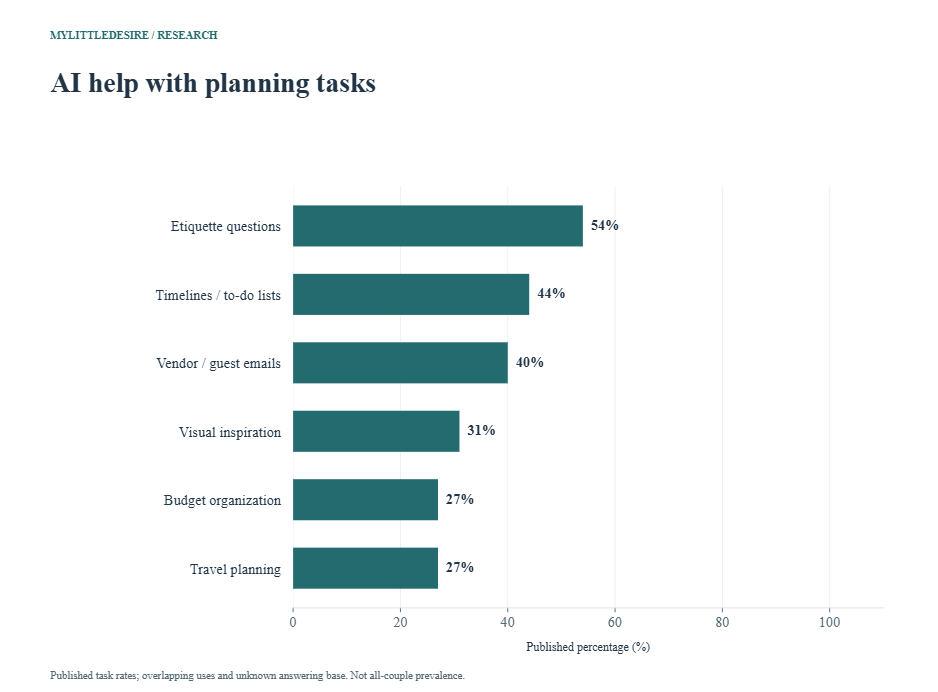
F04 Six task-use figures in Zola’s 2026 report. Exact task eligibility/answering n and routing not supplied. Do not assert these are unconditional shares of all couples or sum overlapping tasks.
| Measure / response | Published result | Actual cohort or report period | Source |
|---|---|---|---|
| Etiquette questions | 54% | Couples getting married in 2026; exact survey fieldwork dates not supplied in checked original page | Original source [S01] AI wedding support section, 2026 First Look Report, practical-task bullet list |
| Timelines and to-do lists | 44% | Couples getting married in 2026; exact survey fieldwork dates not supplied in checked original page | Original source [S01] AI wedding support section, 2026 First Look Report, practical-task bullet list |
| Vendor or guest emails | 40% | Couples getting married in 2026; exact survey fieldwork dates not supplied in checked original page | Original source [S01] AI wedding support section, 2026 First Look Report, practical-task bullet list |
| Image-based décor, attire or floral inspiration | 31% | Couples getting married in 2026; exact survey fieldwork dates not supplied in checked original page | Original source [S01] AI wedding support section, 2026 First Look Report, practical-task bullet list |
| Budget creation or organization | 27% | Couples getting married in 2026; exact survey fieldwork dates not supplied in checked original page | Original source [S01] AI wedding support section, 2026 First Look Report, practical-task bullet list |
| Travel planning | 27% | Couples getting married in 2026; exact survey fieldwork dates not supplied in checked original page | Original source [S01] AI wedding support section, 2026 First Look Report, practical-task bullet list |
For budget context, see our wedding cost and budget statistics. A reported AI budgeting task does not show how much money a couple saved.
Where do couples set boundaries around AI writing?
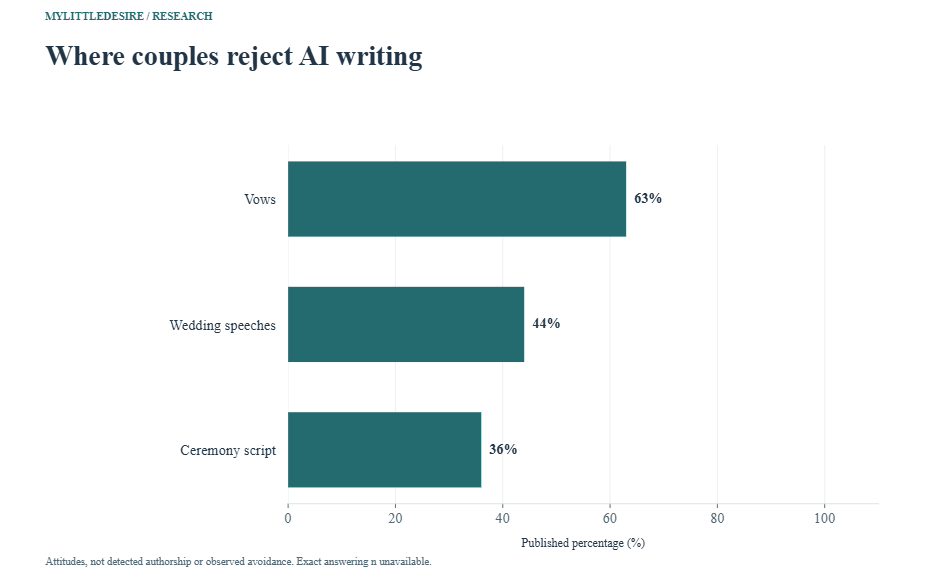
F05 Three source-reported no-AI preferences for personal wedding writing. Attitudes, not observed avoidance, detected AI authorship or an ethical rule for every couple. Exact answering n unavailable.
| Measure / response | Published result | Actual cohort or report period | Source |
|---|---|---|---|
| Rejects AI writing vows | 63% | Couples getting married in 2026; exact survey fieldwork dates not supplied in checked original page | Original source [S01] AI wedding support section, 2026 First Look Report, human-boundary bullets |
| Rejects AI wedding speeches | 44% | Couples getting married in 2026; exact survey fieldwork dates not supplied in checked original page | Original source [S01] AI wedding support section, 2026 First Look Report, human-boundary bullets |
| Rejects AI ceremony scripts | 36% | Couples getting married in 2026; exact survey fieldwork dates not supplied in checked original page | Original source [S01] AI wedding support section, 2026 First Look Report, human-boundary bullets |
A couple can welcome help with an administrative draft and still want personal promises written in their own words. Discussing that preference is a practical use of the evidence; it is not a claim that one writing approach improves the relationship. Related engagement proposal statistics also separate participation from expectations.
Which AI shortcuts did the 2025 cohort find acceptable?
The original 2025 questionnaire is especially useful because it separates combined experience/intention from a second question about acceptable shortcuts. A high acceptable-use percentage is not evidence that the same share actually completed that task with AI. Zola [S02].
F07 Question asks whether AI has or will support wedding planning. Combines experience and intention. Do not label 23% as current-use-only or compare directly with 2026 adoption as a growth rate.
| Measure / response | Published result | Actual cohort or report period | Source |
|---|---|---|---|
| Has or will receive AI planning support: yes | 23% | Couples getting married in 2025; exact survey fieldwork dates unavailable | Original source [S02] Has or will AI support you with wedding planning? |
| Published no response: not using AI | 77% | Couples getting married in 2025; exact survey fieldwork dates unavailable | Original source [S02] Has or will AI support you with wedding planning? |
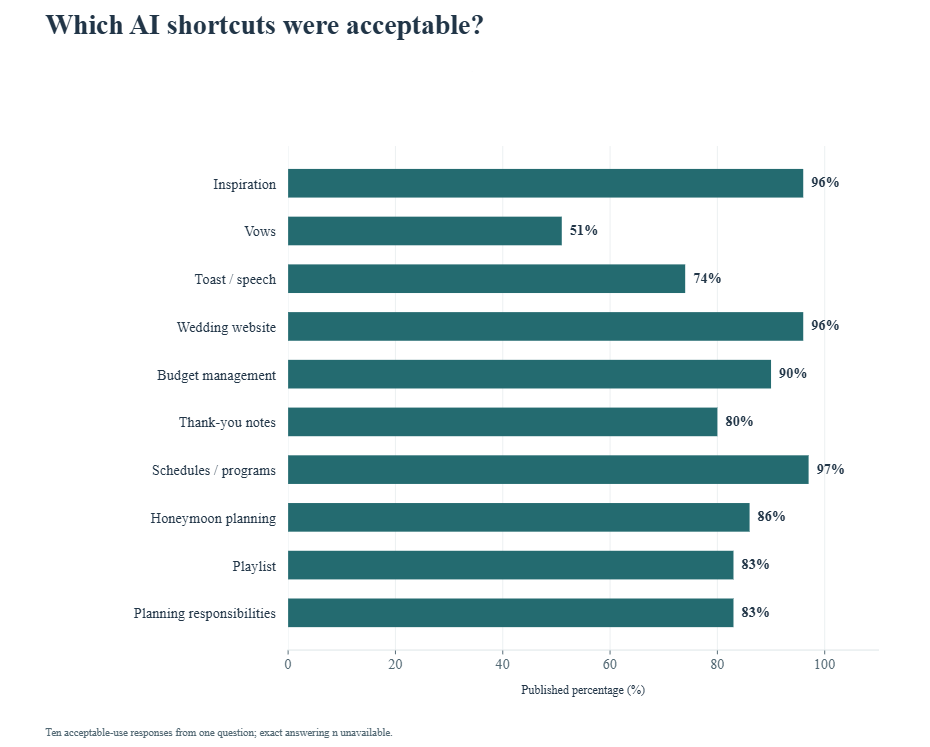
F08 Ten acceptable-use rates from the 2025 cohort’s attitudes table. Acceptable is not used. Selected acceptable side only; complements are not added as new observations. Exact answering n unavailable.
| Measure / response | Published result | Actual cohort or report period | Source |
|---|---|---|---|
| Inspiration | 96% | Couples getting married in 2025; exact survey fieldwork dates unavailable | Original source [S02] Is it or is it not acceptable to use AI as a shortcut to… |
| Vows | 51% | Couples getting married in 2025; exact survey fieldwork dates unavailable | Original source [S02] Is it or is it not acceptable to use AI as a shortcut to… |
| Toast or speech | 74% | Couples getting married in 2025; exact survey fieldwork dates unavailable | Original source [S02] Is it or is it not acceptable to use AI as a shortcut to… |
| Wedding website | 96% | Couples getting married in 2025; exact survey fieldwork dates unavailable | Original source [S02] Is it or is it not acceptable to use AI as a shortcut to… |
| Budget management | 90% | Couples getting married in 2025; exact survey fieldwork dates unavailable | Original source [S02] Is it or is it not acceptable to use AI as a shortcut to… |
| Thank-you notes | 80% | Couples getting married in 2025; exact survey fieldwork dates unavailable | Original source [S02] Is it or is it not acceptable to use AI as a shortcut to… |
| Schedules or programs | 97% | Couples getting married in 2025; exact survey fieldwork dates unavailable | Original source [S02] Is it or is it not acceptable to use AI as a shortcut to… |
| Honeymoon planning | 86% | Couples getting married in 2025; exact survey fieldwork dates unavailable | Original source [S02] Is it or is it not acceptable to use AI as a shortcut to… |
| Playlist | 83% | Couples getting married in 2025; exact survey fieldwork dates unavailable | Original source [S02] Is it or is it not acceptable to use AI as a shortcut to… |
| Dividing planning responsibilities | 83% | Couples getting married in 2025; exact survey fieldwork dates unavailable | Original source [S02] Is it or is it not acceptable to use AI as a shortcut to… |
What do Australian task, sentiment and trust figures show?
Easy Weddings publishes three distinct panels: a task profile, feelings about AI planning, and trust relative to human recommendations. The profile’s selection design and denominator are not stated. Its categories total 100%, which alone does not establish whether it describes AI users, all couples, or a different response base. Easy Weddings [S03].
F10 Seven percentages under the report’s task-profile heading. Exact denominator and selection design not stated. Retained as a published task profile, not share of all couples or proven share of AI users. A total of 100% does not resolve the base.
| Measure / response | Published result | Actual cohort or report period | Source |
|---|---|---|---|
| Ideas and inspiration | 21% | 2026 report edition; exact AI-item fieldwork and wedding dates not supplied | Original source [S03] PDF physical/printed p.12, What Tasks Are Couples Using AI For? |
| Budgeting and timelines | 18% | 2026 report edition; exact AI-item fieldwork and wedding dates not supplied | Original source [S03] PDF physical/printed p.12, What Tasks Are Couples Using AI For? |
| Emails and messages | 17% | 2026 report edition; exact AI-item fieldwork and wedding dates not supplied | Original source [S03] PDF physical/printed p.12, What Tasks Are Couples Using AI For? |
| Invitations and signage | 14% | 2026 report edition; exact AI-item fieldwork and wedding dates not supplied | Original source [S03] PDF physical/printed p.12, What Tasks Are Couples Using AI For? |
| Vows and speeches | 14% | 2026 report edition; exact AI-item fieldwork and wedding dates not supplied | Original source [S03] PDF physical/printed p.12, What Tasks Are Couples Using AI For? |
| Finding and comparing suppliers | 9% | 2026 report edition; exact AI-item fieldwork and wedding dates not supplied | Original source [S03] PDF physical/printed p.12, What Tasks Are Couples Using AI For? |
| Music playlists | 7% | 2026 report edition; exact AI-item fieldwork and wedding dates not supplied | Original source [S03] PDF physical/printed p.12, What Tasks Are Couples Using AI For? |
F11 Three published sentiment categories. Attitudes toward using AI, not adoption or measured satisfaction with completed AI-assisted weddings. Exact item n unavailable.
| Measure / response | Published result | Actual cohort or report period | Source |
|---|---|---|---|
| Positive | 61% | 2026 report edition; exact AI-item fieldwork and wedding dates not supplied | Original source [S03] PDF physical/printed p.12, feelings panel |
| Neutral | 25% | 2026 report edition; exact AI-item fieldwork and wedding dates not supplied | Original source [S03] PDF physical/printed p.12, feelings panel |
| Negative | 14% | 2026 report edition; exact AI-item fieldwork and wedding dates not supplied | Original source [S03] PDF physical/printed p.12, feelings panel |
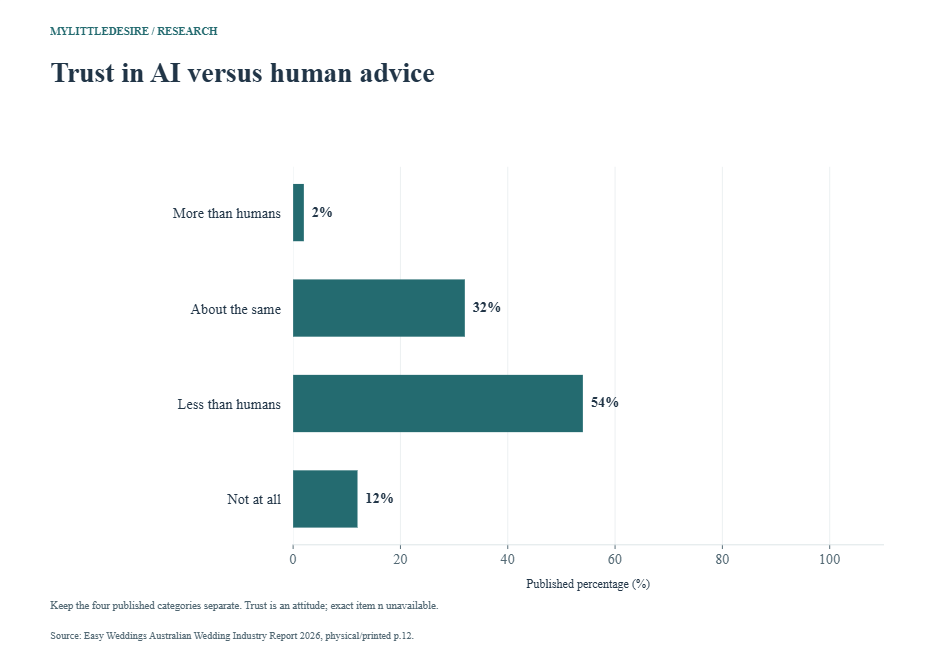
F12 Four categories from the relative-trust panel. Retain source categories, including less than humans and not at all separately. No service quality or accuracy test performed; exact item n unknown.
| Measure / response | Published result | Actual cohort or report period | Source |
|---|---|---|---|
| More than humans | 2% | 2026 report edition; exact AI-item fieldwork and wedding dates not supplied | Original source [S03] PDF physical/printed p.12, trust panel |
| About the same as humans | 32% | 2026 report edition; exact AI-item fieldwork and wedding dates not supplied | Original source [S03] PDF physical/printed p.12, trust panel |
| Less than humans | 54% | 2026 report edition; exact AI-item fieldwork and wedding dates not supplied | Original source [S03] PDF physical/printed p.12, trust panel |
| Not at all | 12% | 2026 report edition; exact AI-item fieldwork and wedding dates not supplied | Original source [S03] PDF physical/printed p.12, trust panel |
What did the original 2024 questionnaire actually measure?
The original 2024-cohort table separates already using from very likely, unsure and not likely. This prevents treating a broad willingness summary as actual adoption. Its follow-up task question combines support already received with support planned for the future. Zola [S08].
F17 Four published responses to the use-or-consideration question. Already using differs from likely or unsure. Source rounding totals 100.01%, retained without correction. Exact item n and field dates unavailable.
| Measure / response | Published result | Actual cohort or report period | Source |
|---|---|---|---|
| Not likely; not a fan | 45.82% | Couples getting married in 2024; exact survey fieldwork dates unavailable | Original source [S08] The Latest Wedding Trends, Are you using, or considering using, any AI tools? |
| Unsure; has not ruled it out | 36.02% | Couples getting married in 2024; exact survey fieldwork dates unavailable | Original source [S08] The Latest Wedding Trends, Are you using, or considering using, any AI tools? |
| Very likely; could help | 10.95% | Couples getting married in 2024; exact survey fieldwork dates unavailable | Original source [S08] The Latest Wedding Trends, Are you using, or considering using, any AI tools? |
| Already using at least one AI tool | 7.22% | Couples getting married in 2024; exact survey fieldwork dates unavailable | Original source [S08] The Latest Wedding Trends, Are you using, or considering using, any AI tools? |
F18 Ten categories in a select-all current/planned support question. Combines has and will. Unknown task-question routing/base; not ten unconditional actual-use rates. Multiple selections can overlap; other category retained as published.
| Measure / response | Published result | Actual cohort or report period | Source |
|---|---|---|---|
| Wedding website | 38.28% | Couples getting married in 2024; exact survey fieldwork dates unavailable | Original source [S08] How has or how will AI support your wedding journey? Select all that apply |
| Thank-you notes | 33.97% | Couples getting married in 2024; exact survey fieldwork dates unavailable | Original source [S08] How has or how will AI support your wedding journey? Select all that apply |
| Inspiration | 33.88% | Couples getting married in 2024; exact survey fieldwork dates unavailable | Original source [S08] How has or how will AI support your wedding journey? Select all that apply |
| Vows | 32.05% | Couples getting married in 2024; exact survey fieldwork dates unavailable | Original source [S08] How has or how will AI support your wedding journey? Select all that apply |
| Schedules or programs | 28.66% | Couples getting married in 2024; exact survey fieldwork dates unavailable | Original source [S08] How has or how will AI support your wedding journey? Select all that apply |
| Toasts or speeches | 25.18% | Couples getting married in 2024; exact survey fieldwork dates unavailable | Original source [S08] How has or how will AI support your wedding journey? Select all that apply |
| Honeymoon | 20.88% | Couples getting married in 2024; exact survey fieldwork dates unavailable | Original source [S08] How has or how will AI support your wedding journey? Select all that apply |
| Playlist | 14.74% | Couples getting married in 2024; exact survey fieldwork dates unavailable | Original source [S08] How has or how will AI support your wedding journey? Select all that apply |
| Budget | 17.49% | Couples getting married in 2024; exact survey fieldwork dates unavailable | Original source [S08] How has or how will AI support your wedding journey? Select all that apply |
| Other | 6.59% | Couples getting married in 2024; exact survey fieldwork dates unavailable | Original source [S08] How has or how will AI support your wedding journey? Select all that apply |
Does future-event willingness mean future wedding adoption?
F16 Would use AI to plan a future event. A future event need not be a wedding. Hypothetical willingness is not adoption, a forecast or observed repeat use.
| Measure / response | Published result | Actual cohort or report period | Source |
|---|---|---|---|
| Would use AI for a future event | 65% | Respondents married September 2024–August 2025; exact survey interview dates not supplied | Original source [S07] Future-event paragraph; original methods footnote |
Add to Event’s future-event question does not specify that the next event will be a wedding. Its answer cannot be used as a forecast of wedding-planning adoption. The publisher’s task table is excluded here because task eligibility is unresolved; no conditional denominator is guessed. Add to Event [S07].
How can couples and wedding businesses use these findings?
These are editorial applications of the evidence, not measured intervention effects. Couples can agree which tasks they want help drafting, which details require direct confirmation and which personal writing they want to create themselves. For vendors, the distinction between positive feelings and trust is a useful question to ask clients; the surveys do not prove a particular sales script or AI product works.
| Decision | Useful evidence distinction | Practical application |
|---|---|---|
| Drafting logistics | Task help differs from verified accuracy | Confirm dates, availability and figures against the relevant original record |
| Writing personal promises | Acceptability differs from actual use | Agree together on the desired level of assistance |
| Interpreting adoption | Current, ever-use and has-or-will differ | Retain the original question in any cited claim |
| Vendor communication | Positive sentiment differs from trust | Ask how the couple wants assistance explained |
| Estimating savings | Use rates do not measure causal savings | Record actual time/cost if evaluating your own workflow |
Ten reproducible descriptive comparisons
Each result is first value minus second, expressed in percentage points. These ten differences reuse published inputs and are not ten additional studies or observations. The workbook requires matching units and measure types and leaves incomplete or mismatched inputs blank. No difference is a causal effect or cross-country adoption trend.
| Comparison | Inputs | Difference | Interpretation |
|---|---|---|---|
| Etiquette minus budget task rate | 54% − 27% | 27 percentage points | Published Zola 2026 task rates; eligibility unknown and tasks may overlap. |
| Timelines minus email task rate | 44% − 40% | 4 percentage points | Same published task list; not a ranking across publishers. |
| Reject vows minus reject speeches | 63% − 44% | 19 percentage points | Two attitude items; does not measure actual avoidance. |
| Targeted help minus broad enthusiasm | 38% − 23% | 15 percentage points | Selected approach responses only; full distribution unavailable. |
| Accept schedules minus accept vows | 97% − 51% | 46 percentage points | 2025 cohort attitudes, not current task adoption. |
| Accept inspiration minus thank-you notes | 96% − 80% | 16 percentage points | Same historical acceptability question; responses can overlap. |
| Has-or-will yes minus no | 23% − 77% | -54 percentage points | Combines past/current support with intention; not current-use prevalence. |
| Positive minus negative sentiment | 61% − 14% | 47 percentage points | Same Australian sentiment panel; does not measure actual usage. |
| Trust less minus about the same | 54% − 32% | 22 percentage points | Keep source trust categories separate; exact answering base unknown. |
| Not likely minus very likely | 45.82% − 10.95% | 34.87 percentage points | Historical 2024-cohort consideration responses, not a longitudinal change. |
Common questions
What percentage of couples use AI to plan a wedding?
There is no single interchangeable rate in the selected research. Cite the source’s own current-use, active-use or ever-use wording with its audience and actual period. These commercial survey audiences are not a global prevalence sample.
Are couples comfortable using AI for vows?
Comfort and use are separate questions. The historical acceptability table and the newer rejection items above come from different cohorts and question designs. They should not be subtracted to claim a measured change in actual vow-writing behavior.
Does AI reduce wedding costs or replace planners?
The selected percentages do not establish a causal cost, time or staffing saving. Reporting an AI budgeting task does not measure money saved, and trust in recommendations does not measure whether a professional was replaced.
Research method and limitations
Original publisher pages and the Easy Weddings report were checked for selected public aggregates. The database contains 60 percentage observations, not 60 studies. Zola supplies 40 across three annual cohorts, Easy Weddings supplies 15 across a PDF and companion article from one annual program, The Knot supplies three across two dated programs, and Add to Event supplies two. Eight numerical records therefore represent seven programs and four publisher labels; shared audiences and undisclosed recruitment prevent claiming statistical independence.
The review preserves question meaning, actual period, population, source location and published precision. Exact valid question/subgroup counts are unavailable for all selected items and remain blank in the data and workbook. Known full samples and approximate/lower-bound report totals stay in the source registry. A full sample is not automatically a task denominator. No Canada-specific population benchmark was independently verified.
The Australian AI page was visually checked in the original PDF. Original Zola question tables and both Knot methods were read. Add to Event’s original indexed text and methods were available; a later direct fetch returned 403. The audit records that retrieval limit. Private survey records, respondent-level reanalysis, a representative global sample and a causal experiment were not obtained or performed.
Excluded claims: Unreconciled growth headlines, an exact historical Knot 2023 point, an invented 2024 Zola current-use total, eleven Add to Event task percentages with unresolved eligibility, ambiguous gender gaps, AI visibility scores, unsupported savings and predictions. Charts and calculations reuse the observations. No paid search metrics, outreach placements or measured site performance are supplied.
Original sources and supporting records
- S01. Zola. 2026 Wedding Trends: Zola’s First Look Report. Publication: 2026 report; page updated 2026-10-16. Actual period: Couples getting married in 2026; exact survey fieldwork dates not supplied in checked original page. Report-wide more than 11,500 couples. Exact AI-question and task-specific eligible/answering n not published; do not assign the whole report count to every item. Method: Original publisher summary; selected AI section checked against companion guide. Published task-use, preferences, rejection and human-side responses kept distinct. Commercial wedding-planning audience; full questionnaire, recruitment, weighting and item eligibility not supplied here. Daily AI use is context, not a wedding-use rate. Task rates may be conditional; they are not relabelled as all-couple prevalence. Published growth claims not reconciled to older questionnaires and excluded. Supporting records: record 1.
- S02. Zola. 2025 Wedding Trends: Zola’s First Look Report Data Deep Dive. Publication: Updated 2025-06-11. Actual period: Couples getting married in 2025; exact survey fieldwork dates unavailable. Source introduction says more than 6,000 couples. Exact yes/no and acceptable-use answering n not provided. Method: Original question-level tables. AI-support question combines past/current and intended support; ten acceptable-use percentages come from a separate attitudes question. Has or will is not a current-use-only question. Acceptability is not actual behavior or future conversion. Repeated narrative summaries are not additional observations. Commercial audience and undisclosed weighting/item counts limit population inference. Supporting records: record 1.
- S03. Easy Weddings. 2026 Australian Wedding Industry Report, AI and Wedding Planning. Publication: 2026 report edition; exact PDF release day not specified. Actual period: 2026 report edition; exact AI-item fieldwork and wedding dates not supplied. Report-wide totals are not exact AI-question n. Task-profile eligibility, single/multiple-response design and exact answering base not stated. Feelings and trust item n also unavailable. Method: Original PDF foreword p.2 and physical/printed AI page p.12 checked. Seven task-profile percentages, three sentiment categories and four relative-trust categories transcribed. Task profile sums to 100%, but that does not establish its denominator or response design. It is not presented here as the share of all couples doing each task. Trust and feelings are attitudes, not adoption. Report edition is not fieldwork year. Same research program as S04. Supporting records: record 1.
- S04. Easy Weddings. Are Australian couples using AI to plan their wedding?. Publication: Updated 2026-02-25. Actual period: 2026 annual-report research; exact AI-item fieldwork dates not supplied. Exact adoption-question n unavailable. Use the original published 32% without inferring a respondent count from the report-wide lower bound. Method: Original publisher companion article explicitly reports couples who used AI at some point in their planning journey. Same annual program as S03, not another independent survey. At some point is retrospective/ever-use, not necessarily active daily use or future intention. Article update is not survey fieldwork. Qualitative product/vendor claims and unrelated booking metrics not counted.
- S05. The Knot Worldwide. Future of Marriage: 2026 Trends To Watch Report, separate AI study. Publication: 2025-11-11. Actual period: Late 2025 AI survey; exact AI-study dates unavailable. Body states AI-study total n=228; methods round it to roughly 230. Exact valid n for each of the two AI questions unavailable. The 600-person Economic Pulse and 1,004-person dating/single samples are separate. Method: Original Rise of AI section and methodology checked. Two measures: active wedding-planning AI use and image-based AI use for inspiration/planning. Small commercial member audience, not all US couples. Report title says 2026, but survey is late 2025. Do not substitute main Real Weddings n=10,474 for this AI study. Image-use wording is approximate 3 in 10 and remains approximate.
- S06. The Knot Worldwide. Inaugural 2025 Wedding Trends to Watch Report, original release. Publication: 2024-10-15. Actual period: September 18–30, 2024 engaged-couple research; planning weddings through December 31, 2025. Methods describe approximately 500 planning respondents. Separate approximately 500 dating Gen Z respondents and approximately 800 destination respondents are not AI-question n. Method: Original 20% current-use result and methods read. Email/onsite member invitations; September 18–30, 2024. Historic point retained with its actual period. Not a measured 2025 fieldwork result merely because report is titled 2025. Full instrument and exact AI-item base unavailable. Historical 10%/under-10% and growth interpretations are withheld due conflicting summaries; no harmonized adoption time series built.
- S07. Add to Event. AI in wedding planning. Publication: 2025-11-06. Actual period: Respondents married September 2024–August 2025; exact survey interview dates not supplied. Total n=120. Exact valid adoption and future-event item bases not printed. Task table has unresolved eligibility and is excluded. Method: Original publisher indexed article, original methods footnote and two overall percentages checked. Self-reported past wedding use and willingness for a future event are different measures. Small platform audience, not all UK newlyweds. Future event is not necessarily a wedding. Published checklist task 37% exceeds overall adoption 32%; eligible task denominator not specified, so eleven task figures and ambiguous gender comparisons are withheld. Later direct fetch returned 403; original indexed text retained.
- S08. Zola. 2024 Wedding Trends: Zola’s First Look Report Data Deep Dive. Publication: Updated 2025-05-06; 2024 cohort report. Actual period: Couples getting married in 2024; exact survey fieldwork dates unavailable. Four use/consideration response categories and ten select-all current/planned support categories. Exact valid bases and task-question routing not provided. Method: Original question-level tables checked. Already using, very likely, unsure and not likely remain separate. Task question explicitly asks how AI has or will support the wedding journey and allows multiple responses. 7.22% already using differs from 10.95% very likely. Do not call their sum current use or silently replace exact responses with a rounded 18% narrative. Task use/intention and unknown routing prevent all-couple behavior claims. Rounded response categories total 100.01%; source precision preserved.
Supporting records without additional observations
- R01. Zola. The AI Wedding Planning Guide. Companion cross-check to S01. Repeats practical-task and writing-boundary results from the 2026 program. Not an independent study or additional numerical observations; no product recommendations adopted.
- R02. Zola. 2025 Wedding Trends: First Look narrative. Narrative cross-check to the original 2025 questionnaire. Narrative current-use wording is narrower than the deep-dive has-or-will question. Original question semantics take precedence. Rounded growth/open-to-AI summaries not counted.
- R03. The Knot Worldwide. The Knot Real Weddings Study 2026. Cross-check of AI summary and study-base separation. Main newlywed study is separate from the late-2025 AI study identified explicitly in S05. No duplicate AI observations or main-study sample assigned to AI. Historical under-10 wording prevents adopting an exact 2023 point from conflicting summaries.
- R04. Bridebook. Bridebook launches AI venue search on ChatGPT. Screened original publisher launch summary. Venue-specific trust and shortlist claims are narrower than general planning adoption. Not included in numerical database; underlying question-level cohort and eligible bases not verified. Ambiguous percentage increase not adopted.
How to cite this resource
MyLittleDesire. AI in Wedding Planning Statistics 2027. https://mylittledesire.com/ai-wedding-planning-statistics/.