Cheating statistics can describe a hidden emotional relationship, sexual activity outside marriage, a perceived betrayal, or a judgment about someone else’s behavior. The number becomes useful only when the question, population and time period are visible.
This resource contains 54 grouped findings from 13 original-source publications and analyses, four MyLittleDesire chart designs and 20 reproducible descriptive comparisons. Related response categories stay together. An additional percentage from the same question is not presented as another independent study.
What are the key cheating and infidelity statistics?
33%
25% / 11%
Said they had ever cheated on someone in YouGov’s April 2025 survey of US adult citizens. This was a broad lifetime self-description. YouGov US [S01].
Reported outside sexual activities without / with the main partner’s agreement in that US survey. These are separate questions and can overlap. YouGov US [S01].
23%
17% / 18%
Of ever-partnered GB adults reported sexual or emotional cheating in July 2026. Great Britain excludes Northern Ireland. YouGov GB [S02].
Reported sexual / emotional cheating in that GB survey; 12% reported both, so the two rates cannot be added. YouGov GB [S02].
94% / 52%
30% / 41%
Labelled sex with someone else / a deep emotional attachment as cheating in the GB survey. These are attitudes, not behavior rates. YouGov GB [S02].
Labelled romantic or sexual AI conversations cheating / not harmless but not cheating. This does not measure actual AI relationships. YouGov GB [S02].
37% / 41%
11% / 14%
Said reconciliation can be reasonable in some circumstances / never reasonable after cheating. Opinions do not establish recovery rates. YouGov GB [S02].
Of ever-married US men / women aged 25–54 reported sex outside marriage in Wang’s recent GSS analysis. The difference was not statistically significant. Wendy Wang, Institute for Family Studies; original data: NORC General Social Survey [S03].
45% / 18%
90% / 84% / 81% / 76%
Reported ESI in a subsequent relationship with / without earlier ESI in one selected historical cohort. The raw rate ratio is 2.50; agreement was not established. Knopp, Scott, Ritchie, Rhoades, Markman and Stanley; University of Denver and collaborators [S04].
Moral disapproval of affairs in the US / Australia / UK / Canada, from Pew’s 2025 fieldwork. Wording and modes differ slightly. Pew Research Center [S07].
89%
59.6%
Called affairs morally wrong in Gallup’s May 2026 survey. The affair item was asked of approximately 750 people, within a 1,001-person overall survey. Gallup / ReconMR [S08].
Cited infidelity as a major contributor in a selected 52-person divorced follow-up interviewed in 2010–2012. This is not the percentage of all marriages ending because of infidelity. Scott, Rhoades, Stanley, Allen and Markman; University of Denver and collaborators [S09].
What does an infidelity statistic actually measure?
Check the definition before comparing percentages. “Ever cheated,” sex outside marriage, suspected partner behavior, moral judgment and willingness to reconcile answer different questions. Consensual non-monogamy concerns agreed relationship arrangements and should not automatically be counted as cheating.
| Measure | What it tells you | Essential boundary |
|---|---|---|
| Broad lifetime cheating | Whether someone describes any past conduct as cheating | May include different acts and relationships; it is not necessarily sexual or marriage-specific. |
| Sex outside marriage | A sexual history during a marriage | Does not by itself establish absence of permission; lifetime recall is different from annual incidence. |
| Sexual/emotional cheating with secrecy or lack of agreement | Outside contact or an intimate connection under the question’s specified conditions | The two forms can overlap. Sexual contact can be broader than intercourse. |
| Extradyadic sexual involvement or sex (ESI/EDS) | Outside sexual activity in a specified relationship | Some studies did not establish agreements. Preserve ESI/EDS terminology. |
| Known or suspected partner behavior | What a respondent believes happened | Known means respondent-reported knowledge, not independent researcher confirmation. Suspicion is a separate measure. |
| Moral disapproval or behavior labels | How people judge a description | Does not show how often they behave that way or what boundaries a particular couple agreed. |
| Reconciliation opinion or clinical outcome | A hypothetical preference or an outcome in a selected setting | Neither gives a universal probability that a relationship will recover. |
| Current marital status conditional on sexual history | A cross-sectional association | Does not establish the future divorce risk of an affair or whether the same spouse is involved. |
How many Americans say they have cheated or been cheated on?
YouGov’s April 2025 survey found that 33% had ever cheated on someone and 53% had been cheated on. Its target was US citizens aged 18+, with opt-in recruitment and weighting. These are lifetime experiences across potentially several relationships, rather than matched accounts of the same couples.
| ID | Finding and qualification | Population, actual period and base | Original source and locator |
|---|---|---|---|
| F01 | In the April 2025 US survey, 53% said someone had cheated on them; the figures were 48% for men and 57% for women. The generic item does not define a physical-only affair or independently confirm the partner’s behavior. | US citizens aged 18+; the current-relationship item has a partnered-only base. 2025-04-18 to 2025-04-21; lifetime experience questions unless otherwise stated Item n=1,124: 509 men, 615 women; survey overall 1,125. | Original source [S01] Full results physical p.25 / printed p.19, Q7M. |
| F02 | Thirty-three percent said they had cheated on someone; the reported percentage was 33% for both men and women. This broad lifetime self-description is not the GSS question about sex outside marriage. | US citizens aged 18+; the current-relationship item has a partnered-only base. 2025-04-18 to 2025-04-21; lifetime experience questions unless otherwise stated Item n=1,121: 509 men, 612 women; survey overall 1,125. | Original source [S01] Physical p.33 / printed p.27, Q7U. |
| F03 | Twenty-five percent reported sexual activities outside the main relationship without that partner’s consent, compared with 11% reporting such activities with consent. The without-consent figures were 29% of men and 21% of women. Agreement means the main romantic partner’s permission for outside activity. The two lifetime questions can overlap; they are not mutually exclusive groups. | US citizens aged 18+; the current-relationship item has a partnered-only base. 2025-04-18 to 2025-04-21; lifetime experience questions unless otherwise stated Without-consent item n=1,121 (507 men, 614 women); with-consent exact item base not extracted; survey 1,125. | Original source [S01] Physical p.5 Q16–17; physical p.62 / printed p.56 Q17. |
| F04 | Seventy-four percent would not be OK with a partner wanting sexual activities with someone else; 15% said it depended on the situation and 4% would be OK. The not-OK figures were 81% of women and 68% of men. A hypothetical boundary preference is not observed behavior or a diagnosis of relationship quality. | US citizens aged 18+; the current-relationship item has a partnered-only base. 2025-04-18 to 2025-04-21; lifetime experience questions unless otherwise stated Item n=1,124: 509 men and 615 women. | Original source [S01] Physical p.63 / printed p.57, Q18. |
| F05 | Among respondents currently in a relationship, 67% described it as completely monogamous and 8% as completely non-monogamous. Non-monogamy is not evidence of cheating; agreements are central. These are selected endpoints of a seven-point scale. | Currently partnered US adult citizens. 2025-04-18 to 2025-04-21; lifetime experience questions unless otherwise stated Partnered item n=697 (317 men, 380 women). | Original source [S01] Physical p.59 / printed p.53, Q15. |
The difference between self-reported cheating and being cheated on does not count “missing cheaters.” People can have several partners, differ in how they define cheating, or know different amounts about a partner’s behavior. The generic cheating item also differs from the more specific question about outside sexual activities without the main partner’s agreement. The 33% and 25% figures cannot be subtracted to identify an emotional-only group.
In the agreement questions, consent refers to the main romantic partner’s agreement to outside sexual activity. The 11% with agreement should not be added to the 25% without agreement as though they were mutually exclusive people. Current non-monogamy also does not establish deception.
What do recent British findings show about cheating and reconciliation?
The July 2026 GB survey reports either sexual or emotional cheating among 23% of ever-partnered adults. Its sexual item specifies contact without the partner’s knowledge or agreement; its emotional item specifies a hidden intimate connection. The personal-experience base differs from the all-adult attitude questions.
| ID | Finding and qualification | Population, actual period and base | Original source and locator |
|---|---|---|---|
| F06 | Among ever-partnered GB adults, 23% reported either sexual or emotional cheating: 17% sexual contact without a partner’s knowledge or agreement, 18% a hidden emotionally intimate connection, and 12% both. The two types overlap. The 23% and 12% joint results are explicitly supplied by YouGov’s original article; do not add 17% and 18%. | GB adults who are or have been in a relationship. 2026-07-09 to 2026-07-10; lifetime behavior and current attitudes as labelled Ever-partnered item n=1,684; overall survey 1,882. | Original source [S02] Original article opening; full tables physical pp.43–44 for the separate sexual/emotional questions. |
| F07 | Forty percent would find a sexual-only affair worse than an emotional-only affair, while 25% chose the emotional-only affair. Men chose these options at 46% and 20%; women at 35% and 29%. A forced hypothetical comparison is not a measure of distress following an actual affair. A further 35% answered do not know. | GB adults 18+; ever-partnered-only base for personal sexual/emotional cheating; all-adult base for attitude questions. 2026-07-09 to 2026-07-10; lifetime behavior and current attitudes as labelled 1,882 overall (879 male, 1,003 female); 1,684 ever-partnered for the experience item; see physical pp.43–51. | Original source [S02] Full tables physical p.43, Which would you find worse? |
| F08 | Thirty-seven percent said there are circumstances where taking back a cheating partner is reasonable, while 41% said there are none. Acceptance was 47% among adults 60+ versus 22% at 18–29, and 41% among men versus 33% among women. Opinion about reconciliation is not a rate of actual reconciliation or successful recovery. Age groups are cross-sectional, not changes as individuals grow older. | GB adults 18+; ever-partnered-only base for personal sexual/emotional cheating; all-adult base for attitude questions. 2026-07-09 to 2026-07-10; lifetime behavior and current attitudes as labelled 1,882 overall (879 male, 1,003 female); 1,684 ever-partnered for the experience item; see physical pp.43–51. | Original source [S02] Physical p.43, reasonable to take someone back question. |
| F09 | Eleven percent said cheating can be acceptable in some circumstances; 76% said there are no such circumstances. The question is different from whether to reconcile after an affair. Do not equate forgiveness with approval of cheating. | GB adults 18+; ever-partnered-only base for personal sexual/emotional cheating; all-adult base for attitude questions. 2026-07-09 to 2026-07-10; lifetime behavior and current attitudes as labelled 1,882 overall (879 male, 1,003 female); 1,684 ever-partnered for the experience item; see physical pp.43–51. | Original source [S02] Physical p.45, acceptable to cheat question. |
Sexual and emotional experiences overlap: 12% reported both. Treating 17% and 18% as two exclusive categories would overcount. Likewise, saying reconciliation can sometimes be reasonable is different from saying cheating can sometimes be acceptable. The 25-point age difference in reconciliation opinion (C07) is a comparison of age groups, not evidence of how one person’s views change over time.
Which physical, emotional and online behaviors count as cheating?
Agreement is strongest for sex with someone else, while emotional and online scenarios draw more varied labels. The GB survey offered a useful distinction: a behavior could be considered not harmless while still falling outside someone’s cheating label.
| ID | Finding and qualification | Population, actual period and base | Original source and locator |
|---|---|---|---|
| F10 | Sex with someone else was labelled cheating by 94%, compared with 73% for kissing. A further 1% and 16%, respectively, described these as not harmless but not cheating. These are judgments about descriptions. The source does not supply an agreed-consensual-relationship exception in each scenario. | GB adults 18+; ever-partnered-only base for personal sexual/emotional cheating; all-adult base for attitude questions. 2026-07-09 to 2026-07-10; lifetime behavior and current attitudes as labelled 1,882 overall (879 male, 1,003 female); 1,684 ever-partnered for the experience item; see physical pp.43–51. | Original source [S02] Physical p.45, behavior-classification battery. |
| F11 | Sending naked photos to someone else was considered cheating by 82%; another 11% called it not harmless but not cheating. This measures how respondents classify a behavior, not how many sent photos. | GB adults 18+; ever-partnered-only base for personal sexual/emotional cheating; all-adult base for attitude questions. 2026-07-09 to 2026-07-10; lifetime behavior and current attitudes as labelled 1,882 overall (879 male, 1,003 female); 1,684 ever-partnered for the experience item; see physical pp.43–51. | Original source [S02] Physical p.45, naked-photo item. |
| F12 | Using a dating app while in a relationship was labelled cheating by 80%, and secretly messaging or meeting an ex by 69%. Another 12% and 22%, respectively, considered the actions not harmless but not cheating. Having an account is not independently established infidelity. The table reports judgments about the specified scenarios. | GB adults 18+; ever-partnered-only base for personal sexual/emotional cheating; all-adult base for attitude questions. 2026-07-09 to 2026-07-10; lifetime behavior and current attitudes as labelled 1,882 overall (879 male, 1,003 female); 1,684 ever-partnered for the experience item; see physical pp.43–51. | Original source [S02] Physical p.47, dating-app and ex-partner items. |
| F13 | A deep emotional attachment was labelled cheating by 52%, with 32% choosing not harmless but not cheating. For romantic feelings without physical contact, the corresponding figures were 40% and 44%. Feeling romantic attraction and conducting a hidden emotional relationship are not the same item. These opinions do not show which boundaries a specific couple agreed. | GB adults 18+; ever-partnered-only base for personal sexual/emotional cheating; all-adult base for attitude questions. 2026-07-09 to 2026-07-10; lifetime behavior and current attitudes as labelled 1,882 overall (879 male, 1,003 female); 1,684 ever-partnered for the experience item; see physical pp.43–51. | Original source [S02] Physical pp.47 and 49, emotional-attachment and romantic-feelings items. |
| F14 | A crush was considered cheating by 15%, not harmless but not cheating by 48%, and harmless by 29%. For sexual or intimate fantasies, the figures were 16%, 44% and 29%. Remaining responses include do not know and prefer not to say. These are public classifications, not a universal clinical definition. | GB adults 18+; ever-partnered-only base for personal sexual/emotional cheating; all-adult base for attitude questions. 2026-07-09 to 2026-07-10; lifetime behavior and current attitudes as labelled 1,882 overall (879 male, 1,003 female); 1,684 ever-partnered for the experience item; see physical pp.43–51. | Original source [S02] Physical pp.49 and 51, fantasy and crush items. |
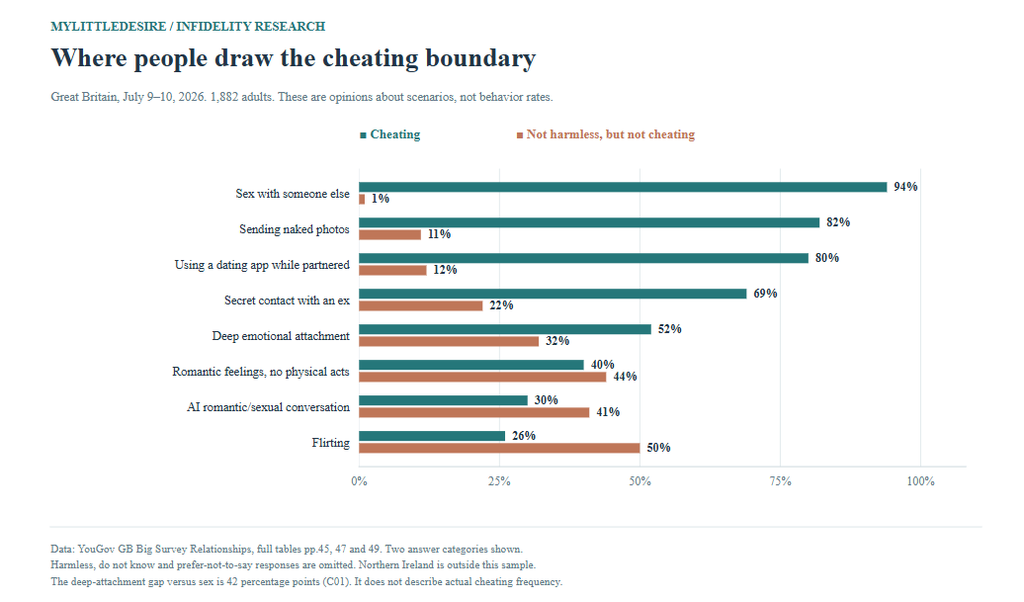
The sex-versus-deep-attachment difference in the cheating label is 42 percentage points (C01). But the latter behavior was not generally dismissed as harmless: adding the mutually exclusive “cheating” and “not harmless but not cheating” categories gives 84% for deep attachment (52% + 32%; C08). That is MyLittleDesire’s sum of published response categories, rather than another survey or a measure of emotional-affair prevalence.
The scenarios matter. A deep attachment, feelings with no physical act, a crush, a fantasy and a secret emotionally intimate relationship are not interchangeable descriptions. A poll about labels also cannot determine the agreed boundaries of a specific relationship.
How do people view AI conversations, paid sexual content and flirting?
Many respondents objected to these scenarios without using the cheating label. The AI and sexual-content-creator questions provide recent evidence about definitions; they do not measure how many people use those services or have digital affairs.
| ID | Finding and qualification | Population, actual period and base | Original source and locator |
|---|---|---|---|
| F15 | Direct interaction with sexual content creators was labelled cheating by 47%; 33% chose not harmless but not cheating and 6% harmless. Women were more likely than men to label it cheating, at 57% versus 37%. The scenario involves direct engagement, not merely viewing any sexual content. No rate of OnlyFans use or actual infidelity is inferred. | GB adults 18+; ever-partnered-only base for personal sexual/emotional cheating; all-adult base for attitude questions. 2026-07-09 to 2026-07-10; lifetime behavior and current attitudes as labelled 1,882 overall (879 male, 1,003 female); 1,684 ever-partnered for the experience item; see physical pp.43–51. | Original source [S02] Physical p.49, sexual-content-creator item. |
| F16 | Romantic or sexual conversations with AI chatbots or virtual companions were labelled cheating by 30%, not harmless but not cheating by 41%, and harmless by 10%. Women labelled it cheating at 38%, compared with 22% of men. This is an attitude toward a hypothetical behavior, not AI use, emotional attachment to AI, or a measured AI-affair prevalence. | GB adults 18+; ever-partnered-only base for personal sexual/emotional cheating; all-adult base for attitude questions. 2026-07-09 to 2026-07-10; lifetime behavior and current attitudes as labelled 1,882 overall (879 male, 1,003 female); 1,684 ever-partnered for the experience item; see physical pp.43–51. | Original source [S02] Physical p.49, AI-chatbot/virtual-companion item. |
| F17 | Flirting was classified as cheating by 26%, not harmless but not cheating by 50%, and harmless by 17%. At ages 18–29, 45% called it cheating, versus 20% among adults 60+. Age differences are unadjusted opinions; they do not show which generation actually cheats more. | GB adults 18+; ever-partnered-only base for personal sexual/emotional cheating; all-adult base for attitude questions. 2026-07-09 to 2026-07-10; lifetime behavior and current attitudes as labelled 1,882 overall (879 male, 1,003 female); 1,684 ever-partnered for the experience item; see physical pp.43–51. | Original source [S02] Physical p.47, flirting item. |
For AI conversations, the harmful-but-not-cheating response exceeded the cheating response by 11 points (C04). For flirting, the difference was 24 points (C03). The women-minus-men difference in applying the cheating label was 20 points for direct creator interaction and 16 points for AI conversations (C05–C06). These are unadjusted opinion comparisons, not claims that one group is more faithful.
What does marriage-specific US research show?
Wang’s 2025 analysis of the GSS reports different patterns for a restricted population: ever-married adults aged 25–54. Its recent-wave results concern 2021–2022 data and a history of sex outside marriage. They should not replace all-age estimates or be called measurements from 2025 or 2027.
| ID | Finding and qualification | Population, actual period and base | Original source and locator |
|---|---|---|---|
| F18 | The 2025 GSS analysis reports sex outside marriage among 13% of ever-married adults aged 25–54 in 2021–2022, compared with 17% in the pooled 1991–1998 data and 14% in 2010–2018. A lifetime-during-marriage report is not annual incidence. The author cautions about recent mode changes; do not describe the figures as new 2025 or 2027 measurements. | Ever-married adults aged 25–54; reporting sex with someone other than a spouse while married. Selected demographic and current-status groups have conditional bases. Recent-wave analysis uses GSS 2021–2022; trend pools 1991–1998 and 2010–2018. Exact per-figure sample counts and pooling are not fully documented in the article. Analytic item/subgroup sample sizes not published in the article. | Original source [S03] Overall trend paragraph; GSS mode-change footnote 1. |
| F19 | Among ever-married adults aged 25–54 in the recent GSS analysis, 11% of men and 14% of women reported sex outside marriage. The analyst states that the difference was not statistically significant. This restricted age range cannot replace all-age estimates. The point estimates do not establish that women cheat more than men. | Ever-married adults aged 25–54; reporting sex with someone other than a spouse while married. Selected demographic and current-status groups have conditional bases. Recent-wave analysis uses GSS 2021–2022; trend pools 1991–1998 and 2010–2018. Exact per-figure sample counts and pooling are not fully documented in the article. Analytic item/subgroup sample sizes not published in the article. | Original source [S03] Who Cheats More? first paragraph. |
| F20 | The analyst reports 18% of prime-age men in high-prestige occupations had sex outside marriage, compared with 7% in upper-middle-prestige and 13% in low-prestige occupations. Selected occupational categories, not a causal effect of promotion or a rate for every named profession. Exact figure-specific n and pooling are not published. | Ever-married adults aged 25–54; reporting sex with someone other than a spouse while married. Selected demographic and current-status groups have conditional bases. Recent-wave analysis uses GSS 2021–2022; trend pools 1991–1998 and 2010–2018. Exact per-figure sample counts and pooling are not fully documented in the article. Analytic item/subgroup sample sizes not published in the article. | Original source [S03] Are Higher Status Men More Likely to Cheat? and occupational-prestige appendix. |
| F21 | For women in the analysis, the reported sex-outside-marriage figures were 21% in low-prestige occupations and 9% in high-prestige occupations. A cross-sectional occupational association does not identify why the groups differ. It is not evidence that higher or lower income causes infidelity. | Ever-married adults aged 25–54; reporting sex with someone other than a spouse while married. Selected demographic and current-status groups have conditional bases. Recent-wave analysis uses GSS 2021–2022; trend pools 1991–1998 and 2010–2018. Exact per-figure sample counts and pooling are not fully documented in the article. Analytic item/subgroup sample sizes not published in the article. | Original source [S03] Are Higher Status Men More Likely to Cheat? second substantive paragraph. |
| F22 | Ten percent of college-educated prime-age ever-married adults reported sex outside marriage, compared with 15% without a college degree. Education is associated with many other characteristics; no adjusted effect or significance is inferred from these two percentages. | Ever-married adults aged 25–54; reporting sex with someone other than a spouse while married. Selected demographic and current-status groups have conditional bases. Recent-wave analysis uses GSS 2021–2022; trend pools 1991–1998 and 2010–2018. Exact per-figure sample counts and pooling are not fully documented in the article. Analytic item/subgroup sample sizes not published in the article. | Original source [S03] Who Cheats More? demographic paragraph. |
| F23 | The corresponding figures were 8% among regular religious-service attenders and 18% among those who never or rarely attended. This is an association, not proof that attendance prevents infidelity. The summary does not supply detailed attendance cutoffs or subgroup counts. | Ever-married adults aged 25–54; reporting sex with someone other than a spouse while married. Selected demographic and current-status groups have conditional bases. Recent-wave analysis uses GSS 2021–2022; trend pools 1991–1998 and 2010–2018. Exact per-figure sample counts and pooling are not fully documented in the article. Analytic item/subgroup sample sizes not published in the article. | Original source [S03] Who Cheats More? demographic paragraph. |
| F24 | Sex outside marriage was reported by 34% of currently divorced/separated adults versus 7% of currently married adults in the prime-age analysis. Reversing the condition, 52% of those reporting outside sex were currently divorced/separated, versus 15% of those not reporting it. The conditions and denominators reverse between pairs. Neither pair is the prospective probability that a particular affair will cause divorce. A current marriage can be a remarriage. | Ever-married adults aged 25–54; reporting sex with someone other than a spouse while married. Selected demographic and current-status groups have conditional bases. Recent-wave analysis uses GSS 2021–2022; trend pools 1991–1998 and 2010–2018. Exact per-figure sample counts and pooling are not fully documented in the article. Analytic item/subgroup sample sizes not published in the article. | Original source [S03] Who Cheats More? current-status paragraphs and discussion of remarriage. |
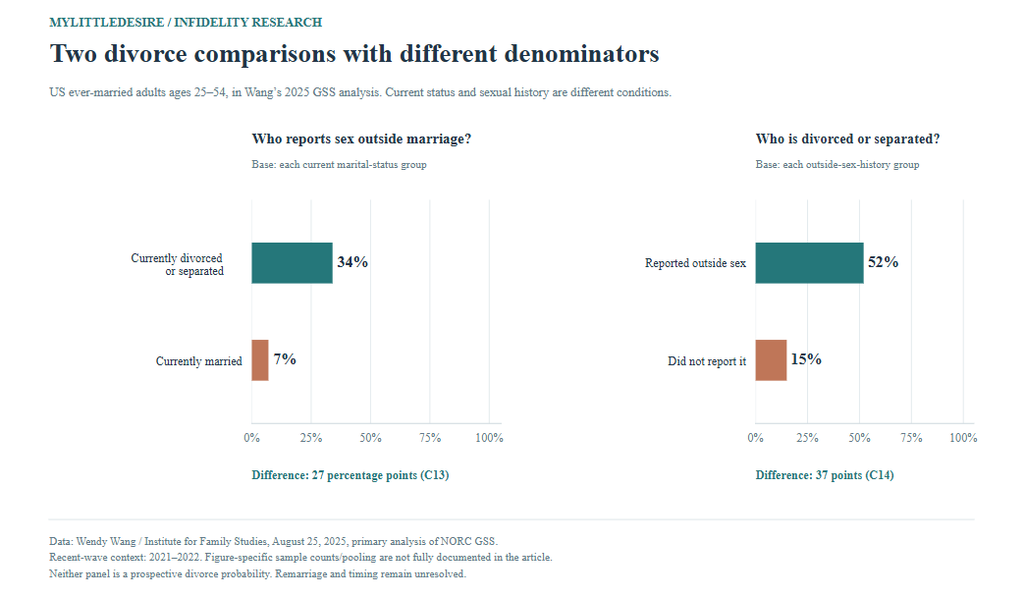
The 11% male and 14% female point estimates do not establish that women cheat more. The analyst explicitly reports no statistically significant difference. Comparing this restricted group with an older all-age “20% versus 13%” headline without matching periods and eligibility would also be misleading.
The divorce comparisons illustrate a separate denominator problem. One asks about sexual history within current marital-status groups; the other asks about current status within sexual-history groups. The second contrast is 37 percentage points and a current-status prevalence ratio of approximately 3.47 (C14–C15). It is not a 3.47-fold prospective divorce risk. A respondent who reports sex outside an earlier marriage could now be remarried.
The source article does not publish analytic subgroup sizes or complete per-figure weighting/pooling details, and those tabulations were not independently rerun from microdata. Its own caution about GSS mode changes stays attached to the trend. Education, occupation and religious attendance are associations here, rather than explanations of why someone cheats.
Does earlier infidelity predict reports in a later relationship?
One longitudinal cohort found an association across two different relationships, while most people with earlier own ESI did not report it again during the observed second relationship. The cohort was selected for relationship transitions and began with unmarried participants aged 18–35. Its ESI question did not establish permission, so the original behavior term is retained.
| ID | Finding and qualification | Population, actual period and base | Original source and locator |
|---|---|---|---|
| F25 | Forty-four percent of the selected relationship-transition cohort reported their own extradyadic sexual involvement at some point during the study. This high-exposure selected cohort is not a national lifetime cheating estimate. The item did not establish whether outside activity was permitted. | Participants aged 18–35 and unmarried at initial recruitment; selected participants who reported at least two mixed-gender relationships. Parent cohort began in the mid-2000s; approximately five years, eleven waves every four to six months. Exact start/end calendar dates not stated in the accessed manuscript. 484 selected from a 1,294-person parent cohort; model n=467 for own ESI, 389 known-partner ESI, 329 suspected-partner ESI. | Original source [S04] Methods: Own Extradyadic Sexual Involvement; Discussion summary. |
| F26 | Thirty percent reported known partner ESI during the study and 18% reported suspected partner ESI. Known means the respondent said they knew, not that researchers verified it. Suspected and known codes are handled differently across waves; do not add their study-wide percentages as exclusive people. | Participants aged 18–35 and unmarried at initial recruitment; selected participants who reported at least two mixed-gender relationships. Parent cohort began in the mid-2000s; approximately five years, eleven waves every four to six months. Exact start/end calendar dates not stated in the accessed manuscript. 484 selected from a 1,294-person parent cohort; model n=467 for own ESI, 389 known-partner ESI, 329 suspected-partner ESI. | Original source [S04] Methods: Perceived Partner Extradyadic Sexual Involvement. |
| F27 | Reported own ESI in the second relationship was 45% among those reporting it in the first, versus 18% among those not reporting it in the first. The adjusted odds ratio was 3.35, with a 95% interval of 2.15–5.22. The raw probability ratio is 45/18=2.50, not 3.35. The adjusted odds ratio uses a model and different scale. These are different relationships, not repeated cheating within one marriage. | Participants aged 18–35 and unmarried at initial recruitment; selected participants who reported at least two mixed-gender relationships. Parent cohort began in the mid-2000s; approximately five years, eleven waves every four to six months. Exact start/end calendar dates not stated in the accessed manuscript. Parent selected cohort 484; own-ESI logistic model n=467. Conditional group counts not separately shown in the narrative. | Original source [S04] Results primary own-ESI paragraph; Table 2, Own → Own. |
| F28 | Known partner ESI in a subsequent relationship was reported by 22% of those reporting known partner ESI in the first, versus 9% of those reporting none. The adjusted odds ratio was 2.36 (95% interval 1.18–4.72). This concerns reports about different partners. It does not show that a person caused a partner’s behavior. Suspected-partner cases are excluded from the corresponding model. | Participants aged 18–35 and unmarried at initial recruitment; selected participants who reported at least two mixed-gender relationships. Parent cohort began in the mid-2000s; approximately five years, eleven waves every four to six months. Exact start/end calendar dates not stated in the accessed manuscript. Known-partner logistic model n=389; subgroup conditional counts not separately supplied. | Original source [S04] Results partner-ESI paragraph; Table 2, Known Partner → Known Partner. |
| F29 | Suspicion of ESI in the next relationship was reported by 37% of those with earlier suspicion, versus 6% of those without it. The adjusted odds ratio was 4.27 (95% interval 1.63–11.22). Suspicion is a perception, not confirmed cheating. This result cannot estimate how accurate a suspicion is. | Participants aged 18–35 and unmarried at initial recruitment; selected participants who reported at least two mixed-gender relationships. Parent cohort began in the mid-2000s; approximately five years, eleven waves every four to six months. Exact start/end calendar dates not stated in the accessed manuscript. Suspected-partner logistic model n=329; subgroup conditional counts not separately supplied. | Original source [S04] Results partner-ESI paragraph; Table 2, Suspected Partner → Suspected Partner. |
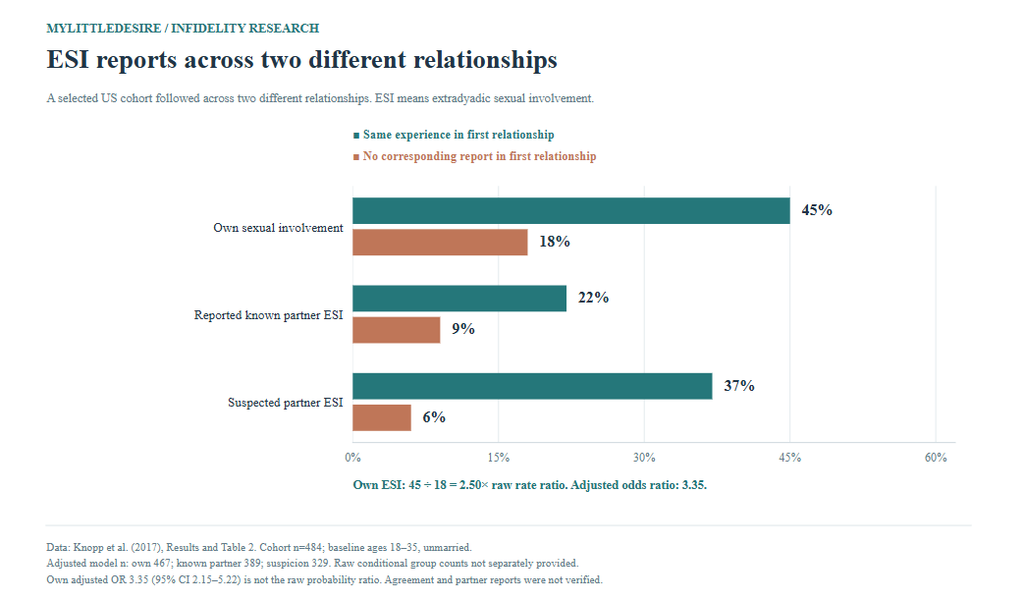
The observed own-ESI rates, 45% and 18%, differ by 27 percentage points; their raw probability ratio is 2.50 (C09–C10). The adjusted model’s odds ratio is 3.35, with a 95% interval of 2.15–5.22. The adjusted odds ratio and raw probability ratio are different quantities. Neither predicts a particular person’s future conduct with certainty.
The 22%-versus-9% contrast concerns respondent reports of known behavior by different partners. The 37%-versus-6% contrast concerns repeated suspicion. It does not establish how accurate that suspicion was or imply that the person reporting it caused a partner’s behavior. First and second relationships also differed in duration and observation time.
What do young-adult relationship histories add?
Add Health distinguishes respondent-only, partner-only, mutual and no-known outside sex. Those categories help avoid counting a respondent-only percentage as everyone who had outside sex. The data are historical, from Wave IV in 2007–2008, with some attitudes measured earlier.
| ID | Finding and qualification | Population, actual period and base | Original source and locator |
|---|---|---|---|
| F30 | Among women in the Add Health analysis, the four EDS categories were 75% no known EDS, 10% respondent-only, 8% partner-only and 8% mutual. For men they were 74%, 13%, 5% and 8%. The respondent-only category excludes people reporting both partners’ outside sex. Female percentages sum to 101 through rounding; no hidden correction is applied. | Young adults whose Wave IV current/most recent relationship was an opposite-sex marital or cohabiting union; weighted analytic subsample. Wave III 2001–2002; Wave IV 2007–2008, when respondents were aged 24–32; EDS concerns current or most recent sexual relationship. 8,301: 4,692 women and 3,609 men. Married women 3,094; cohabiting women 1,598; married men 2,223; cohabiting men 1,386. | Original source [S05] Table 2, All Women / All Men; Methods: EDS variable construction. |
| F31 | No known EDS was reported by 78% of married women and 77% of married men, versus 69% of cohabiting women and 69% of cohabiting men. Mutual EDS was 6% in each married group, versus 11% of cohabiting women and 10% of cohabiting men. These selected categories are not the complete four-category table. Cohabiting versus married groups are not randomized; their agreements and histories can differ. | Young adults whose Wave IV current/most recent relationship was an opposite-sex marital or cohabiting union; weighted analytic subsample. Wave III 2001–2002; Wave IV 2007–2008, when respondents were aged 24–32; EDS concerns current or most recent sexual relationship. 8,301: 4,692 women and 3,609 men. Married women 3,094; cohabiting women 1,598; married men 2,223; cohabiting men 1,386. | Original source [S05] Table 2, union-type rows. |
| F32 | On a 1–10 importance-of-fidelity scale at Wave III, women averaged 9.84 and men 9.68. This attitude was measured in 2001–2002, roughly six to seven years before the Wave IV EDS reports. It is not a percentage or a current attitude measurement. | Young adults whose Wave IV current/most recent relationship was an opposite-sex marital or cohabiting union; weighted analytic subsample. Wave III 2001–2002; later analytic subsample defined using Wave IV 2007–2008. 8,301: 4,692 women and 3,609 men. Married women 3,094; cohabiting women 1,598; married men 2,223; cohabiting men 1,386. | Original source [S05] Table 1; Results 4.1, importance-of-fidelity paragraph. |
| F33 | Among young men, reporting partner-only EDS was associated with an adjusted union-dissolution hazard ratio of 2.17 versus no known EDS. This is a time-to-event association, not a percentage, probability ratio or demonstrated causal effect. Timing of EDS relative to marriage/cohabitation and dissolution is not established. | Young adults whose Wave IV current/most recent relationship was an opposite-sex marital or cohabiting union; weighted analytic subsample. Wave III 2001–2002; Wave IV 2007–2008, when respondents were aged 24–32; EDS concerns current or most recent sexual relationship. Male analytic sample n=3,609; source reports adjusted hazard ratio in text. | Original source [S05] Results 4.3; Table 4 Model 3 (log-hazard coefficient 0.77). |
The four categories describe respondents’ accounts of a current or most recent opposite-sex marital or cohabiting relationship. Researchers could not fully establish permission or the timing of outside activity relative to marriage or moving in together. They therefore used EDS rather than assuming every report was infidelity. The adjusted dissolution hazard ratio is also a time-to-event association, rather than an affair-specific percentage of relationships ending.
What did pandemic-era research actually measure?
The paper published in August 2025 surveyed people in January 2021. It selected 1,070 heterosexual men and women aged 18–45 in committed exclusive, engaged or married relationships from opt-in panels. Participants described perceived changes in desire and behavior since the pandemic began; the researchers did not observe them before and after a randomized change.
| ID | Finding and qualification | Population, actual period and base | Original source and locator |
|---|---|---|---|
| F34 | In the January 2021 sample, the mean comparative desire score was 2.38 on a 1–7 scale; 19.6% selected a score above the midpoint, indicating increased desire relative to before the pandemic. Desire was reported retrospectively, not measured in repeated pre/post interviews. This is not evidence that the pandemic caused an increase. | English-speaking heterosexual men and women aged 18–45 in committed exclusive, engaged or married relationships. 2021-01-01 to 2021-01-31; retrospective comparison with the year before the pandemic and behavior since the pandemic began. 1,070 analytic participants from 2,000 recruited: 498 men, 572 women; 771 parents, 299 non-parents. Valid item/model counts can be smaller. | Original source [S06] Original PDF physical p.8, Results: Pandemic-influenced desires and engagement. |
| F35 | Increased desire was reported by 29.2% of men and 9.7% of women in the restricted sample. The original confidence intervals accompany the unadjusted rates. Gender labels reflect this paper’s selected men/women sample, not all genders. | English-speaking heterosexual men and women aged 18–45 in committed exclusive, engaged or married relationships. 2021-01-01 to 2021-01-31; retrospective comparison with the year before the pandemic and behavior since the pandemic began. 1,070 analytic participants from 2,000 recruited: 498 men, 572 women; 771 parents, 299 non-parents. Valid item/model counts can be smaller. | Original source [S06] PDF physical p.8, first results paragraph. |
| F36 | Increased desire was reported by 24.2% of parents and 8.3% of non-parents. Parent groups differed in relationship length, age and marital status; the raw contrast is not a causal effect of becoming a parent. | English-speaking heterosexual men and women aged 18–45 in committed exclusive, engaged or married relationships. 2021-01-01 to 2021-01-31; retrospective comparison with the year before the pandemic and behavior since the pandemic began. 1,070 analytic participants from 2,000 recruited: 498 men, 572 women; 771 parents, 299 non-parents. Valid item/model counts can be smaller. | Original source [S06] PDF physical p.8, first results paragraph. |
| F37 | Eighteen point eight percent reported doing something since the pandemic began that they believed their partner would consider infidelity (95% interval 16.4–21.2%). The item includes online, offline or both. The exact behavior-item valid count is not supplied alongside the rate; uncertain responses were excluded. It is not a population-wide or 2025 annual rate. | English-speaking heterosexual men and women aged 18–45 in committed exclusive, engaged or married relationships. 2021-01-01 to 2021-01-31; retrospective comparison with the year before the pandemic and behavior since the pandemic began. 1,070 analytic participants from 2,000 recruited: 498 men, 572 women; 771 parents, 299 non-parents. Valid item/model counts can be smaller. | Original source [S06] PDF pp.7–8, infidelity item and results. |
| F38 | The reported behavior rates were 28.1% for men, 10.9% for women, 20.7% for parents and 13.9% for non-parents. Gender and parent groups overlap; they are not four disjoint parts of a whole. This is self-reported conduct according to perceived partner boundaries. | English-speaking heterosexual men and women aged 18–45 in committed exclusive, engaged or married relationships. 2021-01-01 to 2021-01-31; retrospective comparison with the year before the pandemic and behavior since the pandemic began. 1,070 analytic participants from 2,000 recruited: 498 men, 572 women; 771 parents, 299 non-parents. Valid item/model counts can be smaller. | Original source [S06] PDF physical p.8, behavior-results paragraph. |
The original confidence intervals accompany the percentages in the research database. Parent and gender groups overlap, and parents differed from non-parents in age, relationship duration and marital status. The comparisons do not show that parenthood or the pandemic caused cheating. Desire was a different question from behavior, and the published summaries do not identify exactly which people reported both.
The study allowed online-only, in-person-only or both forms of behavior, but a precise verified split is not supplied in the retained findings. It would be inappropriate to say a fixed percentage of infidelity “moved online,” or to describe this cross-sectional survey as a natural experiment.
How do attitudes toward affairs differ across the US, UK, Canada and Australia?
Pew’s 2025 fieldwork found substantial moral disapproval in all four markets. Its shared topic allows a useful comparison, with the US wording “morally wrong” distinguished from “morally unacceptable” elsewhere. Moral judgment does not reveal how often respondents themselves had an affair.
| ID | Finding and qualification | Population, actual period and base | Original source and locator |
|---|---|---|---|
| F39 | In Pew’s 2025 fieldwork, affairs by married people were considered morally wrong by 90% in the US and morally unacceptable by 84% in Australia, 81% in the UK and 76% in Canada. This is a matched topic within one international study, with wording/mode differences preserved. It is not a ranking of cheating prevalence. | National adult samples; affair question is moral judgment about married people, not self-reported behavior. US affair item: 2025-03-24 to 2025-03-30, ATP Wave 166. Non-US study collection: 2025-01-08 to 2025-04-26; individual country dates not extracted here. US 3,605; UK 1,006; Canada 1,024; Australia 1,829. Non-US study total 28,333; religious subgroup bases in topline pp.5–6. | Original source [S07] Original topline physical pp.5–6, Q17a, national totals. |
| F40 | Across the 25 countries, the median share viewing affairs as morally unacceptable or wrong was 77%. This is the median of country percentages, not 77% of the world’s adults or an estimate of world infidelity. | National adult samples; affair question is moral judgment about married people, not self-reported behavior. US affair item: 2025-03-24 to 2025-03-30, ATP Wave 166. Non-US study collection: 2025-01-08 to 2025-04-26; individual country dates not extracted here. US 3,605; UK 1,006; Canada 1,024; Australia 1,829. Non-US study total 28,333; religious subgroup bases in topline pp.5–6. | Original source [S07] Report: Married people having an affair section; definition of median. |
| F41 | In Canada, 85% of adults aged 18–39 considered affairs morally unacceptable, compared with 73% of adults 40+. The age groups differ from YouGov’s 18–29 versus 60+ reconciliation comparison, and the question concerns moral judgment, not forgiveness. | National adult samples; affair question is moral judgment about married people, not self-reported behavior. US affair item: 2025-03-24 to 2025-03-30, ATP Wave 166. Non-US study collection: 2025-01-08 to 2025-04-26; individual country dates not extracted here. US 3,605; UK 1,006; Canada 1,024; Australia 1,829. Non-US study total 28,333; religious subgroup bases in topline pp.5–6. | Original source [S07] Report: Age section, affair example. |
| F42 | Among Christians versus religiously unaffiliated adults, the figures were 92% versus 87% in the US, 90% versus 81% in Australia, 84% versus 78% in the UK, and 80% versus 72% in Canada. These are within-group moral judgments; no causal or behavioral religious-group claim is made. | National adult samples; affair question is moral judgment about married people, not self-reported behavior. US affair item: 2025-03-24 to 2025-03-30, ATP Wave 166. Non-US study collection: 2025-01-08 to 2025-04-26; individual country dates not extracted here. US Christian 1,859 / none 881; AU 680 / 983; UK 458 / 442; Canada 539 / 374 (unweighted topline bases). | Original source [S07] Topline pp.5–6, Q17a religious-group rows. |
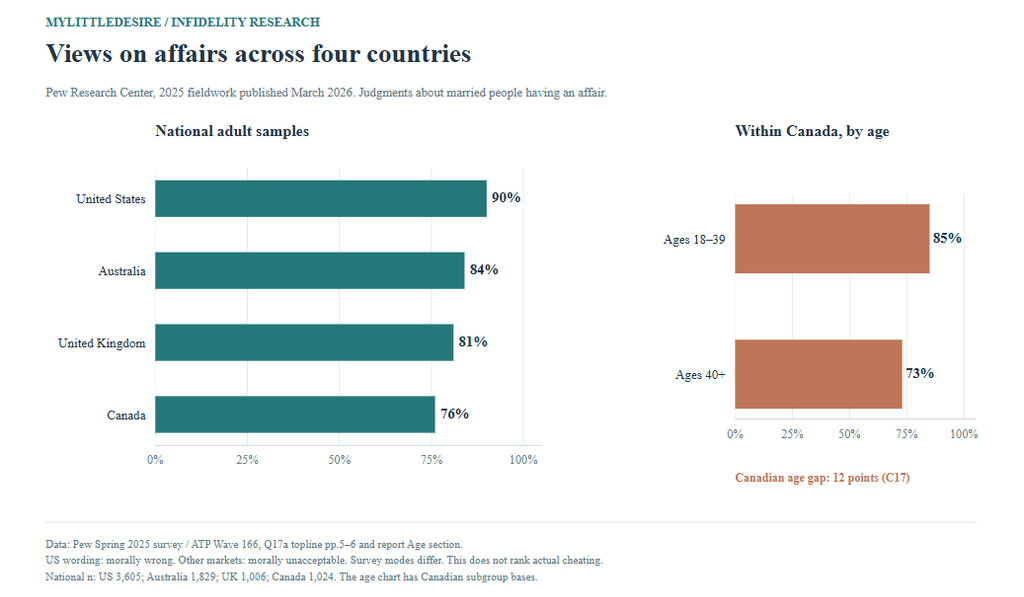
The US–UK difference is nine percentage points and the US–Canada difference 14 points (C16 and C20). Modes and wording differ, so those are descriptive differences in judgments. Within Canada, the age-group difference is 12 points (C17). That question cannot be combined with YouGov’s differently aged reconciliation groups as a measure of national forgiveness.
What do the Gallup and additional Canadian surveys show?
Other surveys offer separate attitude measurements with their own wording and samples. They should be kept visible rather than averaged into one supposedly definitive rate.
| ID | Finding and qualification | Population, actual period and base | Original source and locator |
|---|---|---|---|
| F43 | In May 2026, 89% considered married men and women having an affair morally wrong and 7% considered it morally acceptable. Use the approximate 750-person item base, not the whole survey’s 1,001, when describing this result. | Adults aged 18+ in 50 states and DC; moral-acceptability question about married men and women having an affair. 2026-05-01 to 2026-05-17; selected historical annual observations 2001–2025 separately labelled. 1,001 overall; each issue asked of approximately 750 respondents (topline p.2), item margin ±5 points; subgroup counts not printed. | Original source [S08] Final topline physical p.9, Q21G; question/item base on p.2. |
| F44 | The same series reported 89% morally wrong in 2001 and 2026, 85% in 2023, and 93% in 2003, 2005 and 2006. Selected historical points from separate annual samples; no finding of no change or significance is inferred from equal rounded endpoints. | Adults aged 18+ in 50 states and DC; moral-acceptability question about married men and women having an affair. Selected May surveys: 2001, 2003, 2005, 2006, 2023 and 2026. 1,001 overall; each issue asked of approximately 750 respondents (topline p.2), item margin ±5 points; subgroup counts not printed. | Original source [S08] Final topline physical p.9, historical Q21G table. |
| F45 | In 2026, 86% of men and 92% of women judged affairs morally wrong. The corresponding age-group figures were 90% at 18–34, 87% at 35–54 and 91% at 55+. Subgroup bases and margins differ from the overall issue estimate. Small rounded differences are not declared statistically significant. | Adults aged 18+ in 50 states and DC; moral-acceptability question about married men and women having an affair. 2026-05-01 to 2026-05-17; selected historical annual observations 2001–2025 separately labelled. 1,001 overall; each issue asked of approximately 750 respondents (topline p.2), item margin ±5 points; subgroup counts not printed. | Original source [S08] Final release physical p.23, QN21G crosstab. |
| ID | Finding and qualification | Population, actual period and base | Original source and locator |
|---|---|---|---|
| F54 | Eighteen percent of Canadian respondents in the September 2025 online poll considered married men and/or women having an affair morally acceptable. This is not a Canadian cheating prevalence estimate. Different choices and sampling prevent subtracting it directly from Pew’s Canadian result. | Canadian adults; moral acceptability of married men and/or women having an affair. 2025-09-10 to 2025-09-12 1,003 adults overall; item base not separately supplied in release. | Original source [S13] Original release physical p.1; methods physical p.2. |
Gallup’s affair item was asked of approximately 750 respondents, even though 1,001 completed the overall survey. Equal rounded disapproval at two endpoints does not prove there was no change between them. The Canadian online poll’s moral-acceptability result also cannot be subtracted directly from Pew’s result to manufacture a trend.
How is infidelity linked to divorce and relationship recovery?
Retrospective divorce accounts and selected clinical outcomes can inform this question, but they do not establish one universal divorce or recovery percentage. A study beginning with people already divorced answers a different question from a study following couples after treatment.
| ID | Finding and qualification | Population, actual period and base | Original source and locator |
|---|---|---|---|
| F46 | In the 52-person divorced follow-up, 59.6% identified infidelity or an extramarital affair as a major contributor to divorce. This is a percentage of selected divorced interviewees, not the percentage of all marriages ending because of infidelity. | Divorced participants previously receiving PREP premarital education; retrospective accounts, including 18 former couples interviewed on both sides. Post-divorce interviews 2010–2012; parent premarital cohort began in 1996. 52 people (31 women, 21 men); 18 matched former couples / 36 of those people. Item/qualitative-code bases differ. | Original source [S09] Table 1; Results: Infidelity subsection. |
| F47 | Among matched former couples where at least one person cited infidelity as a contributor, 31.3% had both former partners cite it. The base is conditional on at least one endorsement and comes from only 18 interviewed former couples overall. It is not a national rate of agreement or proof either person’s account was accurate. | Divorced participants previously receiving PREP premarital education; retrospective accounts, including 18 former couples interviewed on both sides. Post-divorce interviews 2010–2012; parent premarital cohort began in 1996. 52 people (31 women, 21 men); 18 matched former couples / 36 of those people. Item/qualitative-code bases differ. | Original source [S09] Table 1 Couple Agreement; Results: Infidelity. |
| F48 | Among interviewees who identified a final-straw event, 24% cited infidelity as that event. This is a conditional qualitative-code percentage, not all 52 interviewees or all US divorces. Multiple contributing problems could precede the event. | Divorced participants previously receiving PREP premarital education; retrospective accounts, including 18 former couples interviewed on both sides. Post-divorce interviews 2010–2012; parent premarital cohort began in 1996. Parent study sample 52; exact eligible valid-code denominator not explicitly supplied beside the 24% figure. | Original source [S09] Results: Final straw section. |
The 59.6% finding is frequently useful to writers, provided the 52-person selected sample and 2010–2012 interview period stay attached. Multiple contributors could be endorsed, and reports were retrospective. The 31.3% couple-agreement finding has another conditional base. None describes the proportion of all marriages ending because of infidelity.
What can the small five-year therapy follow-up tell us?
The study observed different outcomes in very small, distressed treatment-seeking groups. Infidelity and disclosure were not randomly assigned.
| ID | Finding and qualification | Population, actual period and base | Original source and locator |
|---|---|---|---|
| F49 | At five years after therapy, divorce was reported for 4 of 5 secret-affair couples (80%), 6 of 14 revealed-affair couples (43%), and 26 of 115 couples without identified infidelity (23%). The tiny denominators are essential. These observational subgroups cannot estimate the effect of disclosure or the chance that any particular marriage survives. | Seriously and chronically distressed heterosexual married couples seeking treatment at two university sites. Recruited November 1997–February 2001; follow-up through five years after treatment. Exact final follow-up dates not reported in the accessed sections. 134 couples: 19 with identified infidelity (5 secret, 14 revealed), 115 without identified infidelity. | Original source [S10] Original PDF physical p.1 abstract; Results physical pp.6–7. |
| F50 | Among the 19 identified infidelity couples, affair duration ranged from 1 to 24 months, with a median of 6 months. A duration summary from 19 distressed treatment-seeking couples is not the typical affair duration in the population. | Seriously and chronically distressed heterosexual married couples seeking treatment at two university sites. Recruited November 1997–February 2001; follow-up through five years after treatment. Exact final follow-up dates not reported in the accessed sections. 134 couples: 19 with identified infidelity (5 secret, 14 revealed), 115 without identified infidelity. | Original source [S10] Original PDF physical p.4, Participants. |
The secret-affair percentage represents four of five couples. It should be quoted with those counts, not promoted as an 80% national risk or proof that disclosure changes divorce probability. The duration summary is similarly limited to 19 identified infidelity couples. General relationship support and communication findings are discussed in our relationship statistics resource; our breakup research covers a broader set of relationship endings.
How do sexual and financial deception overlap?
One iFidelity analysis classified sexual extramarital activity and financial deception separately. Its currently married sample does not establish that every reported event happened in the current marriage, or that one form of deception led to the other.
| ID | Finding and qualification | Population, actual period and base | Original source and locator |
|---|---|---|---|
| F51 | In the 946 currently married respondents used in the iFidelity analysis, 14.5% reported extramarital sexual activity without the spouse’s knowledge and approval. The authors could not establish whether the behavior happened in the current marriage. This is not emotional-only infidelity or the percentage currently having an affair. | Currently married respondents; behavior questions could refer to a previous marriage, not necessarily the current spouse. Late 2019, as reported in this paper; exact fieldwork dates not supplied. 946 married participants selected from the 2,000-person iFidelity dataset. | Original source [S11] Materials and methods: Dependent variable. |
| F52 | The study’s mutually exclusive groups were 43.5% financial deception only, 5.5% sexual infidelity only, 9% both, and 42% neither. The groups describe reported lifetime-marriage histories in a currently married sample, not proof that the events occurred together in one relationship or that one caused the other. The 9% group is already included in the 14.5% sexual total. | Currently married respondents; behavior questions could refer to a previous marriage, not necessarily the current spouse. Late 2019, as reported in this paper; exact fieldwork dates not supplied. 946 married participants selected from the 2,000-person iFidelity dataset. | Original source [S11] Materials and methods: Dependent variable, four group percentages. |
The 9% reporting both is already included in the sexual total of 14.5%; it is not an additional group to add on top. The wider financial-deception literature belongs in the separate Financial Infidelity Statistics Hub, which uses its own definitions and evidence.
Why can the method change the reported infidelity estimate?
Question wording, recall period, recruitment, privacy and eligibility can all affect a reported estimate. One historical paper illustrates an assessment difference, with a clear limit on what was independently accessible here.
| ID | Finding and qualification | Population, actual period and base | Original source and locator |
|---|---|---|---|
| F53 | The 2007 paper’s original abstract reports annual sexual-infidelity estimates of 1.08% from face-to-face assessment and 6.13% from computer-assisted self-interview assessment. Only the original abstract was independently verified. The data year, full question construction and detailed eligibility remain unknown here. The comparison is not a privacy intervention effect or a correction multiplier. | Population-based sample of married women; detailed age eligibility and assessment construction were not independently checked in full text. Original data-collection period not established from the accessible primary abstract; annual recall measure. Publication year is not the measurement year. 4,884 married women, as stated in the original abstract. | Original source [S12] Original PubMed abstract, purpose/sample and annual-prevalence sentences. |
The two abstract-reported estimates differ by 5.05 percentage points and a ratio of about 5.68 (C18–C19). Full methods and the original field period were not independently verified, so the comparison is not presented as an experiment isolating privacy, proof that other surveys undercount by that factor, or a current cheating rate.
An original 2024 systematic review by Warach and colleagues also identifies unclear operational definitions, demographic homogeneity and selection or response biases in this literature. Its accessible institutional abstract was checked; a pooled prevalence figure was withheld because the underlying numerical tables were not independently verified.
What comparisons does MyLittleDesire contribute?
Our contribution is organization, original chart design and transparent descriptive arithmetic. Some contrasts were already visible or discussed in the sources. The following are not original fieldwork, new scientific discoveries, adjusted causal effects or new significance tests. Every calculation uses inputs from the same source; its qualifications remain attached.
| ID | Comparison | Result | Qualification and original source |
|---|---|---|---|
| C01 | GB: sex versus deep emotional attachment labelled cheating | 42.0 percentage points | Descriptive comparison of reported estimates; not a causal effect or new significance test. YouGov GB [S02] |
| C02 | GB: sex versus dating-app use labelled cheating | 14.0 percentage points | Descriptive comparison of reported estimates; not a causal effect or new significance test. YouGov GB [S02] |
| C03 | GB flirting: harmful-but-not-cheating versus cheating label | 24.0 percentage points | Descriptive comparison of reported estimates; not a causal effect or new significance test. YouGov GB [S02] |
| C04 | GB AI conversations: harmful-but-not-cheating versus cheating label | 11.0 percentage points | Descriptive comparison of reported estimates; not a causal effect or new significance test. YouGov GB [S02] |
| C05 | GB creator interaction: women-minus-men cheating label | 20.0 percentage points | Descriptive comparison of reported estimates; not a causal effect or new significance test. YouGov GB [S02] |
| C06 | GB AI conversations: women-minus-men cheating label | 16.0 percentage points | Descriptive comparison of reported estimates; not a causal effect or new significance test. YouGov GB [S02] |
| C07 | GB reconciliation: age 60+ minus age 18–29 acceptance | 25.0 percentage points | Descriptive comparison of reported estimates; not a causal effect or new significance test. YouGov GB [S02] |
| C08 | GB deep attachment: combined cheating or harmful-non-cheating responses | 84 % | MyLittleDesire sum of two mutually exclusive answer categories, 52+32. A perception measure; excludes harmless/unknown/refusal. Not a behavior prevalence. YouGov GB [S02] |
| C09 | Own ESI: later-relationship rate difference by earlier ESI | 27.0 percentage points | Unadjusted percentages in the selected cohort. Distinct from the adjusted odds ratio of 3.35. Knopp, Scott, Ritchie, Rhoades, Markman and Stanley; University of Denver and collaborators [S04] |
| C10 | Own ESI: raw later-relationship probability ratio | 2.50 ratio | 45/18=2.50 is a ratio of rounded observed percentages. It is not the adjusted odds ratio of 3.35 or a universal risk multiplier. Knopp, Scott, Ritchie, Rhoades, Markman and Stanley; University of Denver and collaborators [S04] |
| C11 | Known partner ESI: subsequent-report rate difference | 13.0 percentage points | Respondent reports about different partners; no proof of partner behavior or victim responsibility. Knopp, Scott, Ritchie, Rhoades, Markman and Stanley; University of Denver and collaborators [S04] |
| C12 | Suspected partner ESI: subsequent-suspicion rate difference | 31.0 percentage points | A suspicion comparison, not confirmed infidelity or diagnostic accuracy. Knopp, Scott, Ritchie, Rhoades, Markman and Stanley; University of Denver and collaborators [S04] |
| C13 | GSS: outside-sex reports among currently divorced/separated versus married | 27.0 percentage points | Condition is current marital status. Lifetime sexual history is the outcome. Not a divorce probability. Wendy Wang, Institute for Family Studies; original data: NORC General Social Survey [S03] |
| C14 | GSS: current divorce/separation prevalence by outside-sex history | 37.0 percentage points | Condition is reported sexual history. Current status is the outcome. Remarriage and temporal order remain unknown. Wendy Wang, Institute for Family Studies; original data: NORC General Social Survey [S03] |
| C15 | GSS: ratio of current divorce/separation prevalence by outside-sex history | 3.47 ratio | Cross-sectional current-status prevalence ratio of rounded percentages; not the prospective risk of divorce after an affair. Wendy Wang, Institute for Family Studies; original data: NORC General Social Survey [S03] |
| C16 | Pew: US-minus-UK moral disapproval | 9.0 percentage points | One study and topic, with US wording morally wrong versus UK morally unacceptable and mode differences. Not a behavior ranking. Pew Research Center [S07] |
| C17 | Pew Canada: age 18–39 minus age 40+ moral disapproval | 12.0 percentage points | Descriptive comparison of reported estimates; not a causal effect or new significance test. Pew Research Center [S07] |
| C18 | Historical assessment comparison: computer minus face-to-face estimate | 5.05 percentage points | Original-abstract comparison only. Full methods and data year unverified; no causal privacy effect or correction for other studies. Whisman and Snyder; University of Colorado Boulder and Texas A&M University [S12] |
| C19 | Historical assessment comparison: ratio of published estimates | 5.68 ratio | Original-abstract comparison of two assessment estimates; not necessarily identical questions, random assignment or a true-rate correction factor. Whisman and Snyder; University of Colorado Boulder and Texas A&M University [S12] |
| C20 | Pew: US-minus-Canada moral disapproval | 14.0 percentage points | Moral judgment, not prevalence. US and Canadian wording/modes differ; no new significance test claimed. Pew Research Center [S07] |
What should readers check before quoting a cheating statistic?
Is there one verified 2027 cheating rate?
No. This is an editorial edition based on earlier fieldwork. A behavior must be defined for a particular population and time period before a prevalence estimate is meaningful.
Do the findings prove men or women cheat more?
Not universally. The broad 2025 US item, the marriage-specific GSS age restriction and historical cohort questions give different views. A point difference without appropriate uncertainty does not establish a population difference.
Can emotional cheating be added to physical cheating?
Only if the joint distribution permits it and overlapping respondents are handled correctly. The GB sexual and emotional groups overlap. Separate rates do not normally identify an emotional-only population.
Does joining a dating app or talking to AI prove infidelity?
The cited scenarios measure public judgments, not verification of an individual’s conduct or relationship agreement. Use, intent, consent and agreed boundaries are different questions.
Is consensual non-monogamy the same as cheating?
No. Outside activity with a partner’s agreement differs from a breach of that agreement. Some historical ESI/EDS measures did not establish permission; their limitations are explicit.
Does suspicion establish that a partner cheated?
No. The longitudinal study treated suspicion as a distinct report. It did not establish the sensitivity or accuracy of someone’s suspicions.
Can these studies predict whether a marriage will survive?
They do not provide a reliable individual prediction. Current marital status, selected divorced samples and tiny treatment subgroups each have different eligibility, time windows and limitations.
How were the findings selected and verified?
We prioritized original survey results, primary data analyses, peer-reviewed articles and government/research-organization tables. Each database record includes the exact finding, numeric inputs and units, original organization, publication and field periods, URL, population, sample availability, methods, locator, definitions, caveats and date checked. Related response categories are grouped rather than marketed as independent discoveries.
The core contains 54 grouped findings and 174 numeric inputs from 13 source publications and analyses. YouGov US contributes five findings, YouGov GB 12, and the YouGov-fielded iFidelity analysis two; these are different surveys/datasets. The remaining 35 findings come from the other sources. Survey programs, repeated waves and multiple reports should not be assumed to be independent replications.
Original YouGov questionnaires/tables, Pew toplines and methods, Gallup tables, the PLOS article and PDF, the Frontiers paper and the Research Co. release were checked. NCBI’s documented public BioC service supplied author-manuscript text and table content when the ordinary PMC page returned a browser challenge. The APA sample PDF and IFS analysis were checked through public web retrieval when direct downloads were unavailable. The Whisman–Snyder finding is explicitly limited to the original abstract; full methods and field dates remain unverified.
We retained published confidence intervals for the relevant pandemic descriptive estimates and longitudinal adjusted odds ratios. No new confidence intervals, adjusted models or significance tests were created. Calculations use named inputs, readable rounding and explicit percentage-point or ratio units. A ratio calculated from rounded percentages can differ from a model’s adjusted odds ratio.
What was excluded or held back?
Unverified global rates, country cheating league tables, a supposed universal divorce probability, and interpretations that treat suspicion as confirmation were excluded. The pandemic paper’s reduced-desire wording and some model-result translations require reconciliation; the retained descriptive findings are separately documented. An iFidelity financial-total rounding inconsistency was not silently repaired. A numerical meta-analysis estimate was withheld because its primary tables were not independently verified.
What are the main limitations?
- Many measures are sensitive self-reports, and partner behavior is often unverified.
- Some studies use opt-in panels, selected relationship transitions, divorced participants or very small clinical groups.
- GSS analysis details, several exact item counts and some historical field dates remain unavailable.
- GB and UK coverage differ. The Canadian and Australian evidence here is primarily moral attitudes, not verified contemporary national cheating prevalence.
- Cross-sectional associations, retrospective reports and differing observation windows do not establish causation.
- No person-level overlap is invented from separate marginal percentages, and no 2027 measurement or forecast is claimed.
Complete original-source bibliography
- S01 · YouGov US. Relationships survey, April 18–21, 2025; Half of Americans say they have been cheated on. Published: 2025-05-20. Actual period: 2025-04-18 to 2025-04-21; lifetime experience questions unless otherwise stated. Sample: 1,125 overall; selected item and subgroup counts appear in the full results.. Method: Weighted opt-in online panel; weights include demographic and electoral characteristics. Full results physical p.6 gives methods and weighting-adjusted margin of error ±3.9 points.. Limits: Opt-in recruitment is not a probability sample. Generic cheating, partner reports, sexual activities with or without relationship agreement, and current monogamy are different questions. Self-reports are not partner-verified. Supporting original material: Original tables / methods.
- S02 · YouGov GB. Big Survey Relationships: Section 4, cheating in relationships. Published: 2026-08-17. Actual period: 2026-07-09 to 2026-07-10; lifetime behavior and current attitudes as labelled. Sample: 1,882 overall (879 male, 1,003 female); 1,684 ever-partnered for the experience item; see physical pp.43–51.. Method: YouGov weighted online survey. Full tables supply weighted/unweighted bases and questionnaire wording; no new uncertainty intervals calculated here.. Limits: Northern Ireland is outside the GB sample. Sexual cheating includes sexual contact without the partner’s knowledge or agreement. Perceptions of behaviors are not their prevalence. The physical and emotional experience groups overlap. Supporting original material: Original tables / methods.
- S03 · Wendy Wang, Institute for Family Studies; original data: NORC General Social Survey. Men With Prestigious Jobs Are More Likely to Cheat. Published: 2025-08-25. Actual period: Recent-wave analysis uses GSS 2021–2022; trend pools 1991–1998 and 2010–2018. Exact per-figure sample counts and pooling are not fully documented in the article.. Sample: Analytic item/subgroup sample sizes not published in the article.. Method: Original analyst’s GSS tabulations, with pooled trend periods and occupational prestige categories. Published percentages were checked against the analyst’s text; raw microdata and weighting code were not independently rerun.. Limits: GSS mode changes in 2021–2022 complicate trends. Sexual activity outside marriage is narrower than broad cheating and does not itself establish a breach of an exclusivity agreement. Current marital status is not a prospective divorce outcome; remarriage is possible. Missing sample sizes and uncertainty prevent additional significance claims.
- S04 · Knopp, Scott, Ritchie, Rhoades, Markman and Stanley; University of Denver and collaborators. Once a Cheater, Always a Cheater? Serial Infidelity Across Subsequent Relationships. Published: Online 2017-08-07; journal issue November 2017. Actual period: Parent cohort began in the mid-2000s; approximately five years, eleven waves every four to six months. Exact start/end calendar dates not stated in the accessed manuscript.. Sample: 484 selected from a 1,294-person parent cohort; model n=467 for own ESI, 389 known-partner ESI, 329 suspected-partner ESI.. Method: Targeted-listed telephone recruitment; longitudinal mail questionnaires. First two observed relationships analyzed with demographic-adjusted logistic models.. Limits: Selected relationship-transition cohort, not all US adults. Extradyadic sexual involvement (ESI) did not establish whether outside activity was agreed. Partner accounts are respondent reports, not independent confirmation. First and second relationships had different durations and observation windows. Odds ratios are not probability ratios. Supporting original material: Original supporting record, Original supporting record.
- S05 · Frisco, Wenger and Kreager; Penn State and Florida State University; Add Health. Extradyadic sex and union dissolution among young adults in opposite-sex married and cohabiting unions. Published: Online 2016-08-27; journal issue February 2017. Actual period: Wave III 2001–2002; Wave IV 2007–2008, when respondents were aged 24–32; EDS concerns current or most recent sexual relationship.. Sample: 8,301: 4,692 women and 3,609 men. Married women 3,094; cohabiting women 1,598; married men 2,223; cohabiting men 1,386.. Method: National longitudinal school-based cohort, analytic weights, ten multiple-imputation datasets; weighted descriptive tables and Cox models. Original table cells and model text checked using NCBI’s author-manuscript text.. Limits: EDS does not establish lack of agreement or whether it happened before/after marriage or cohabitation. Respondent-only and partner-only categories exclude mutual EDS. Reports are not matched partners. Behavior timing is uncertain, so a dissolution association is not proof of causation. Supporting original material: Original supporting record, Original supporting record.
- S06 · Campbell, Viegas de Moraes Leme and Gesselman; Indiana University/Kinsey Institute and University of Pennsylvania. Infidelity among parents in committed relationships during the COVID-19 pandemic. Published: 2025-08-13. Actual period: 2021-01-01 to 2021-01-31; retrospective comparison with the year before the pandemic and behavior since the pandemic began.. Sample: 1,070 analytic participants from 2,000 recruited: 498 men, 572 women; 771 parents, 299 non-parents. Valid item/model counts can be smaller.. Method: Prodege opt-in Internet panels with demographic targeting. Hearst-funded cross-sectional survey; publication includes data/materials link. Question uses what the respondent believes their partner would consider infidelity.. Limits: The 2025 publication reports January 2021 fieldwork. Restricted opt-in sample; subgroup rates are unadjusted and can reflect confounding. Desire and behavior are separate constructs; uncertain behavior responses were made missing. Several narrative/model inconsistencies are withheld, including reduced-desire wording and interpretation of effect-coded odds ratios. Supporting original material: Original supporting record, Original supporting record.
- S07 · Pew Research Center. In 25-Country Survey, Americans Especially Likely To View Fellow Citizens as Morally Bad. Published: 2026-03-05. Actual period: US affair item: 2025-03-24 to 2025-03-30, ATP Wave 166. Non-US study collection: 2025-01-08 to 2025-04-26; individual country dates not extracted here.. Sample: US 3,605; UK 1,006; Canada 1,024; Australia 1,829. Non-US study total 28,333; religious subgroup bases in topline pp.5–6.. Method: US probability-recruited American Trends Panel, weighted online/live phone interviews; UK/Canada telephone; Australia mixed-mode probability online panel. National weights and sample methods published.. Limits: US says morally wrong; other countries say morally unacceptable. Modes and response options differ slightly. A country median is not a population-weighted world estimate. Approval is not behavior, and religious-group associations are not causes. Supporting original material: Original tables / methods, Original supporting record.
- S08 · Gallup / ReconMR. Moral Acceptability Falls for Several Behaviors; May 2026 final topline and tables. Published: 2026-06-09. Actual period: 2026-05-01 to 2026-05-17; selected historical annual observations 2001–2025 separately labelled.. Sample: 1,001 overall; each issue asked of approximately 750 respondents (topline p.2), item margin ±5 points; subgroup counts not printed.. Method: Random-digit-dial landline/cellphone telephone survey with weighting. Original final topline p.9 and crosstab p.23 checked; long-term table supplies historical dates.. Limits: Overall-survey n=1,001 is not the exact affair-item base. Attitudes do not measure personal conduct. Selected historical samples and subgroup errors differ; no new trend significance test is claimed. Supporting original material: Original tables / methods.
- S09 · Scott, Rhoades, Stanley, Allen and Markman; University of Denver and collaborators. Reasons for Divorce and Recollections of Premarital Intervention: Implications for Improving Relationship Education. Published: Journal publication 2013; author manuscript available 2014. Actual period: Post-divorce interviews 2010–2012; parent premarital cohort began in 1996.. Sample: 52 people (31 women, 21 men); 18 matched former couples / 36 of those people. Item/qualitative-code bases differ.. Method: Selected follow-up of a 306-couple premarital study; telephone interviews and yes/no contributor list plus qualitative coding. Mean interview was 5.2 years after finalized divorce.. Limits: Small, selected retrospective sample of people already divorced. Endorsing a contributor does not establish the percentage of all marriages ending because of infidelity. Multiple contributors can coexist. Couple-level and individual-level bases are different. Supporting original material: Original supporting record.
- S10 · Marín, Christensen and Atkins; University of Washington and UCLA. Infidelity and Behavioral Couple Therapy: Relationship Outcomes Over 5 Years Following Therapy. Published: March 2014. Actual period: Recruited November 1997–February 2001; follow-up through five years after treatment. Exact final follow-up dates not reported in the accessed sections.. Sample: 134 couples: 19 with identified infidelity (5 secret, 14 revealed), 115 without identified infidelity.. Method: Follow-up of a randomized comparison of two behavioral therapies. Infidelity/disclosure groups were observational, not randomized. Original free sample article read through public web PDF retrieval.. Limits: Tiny selected clinical subgroup. A result based on four of five secret-affair couples is not a national divorce rate. Disclosure was not randomized; outcomes cannot prove the effect of telling or of therapy. Historical recruitment and five-year post-treatment window stay visible. Supporting original material: Original supporting record, Original supporting record.
- S11 · Dew, Saxey and Mettmann; Brigham Young University. Money lies and extramarital ties: Predicting separate and joint occurrences of financial deception and extramarital infidelity. Published: 2022-11-22. Actual period: Late 2019, as reported in this paper; exact fieldwork dates not supplied.. Sample: 946 married participants selected from the 2,000-person iFidelity dataset.. Method: YouGov panel matched to ACS characteristics and post-stratification weighted; cross-sectional multinomial analysis. Sexual EMI definition includes anal/oral/vaginal sex outside marriage without the spouse’s knowledge and approval.. Limits: Current married status is not proof the behavior occurred in the current marriage. Financial deception and sexual EMI are distinct; joint classification establishes reported overlap, not temporal order or causation. Some text rounds financial-deception totals differently.
- S12 · Whisman and Snyder; University of Colorado Boulder and Texas A&M University. Sexual infidelity in a national survey of American women: differences in prevalence and correlates as a function of method of assessment. Published: June 2007. Actual period: Original data-collection period not established from the accessible primary abstract; annual recall measure. Publication year is not the measurement year.. Sample: 4,884 married women, as stated in the original abstract.. Method: Original peer-reviewed abstract compares face-to-face and computer-assisted self-interview assessments of annual sexual infidelity. Only the abstract-supported comparison is retained.. Limits: Full methods and original field dates remain unverified. Do not assume identical questions or a randomized privacy experiment, or use the ratio as a correction factor for another poll. These are historical method-associated estimates, not current prevalence. Supporting original material: Original supporting record.
- S13 · Research Co.. Canadian moral-acceptability survey, October 16, 2025 release. Published: 2025-10-16. Actual period: 2025-09-10 to 2025-09-12. Sample: 1,003 adults overall; item base not separately supplied in release.. Method: Online survey; release describes weighting to Canadian census characteristics. A probability recruitment mechanism is not established by the accessible release.. Limits: Moral acceptability is not personal behavior. Different wording, recruitment and response choices prevent treating this as an exact replication of Pew’s estimate or subtracting the two into a trend.
Additional methodological background: Warach, Bornstein, Gorman and Moyer (2024), The current state of affairs in infidelity research. Institutional abstract reviewed; numerical pooled estimates are outside the 54-finding core. Text-retrieval support: NCBI BioC documentation, which requests acknowledgment of Comeau and colleagues’ PMC text-mining subset resource (2019).
How to cite this resource
For a MyLittleDesire compilation, chart design or descriptive calculation, credit this resource and identify the underlying study. For an individual survey finding, consult and cite the original research directly.
MyLittleDesire. Cheating and Infidelity Statistics 2027: Definitions, Surveys and Relationship Outcomes. https://mylittledesire.com/cheating-and-infidelity-statistics. Add an actual access date when required by your citation style.