
AI romantic partner statistics depend on what researchers ask. Having a chatbot relationship, trying romantic or sexual conversation, and imagining a future AI partner describe different experiences. This resource keeps those definitions and populations visible.
What are the key findings?
- 1% reported an existing romantic AI relationship. Population, date and source.
- 5% reported ever romantic or sexual chatbot use. Population, date and source.
- 10% was the ever-use rate for ages 18–29. Population, date and source.
- 84% had not used it and would not consider it. Population, date and source.
- 7% were open in the filtered IFS young-adult sample. Population, date and source.
- 25% believed AI could replace human romance. Population, date and source.
- 40% would refuse a date who used a companion app. Population, date and source.
- 12% of young singles had recently tried a companion app. Population, date and source.
- 77% of current online daters would consider dating AI. Population, date and source.
- 9% of broad companion users reported recent romantic chat. Population, date and source.
What counts as an AI romantic partner?
For this page, romantic AI use includes source questions explicitly mentioning romantic partners, romantic chat, or romantic/sexual companionship. Companion-app trial, emotional attachment and advice are marked as context. None of these surveys establishes that a chatbot reciprocates feelings.
Also Read:-
College Friendship Statistics 2027
Teen Peer Pressure Belonging Statistics 2027
Anniversary Gift Statistics 2027
Romantic Gift Giving Statistics 2027
International Friendship Day Statistics 2027
How many people report romantic AI use?
The April and June YouGov questions measure different things: an existing romantic relationship versus ever romantic or sexual companionship. Treating them as a growth series would confuse a broader definition with a change in behavior.
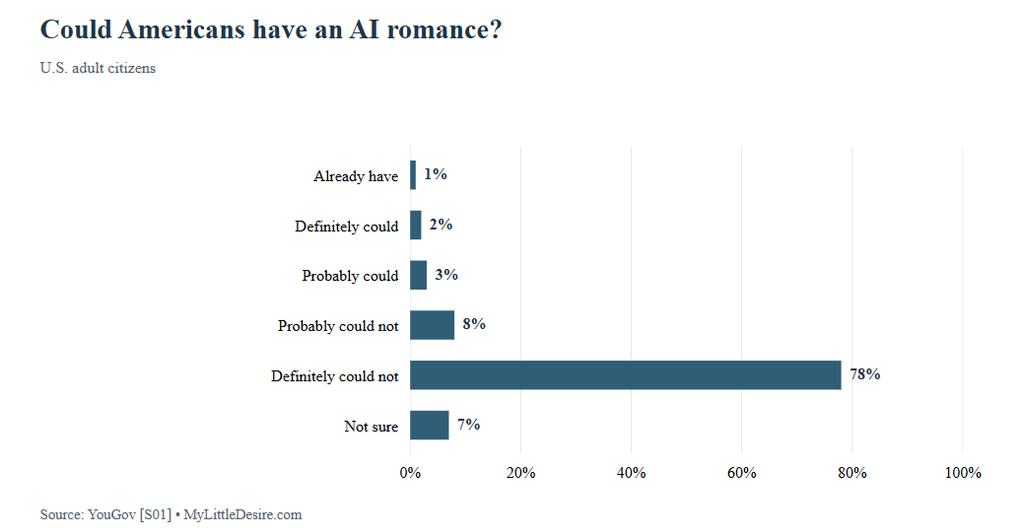
Could Americans have a romantic AI relationship?
Possibility of a romantic relationship with an AI chatbot · April 1–5, 2026 · Romance-specific measure. These categories distinguish an existing relationship from hypothetical possibility. Keep the 99% rounded total.
| Finding | Percent | Population / unweighted base | Source |
|---|---|---|---|
| F01 Already have | 1% | All adult citizens Item n=1,075 | S01 Q22; PDF p.86 / printed p.79 |
| F02 Definitely could | 2% | All adult citizens Item n=1,075 | S01 Q22; PDF p.86 / printed p.79 |
| F03 Probably could | 3% | All adult citizens Item n=1,075 | S01 Q22; PDF p.86 / printed p.79 |
| F04 Probably could not | 8% | All adult citizens Item n=1,075 | S01 Q22; PDF p.86 / printed p.79 |
| F05 Definitely could not | 78% | All adult citizens Item n=1,075 | S01 Q22; PDF p.86 / printed p.79 |
| F06 Not sure | 7% | All adult citizens Item n=1,075 | S01 Q22; PDF p.86 / printed p.79 |
How common is romantic or sexual chatbot use?
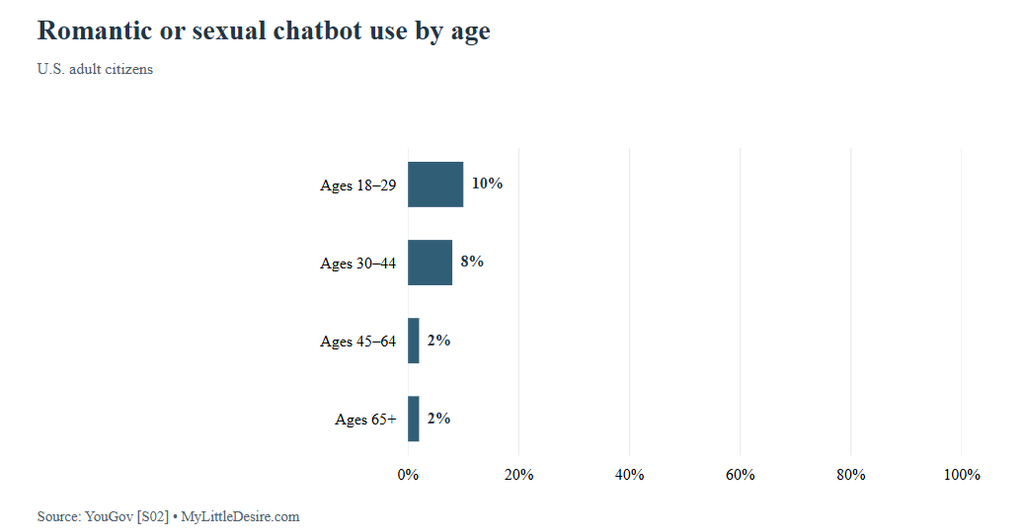
Ever used a chatbot for romantic or sexual companionship · June 26–29, 2026 · Romance-specific measure. Romantic or sexual use is broader than a continuing romantic partnership. These are weighted percentages; n values are unweighted item bases.
| Finding | Percent | Population / unweighted base | Source |
|---|---|---|---|
| F07 Yes | 5% | All adult citizens Item n=1,125 | S02 Q8A; PDF p.37 / printed p.33 |
| F08 No, would consider | 8% | All adult citizens Item n=1,125 | S02 Q8A; PDF p.37 / printed p.33 |
| F09 No, would not consider | 84% | All adult citizens Item n=1,125 | S02 Q8A; PDF p.37 / printed p.33 |
| F10 Prefer not to say | 3% | All adult citizens Item n=1,125 | S02 Q8A; PDF p.37 / printed p.33 |
| F11 Men: yes | 7% | Men Item n=530 | S02 Q8A; PDF p.37 / printed p.33 |
| F12 Women: yes | 4% | Women Item n=595 | S02 Q8A; PDF p.37 / printed p.33 |
| F13 Ages 18–29: yes | 10% | Ages 18–29 Item n=290 | S02 Q8A; PDF p.37 / printed p.33 |
| F14 Ages 30–44: yes | 8% | Ages 30–44 Item n=300 | S02 Q8A; PDF p.37 / printed p.33 |
| F15 Ages 45–64: yes | 2% | Ages 45–64 Item n=319 | S02 Q8A; PDF p.37 / printed p.33 |
| F16 Ages 65+: yes | 2% | Ages 65+ Item n=216 | S02 Q8A; PDF p.37 / printed p.33 |
Would young adults consider AI partners?
The IFS romance question excludes married and cohabiting respondents. Its replacement question uses all surveyed young adults. An opinion about AI’s potential does not establish an intention to use it.
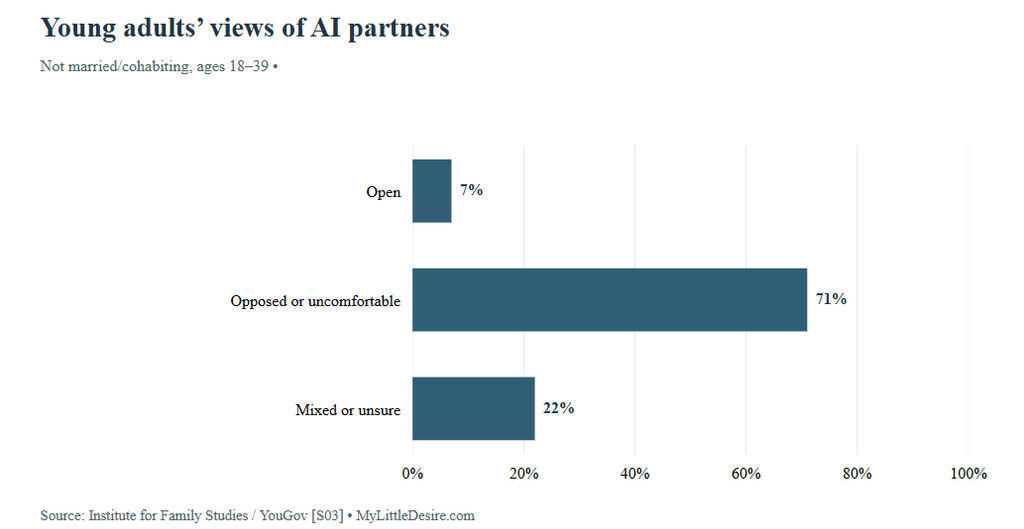
How open are young adults to AI romantic partners?
Attitudes to an AI romantic partner · 2024 survey; exact field dates unavailable in inspected release · Romance-specific measure. Filtered group is not married or cohabiting, not necessarily free of every dating relationship. Open includes existing users. Item/subgroup counts unavailable.
| Finding | Percent | Population / unweighted base | Source |
|---|---|---|---|
| F19 Open | 7% | Not married/cohabiting, ages 18–39 Exact item n unavailable | S03 Sections: 7% of Single Young Adults; education/age paragraphs |
| F20 Opposed or uncomfortable | 71% | Not married/cohabiting, ages 18–39 Exact item n unavailable | S03 Sections: 7% of Single Young Adults; education/age paragraphs |
| F21 Mixed or unsure | 22% | Not married/cohabiting, ages 18–39 Exact item n unavailable | S03 Sections: 7% of Single Young Adults; education/age paragraphs |
| F22 Gen Z: opposed/uncomfortable | 74% | Filtered Gen Z adults Exact item n unavailable | S03 Sections: 7% of Single Young Adults; education/age paragraphs |
| F23 Millennials: opposed/uncomfortable | 67% | Filtered Millennials Exact item n unavailable | S03 Sections: 7% of Single Young Adults; education/age paragraphs |
| F24 Gen Z: open | 7% | Filtered Gen Z adults Exact item n unavailable | S03 Sections: 7% of Single Young Adults; education/age paragraphs |
| F25 Millennials: open | 8% | Filtered Millennials Exact item n unavailable | S03 Sections: 7% of Single Young Adults; education/age paragraphs |
| F26 College group: opposed/uncomfortable | 76% | Filtered degree holders/current college students Exact item n unavailable | S03 Sections: 7% of Single Young Adults; education/age paragraphs |
| F27 No degree: opposed/uncomfortable | 67% | Filtered adults without a college degree Exact item n unavailable | S03 Sections: 7% of Single Young Adults; education/age paragraphs |
Could AI partners replace human romance?
Believe AI partners could replace real-life romance · 2024 survey; exact field dates unavailable in inspected release · Romance-specific measure. This is an opinion about potential, not adoption or a prediction validated by later behavior.
| Finding | Percent | Population / unweighted base | Source |
|---|---|---|---|
| F28 All young adults | 25% | All ages 18–39 Exact item n unavailable | S03 Section: Can AI Replace Real-Life Romance? |
| F29 Men | 28% | Men ages 18–39 Exact item n unavailable | S03 Section: Can AI Replace Real-Life Romance? |
| F30 Women | 22% | Women ages 18–39 Exact item n unavailable | S03 Section: Can AI Replace Real-Life Romance? |
What boundaries do singles report?
Match’s questions address human dating boundaries and companion-app experimentation. Its motive percentages concern the small subgroup of recent young app users, and can overlap.
How do singles set boundaries around companion apps?
Romantic attitudes and companion-app use · April 13–May 8, 2026 · Romance-specific measure. Negative views, refusing a date, and trying an app are different questions. Exact item counts and full questionnaire unavailable.
| Finding | Percent | Population / unweighted base | Source |
|---|---|---|---|
| F31 Negative about romantic AI | 47% | Singles ages 18–39 Exact item n unavailable | S04 Section: Where Singles Draw the Line |
| F32 Would refuse date with companion-app user | 40% | Singles ages 18–39 Exact item n unavailable | S04 Section: Where Singles Draw the Line |
| F33 Young women: would refuse date | 51% | Women singles ages 18–24 Exact item n unavailable | S04 Section: Where Singles Draw the Line |
Why do young companion-app users try these apps?
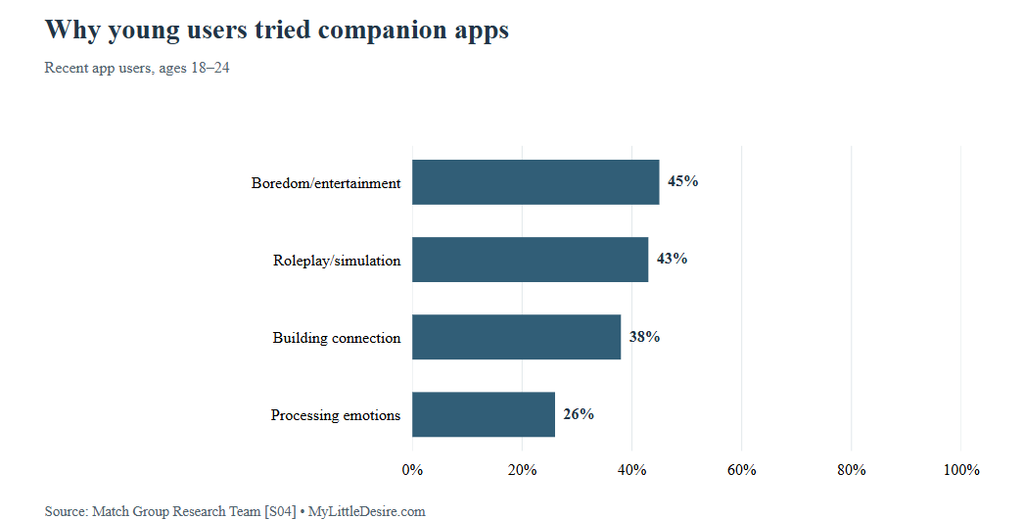
Companion-app trial and motivations · April 13–May 8, 2026 · Companion or advice context. Trial rate uses all 18–24 singles; motives use only recent users in that band. Motives overlap and are not restricted to romantic use.
| Finding | Percent | Population / unweighted base | Source |
|---|---|---|---|
| F34 Tried app in past three months | 12% | Singles ages 18–24 Exact item n unavailable | S04 Section: Where Singles Draw the Line, motivation paragraph |
| F35 Boredom/entertainment | 45% | Recent companion-app users ages 18–24 Exact item n unavailable | S04 Section: Where Singles Draw the Line, motivation paragraph |
| F36 Roleplay/simulation | 43% | Recent companion-app users ages 18–24 Exact item n unavailable | S04 Section: Where Singles Draw the Line, motivation paragraph |
| F37 Building connection | 38% | Recent companion-app users ages 18–24 Exact item n unavailable | S04 Section: Where Singles Draw the Line, motivation paragraph |
| F38 Processing emotions | 26% | Recent companion-app users ages 18–24 Exact item n unavailable | S04 Section: Where Singles Draw the Line, motivation paragraph |
Is AI help with dating the same as dating AI?
Human-dating assistance and personal guidance · April 13–May 8, 2026 · Companion or advice context. Assisting human dating does not imply wanting an AI partner. Different questions; no overlap inferred.
| Finding | Percent | Population / unweighted base | Source |
|---|---|---|---|
| F39 See potential dating assistance | 64% | Singles ages 18–39 Exact item n unavailable | S04 Sections: Where Singles Welcome It; personal-advice paragraph |
| F40 Turn to AI for deeper advice | 20% | Singles ages 18–39 Exact item n unavailable | S04 Sections: Where Singles Welcome It; personal-advice paragraph |
Why does the Norton headline differ?
Norton’s U.S. release concerns current online daters and hypothetical beliefs. Its full adult sample is not the dater-only denominator. Its global webpage uses different figures. Population, wording and unknown conditional counts prevent a direct prevalence comparison with YouGov.
What did Norton find among current U.S. online daters?
Hypothetical AI dating and romantic feelings · July 24–August 11, 2025 · Romance-specific measure. Dater-only beliefs, not all-adult adoption. Unknown conditional n. The 2026 release reports 2025 fieldwork.
| Finding | Percent | Population / unweighted base | Source |
|---|---|---|---|
| F41 Would consider dating AI | 77% | Current U.S. online daters Exact item n unavailable | S05 U.S. release, opening and From Support Tool to Romantic Partner |
| F42 Believe romantic feelings possible | 59% | Current U.S. dating-app users Exact item n unavailable | S05 U.S. release, opening and From Support Tool to Romantic Partner |
What support do daters imagine AI providing?
Beliefs and intentions about AI support · July 24–August 11, 2025 · Companion or advice context. Hypothetical support and self-described therapy intentions establish neither treatment effectiveness nor actual use.
| Finding | Percent | Population / unweighted base | Source |
|---|---|---|---|
| F43 AI partner more emotionally supportive | 63% | Current U.S. online daters Exact item n unavailable | S05 U.S. release: Loneliness Fueling AI Intimacy; From Support Tool to Romantic Partner |
| F44 Would use chatbot after heartbreak | 70% | Current U.S. online daters Exact item n unavailable | S05 U.S. release: Loneliness Fueling AI Intimacy; From Support Tool to Romantic Partner |
| F45 Would trust AI coach above friends/family | 78% | Current U.S. online daters Exact item n unavailable | S05 U.S. release: Loneliness Fueling AI Intimacy; From Support Tool to Romantic Partner |
What do broader AI companion users report?
Elon selected people using LLMs for social or emotional purposes. Romantic chat and sexual roleplay are separate purposes. The relationship-advice question concerns discussion of human relationship problems.
How often do broader companion users report romantic chat?
Past-six-month romantic chat use · May 18–22, 2026 · Romance-specific measure. Base is selected social/emotional AI users. These are not percentages of all adults; related subgroups overlap the total.
| Finding | Percent | Population / unweighted base | Source |
|---|---|---|---|
| F46 All qualifying users | 9% | All qualifying users Exact item n unavailable | S06 Q2; PDF p.9 / printed p.2 |
| F47 Men | 11% | Qualifying men Exact item n unavailable | S06 Q2; PDF p.9 / printed p.2 |
| F48 Women | 6% | Qualifying women Exact item n unavailable | S06 Q2; PDF p.9 / printed p.2 |
| F49 Ages 18–44 | 10% | Qualifying users ages 18–44 Exact item n unavailable | S06 Q2; PDF p.9 / printed p.2 |
| F50 Ages 45+ | 6% | Qualifying users ages 45+ Exact item n unavailable | S06 Q2; PDF p.9 / printed p.2 |
How many companion users report sexual chat or roleplay?
Ever used AI for sexual chat or roleplay · May 18–22, 2026 · Romance-specific measure. Ever-use purpose is not current relationship status. Exact subgroup counts unavailable.
| Finding | Percent | Population / unweighted base | Source |
|---|---|---|---|
| F51 All qualifying users | 9% | All qualifying users Exact item n unavailable | S06 Q53; PDF p.67 / printed p.60 |
| F52 Men | 11% | Qualifying men Exact item n unavailable | S06 Q53; PDF p.67 / printed p.60 |
| F53 Women | 5% | Qualifying women Exact item n unavailable | S06 Q53; PDF p.67 / printed p.60 |
How helpful is AI for discussing human relationship problems?
Helpfulness for romantic or sexual relationship problems · May 18–22, 2026 · Companion or advice context. Base includes people not discussing the topic. Perceived helpfulness is not relationship improvement. Rounded categories total 101%.
| Finding | Percent | Population / unweighted base | Source |
|---|---|---|---|
| F54 Very helpful | 19% | All qualifying users Exact item n unavailable | S06 Q33; PDF p.45 / printed p.38 |
| F55 Moderately helpful | 20% | All qualifying users Exact item n unavailable | S06 Q33; PDF p.45 / printed p.38 |
| F56 Slightly helpful | 12% | All qualifying users Exact item n unavailable | S06 Q33; PDF p.45 / printed p.38 |
| F57 Not helpful | 13% | All qualifying users Exact item n unavailable | S06 Q33; PDF p.45 / printed p.38 |
| F58 Do not discuss topic | 37% | All qualifying users Exact item n unavailable | S06 Q33; PDF p.45 / printed p.38 |
Does emotional connection necessarily mean romance?
Feel emotionally connected to at least one AI chatbot · May 18–22, 2026 · Companion or advice context. Agreement alone does not establish romance, exclusivity or reciprocal emotion.
| Finding | Percent | Population / unweighted base | Source |
|---|---|---|---|
| F59 Strongly agree | 13% | All qualifying users Exact item n unavailable | S06 Q17; PDF p.29 / printed p.22 |
| F60 Somewhat agree | 23% | All qualifying users Exact item n unavailable | S06 Q17; PDF p.29 / printed p.22 |
Does concealed AI use establish infidelity?
Concealing any AI use from a family member is not evidence of romantic infidelity. The question supplies no agreed couple boundary or joint-response record connecting concealment with romantic use.
Does hidden AI use measure an AI affair?
Ever hidden the amount of AI use from a partner or family member · June 26–29, 2026 · Companion or advice context. The question covers any AI use and family members. It does not identify secret romantic relationships.
| Finding | Percent | Population / unweighted base | Source |
|---|---|---|---|
| F17 All adult citizens: yes | 9% | All adult citizens Item n=1,125 | S02 Q9A; PDF p.41 / printed p.37 |
| F18 Ages 18–29: yes | 18% | Ages 18–29 Item n=290 | S02 Q9A; PDF p.41 / printed p.37 |
What comparisons can be calculated?
The workbook contains ten differences calculated from rounded published percentages. For example, the age-specific June ever-use rates differ by eight percentage points between ages 18–29 and 65+. These are descriptive comparisons, without a new significance test, causal inference or reconstructed respondent overlap.
| ID | Within-survey comparison | Difference |
|---|---|---|
| C01 | Youngest minus oldest ever-use | 8 percentage points |
| C02 | Men minus women ever-use | 3 percentage points |
| C03 | Ages 30–44 minus 45–64 ever-use | 6 percentage points |
| C04 | Nonusers considering minus ever-use | 3 percentage points |
| C05 | Gen Z minus Millennial opposition | 7 percentage points |
| C06 | Millennial minus Gen Z openness | 1 percentage points |
| C07 | College group minus no-degree opposition | 9 percentage points |
| C08 | Men minus women replacement belief | 6 percentage points |
| C09 | Boredom minus connection motivation | 7 percentage points |
| C10 | Roleplay minus processing-emotions motivation | 17 percentage points |
Questions readers ask
Does 5% mean one in twenty people currently has an AI partner?
No. That question asks about ever romantic or sexual companionship. It includes experiences that may have ended or did not involve a sustained romantic relationship.
Do these figures show AI is replacing human partners?
No. Beliefs about replacement, app experimentation and romantic-chat use do not measure how many human relationships were displaced.
Related research
For the broader subject, read AI companions and digital relationships statistics. For human matching platforms, see online dating statistics and dating intentions and commitment statistics.
Original sources
- YouGov [S01] — AI Usage survey
Published: 2026; companion analysis May 12. Fieldwork: April 1–5, 2026. Full sample 1,082. Weighted opt-in web panel. Q22 valid unweighted item n=1,075. Rounded categories total 99%. Full-sample margin ±3.9 points is not a subgroup interval. Existing relationship and future possibility differ. - YouGov [S02] — Artificial Intelligence survey
Published: 2026; companion article July 1. Fieldwork: June 26–29, 2026. Full sample 1,126. Weighted opt-in web panel. Q8A and Q9A valid unweighted n=1,125. Romantic OR sexual ever-use is not current partnership. Hidden-use item covers any AI and a partner or family member. - Institute for Family Studies / YouGov [S03] — Artificial Intelligence and Relationships
Published: November 14, 2024. Fieldwork: 2024 survey; exact field dates unavailable in inspected release. Full sample 2,000. IFS-commissioned YouGov survey; selected article does not give complete weighting or item counts. Source calls the filtered group single/unpartnered, operationalized as not married or cohabiting. Exact filtered/subgroup n unavailable. College group includes those currently in college. Belief in replacement uses all young adults. - Match Group Research Team [S04] — AI Is Everywhere. Romance is Still Off-Limits.
Published: June 18, 2026. Fieldwork: April 13–May 8, 2026. Full sample approximately 1,000. Commercial survey, approximately 1,000 respondents; recruitment/weights/item n not supplied. Full n approximate. Recent-use item concerns ages 18–24; motivations only recent companion-app users within that age band. Motives can overlap. Companion app use does not necessarily mean romance. - Norton / Gen / Dynata [S05] — Norton Insights Report: Artificial Intimacy, U.S. release
Published: January 27, 2026. Fieldwork: July 24–August 11, 2025. Full sample 1,000. Commercial Dynata online survey; age/gender/region weighting where necessary. Full U.S. sample 1,000 adults, not selected dater item n. Questionnaire/conditional counts unavailable. Intentions and beliefs, not observed AI partnerships. Global webpage has different estimates and a 14,003-adult base. - Elon University / YouGov [S06] — The Rise of AI Companions: topline and methodology
Published: September 2026 report release. Fieldwork: May 18–22, 2026. Full sample 1,000. YouGov online panel; matched screening n=4,031 from 4,268 interviews; target users n=1,000. Broad companion-user definition. Exact item and subgroup counts unavailable. Q2 asks past six months; Q53 ever-use. Q33 includes non-discussants. Some footers say May 18–23; cover/method dates retained. Q33 rounded categories total 101%.
How to cite this resource
MyLittleDesire. AI Romantic Partners Statistics 2027. Proposed URL: https://mylittledesire.com/ai-romantic-partners-statistics/.