In YouGov’s August 2026 UK survey, 62% of adults who had married or wished to marry preferred a smaller wedding with their closest friends and family. That is a preference without a numeric guest cap. Zola’s separate 2025 planning cohort reports 3% planning to elope. These questions describe different choices and cannot establish one interchangeable micro-wedding or elopement rate. YouGov [S01]; Zola [S02].
This collection contains 59 published percentage observations in 18 grouped findings, four charts and ten reproducible comparisons. Eight numerical source records come from seven publisher labels. Response categories, age groups and repeated annual coverage are not 59 independent studies. The evidence separates wedding-size preferences, plans, self-reported secret elopements, etiquette opinions and event-stage headcounts.
62%
12%
Prefers a smaller wedding with closest friends/family.UK marriage-eligible audience, August 2026; item unweighted n=1,200. YouGov [S01]
Prefers a private registry ceremony with witnesses.Same UK preference question; does not ask about secrecy. YouGov [S01]
3%
57%
Planning to elope in Zola’s wedding cohort.2025 wedding plans; exact valid item n unavailable. Zola [S02]
Currently engaged respondents considering a microwedding.The Knot’s September 2024 research; consideration, not completion. The Knot Worldwide [S03]
How do sources define micro weddings and elopements?
The Knot’s 2025-titled trends report describes micro weddings as events with up to 50 people and elopements as including up to 15 guests. Those are that source’s conventions. Other questionnaires ask about closest friends and family, a private registry ceremony, or eloping without advance notice. A reception threshold also differs from the total guest count across an entire celebration. The Knot Worldwide [S03].
| Term or measure | What the selected evidence describes | What still needs checking |
|---|---|---|
| Micro wedding | A source-specific small-event definition or consideration question | Numeric cap, planning stage and which event the count covers |
| Smaller wedding | A relative preference for close friends/family | No fixed guest limit in the UK preference option |
| Private registry ceremony | Couple and witnesses in the UK question | Does not establish secrecy or self-identification as elopement |
| Secret elopement | Explicitly without telling close people beforehand | Consideration, self-reported behavior and opinion are separate |
| Reception / evening size | Headcount at a particular stage of the day | Not automatically the whole wedding or an at-most-50 category |
Also Read:-
Destination Wedding Statistics 2027
AI Wedding Planning Statistics 2027
Engagement Ring Buying Statistics 2027
Wedding Guest Count Statistics 2027
Premarital Counseling Statistics 2027
Would people choose a smaller or more private wedding?
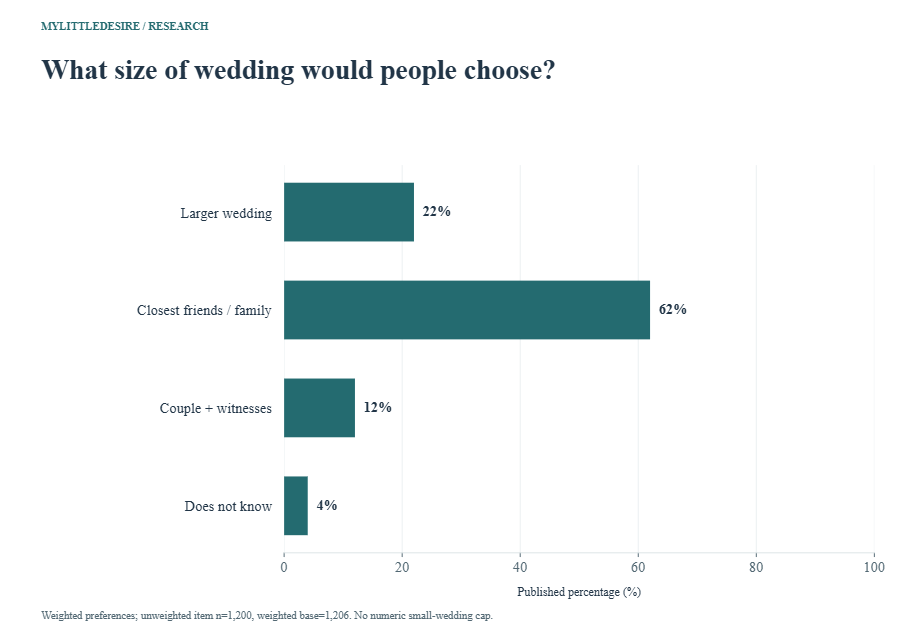
F01 One single-choice question among previously married adults or those wishing to marry. Weighted preferences, not observed micro weddings. Smaller has no numeric cap; private registry ceremony is not automatically secret elopement. Exact unweighted item n=1,200, weighted base=1,206.
| Measure / response | Published result | Actual period and item base | Source |
|---|---|---|---|
| Larger wedding with many people from their lives | 22% | August 7–9, 2026 UK adult survey Unweighted item n=1,200 / weighted base=1,206 | Original source [S01] PDF physical/printed p.15, GuestNos total column |
| Smaller wedding with closest friends and family | 62% | August 7–9, 2026 UK adult survey Unweighted item n=1,200 / weighted base=1,206 | Original source [S01] PDF physical/printed p.15, GuestNos total column |
| Private registry ceremony, couple and witnesses | 12% | August 7–9, 2026 UK adult survey Unweighted item n=1,200 / weighted base=1,206 | Original source [S01] PDF physical/printed p.15, GuestNos total column |
| Does not know | 4% | August 7–9, 2026 UK adult survey Unweighted item n=1,200 / weighted base=1,206 | Original source [S01] PDF physical/printed p.15, GuestNos total column |
How do UK size preferences vary by age?
F02 Five published age-group percentages from the same desired-size question. Age groups are cross-sectional and weighted. Exact unweighted and weighted item bases retained per row; no generational life-course trend, population count or causal age effect.
| Measure / response | Published result | Actual period and item base | Source |
|---|---|---|---|
| 18–24 | 51% | August 7–9, 2026 UK adult survey Unweighted item n=147 / weighted base=159 | Original source [S01] PDF physical/printed p.15, GuestNos age columns |
| 25–34 | 63% | August 7–9, 2026 UK adult survey Unweighted item n=175 / weighted base=192 | Original source [S01] PDF physical/printed p.15, GuestNos age columns |
| 35–44 | 64% | August 7–9, 2026 UK adult survey Unweighted item n=194 / weighted base=220 | Original source [S01] PDF physical/printed p.15, GuestNos age columns |
| 45–54 | 62% | August 7–9, 2026 UK adult survey Unweighted item n=149 / weighted base=154 | Original source [S01] PDF physical/printed p.15, GuestNos age columns |
| 55+ | 65% | August 7–9, 2026 UK adult survey Unweighted item n=535 / weighted base=481 | Original source [S01] PDF physical/printed p.15, GuestNos age columns |
F03 Five published age-group percentages from the same desired-size question. Age groups are cross-sectional and weighted. Exact unweighted and weighted item bases retained per row; no generational life-course trend, population count or causal age effect.
| Measure / response | Published result | Actual period and item base | Source |
|---|---|---|---|
| 18–24 | 10% | August 7–9, 2026 UK adult survey Unweighted item n=147 / weighted base=159 | Original source [S01] PDF physical/printed p.15, GuestNos age columns |
| 25–34 | 10% | August 7–9, 2026 UK adult survey Unweighted item n=175 / weighted base=192 | Original source [S01] PDF physical/printed p.15, GuestNos age columns |
| 35–44 | 12% | August 7–9, 2026 UK adult survey Unweighted item n=194 / weighted base=220 | Original source [S01] PDF physical/printed p.15, GuestNos age columns |
| 45–54 | 15% | August 7–9, 2026 UK adult survey Unweighted item n=149 / weighted base=154 | Original source [S01] PDF physical/printed p.15, GuestNos age columns |
| 55+ | 13% | August 7–9, 2026 UK adult survey Unweighted item n=535 / weighted base=481 | Original source [S01] PDF physical/printed p.15, GuestNos age columns |
The age contrasts compare different people at one point in time. The tables preserve the actual unweighted subgroup sizes and the published weighted bases; they do not show how one person’s preferences change over a lifetime.
What do Zola’s elopement plans and guest bands show?
F04 Published yes/no response to whether the couple is eloping. Plans, not completed weddings or a nationally representative elopement rate. Exact valid item n unavailable.
| Measure / response | Published result | Actual period and item base | Source |
|---|---|---|---|
| Planning to elope: yes | 3% | Couples getting married in 2025; exact survey fieldwork dates unavailable Exact item n unavailable | Original source [S02] The Big Day, eloping question |
| Planning to elope: no | 97% | Couples getting married in 2025; exact survey fieldwork dates unavailable Exact item n unavailable | Original source [S02] The Big Day, eloping question |
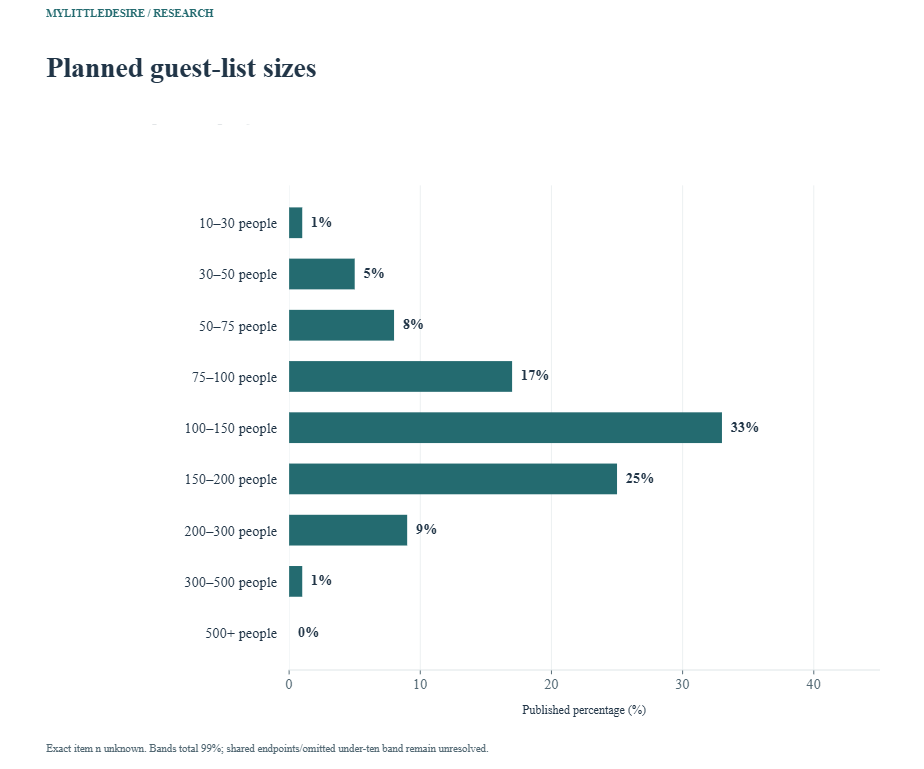
F05 All nine published guest-list categories, reordered by size. Original shared endpoints and missing under-ten band not repaired. Values total 99% as printed. Largest band is rounded 0%, not proof nobody has such a wedding. Do not compute an exact at-most-50 micro share from these bins.
| Measure / response | Published result | Actual period and item base | Source |
|---|---|---|---|
| 10–30 people | 1% | Couples getting married in 2025; exact survey fieldwork dates unavailable Exact item n unavailable | Original source [S02] The Big Day, guest-list size table |
| 30–50 people | 5% | Couples getting married in 2025; exact survey fieldwork dates unavailable Exact item n unavailable | Original source [S02] The Big Day, guest-list size table |
| 50–75 people | 8% | Couples getting married in 2025; exact survey fieldwork dates unavailable Exact item n unavailable | Original source [S02] The Big Day, guest-list size table |
| 75–100 people | 17% | Couples getting married in 2025; exact survey fieldwork dates unavailable Exact item n unavailable | Original source [S02] The Big Day, guest-list size table |
| 100–150 people | 33% | Couples getting married in 2025; exact survey fieldwork dates unavailable Exact item n unavailable | Original source [S02] The Big Day, guest-list size table |
| 150–200 people | 25% | Couples getting married in 2025; exact survey fieldwork dates unavailable Exact item n unavailable | Original source [S02] The Big Day, guest-list size table |
| 200–300 people | 9% | Couples getting married in 2025; exact survey fieldwork dates unavailable Exact item n unavailable | Original source [S02] The Big Day, guest-list size table |
| 300–500 people | 1% | Couples getting married in 2025; exact survey fieldwork dates unavailable Exact item n unavailable | Original source [S02] The Big Day, guest-list size table |
| 500+ people | 0% | Couples getting married in 2025; exact survey fieldwork dates unavailable Exact item n unavailable | Original source [S02] The Big Day, guest-list size table |
Guest-list bands can provide context for small-event planning, but these particular bands cannot be turned into an exact at-most-50 rate. For distinctions between planned lists, accepted invitations and attendance, see our wedding guest count statistics.
How many respondents considered a micro wedding?
F06 Overall source-described couples and currently engaged subgroup. Actual research is September 2024. Item bases and alignment of combined programs unknown. Considering is not booking or completed adoption; audiences differ.
| Measure / response | Published result | Actual period and item base | Source |
|---|---|---|---|
| Couples overall considering a microwedding | 48% | September 2024 planning/dating research in 2025-titled report; exact micro-item dates not separately detailed Exact item n unavailable | Original source [S03] Strong Demand for Microweddings; Methodology |
| Currently engaged considering a microwedding | 57% | September 2024 planning/dating research in 2025-titled report; exact micro-item dates not separately detailed Exact item n unavailable | Original source [S03] Strong Demand for Microweddings; Methodology |
The report was published in October 2024 and draws on September 2024 research, despite the 2025 title. Its combined programs do not supply one verified micro-question denominator. Interest is useful evidence about consideration, but it does not count completed micro weddings. The Knot Worldwide [S03].
What do secret-elopement reports actually measure?
Methods qualification: Maxwell Social is a venue publisher reporting its own survey of 1,006 Americans. It does not publish recruitment, weighting, precise field dates, full instrument or exact subgroup bases on the checked page. Its selected results remain attributed and cannot be treated as established national prevalence. Maxwell Social [S04].
F07 Two different overall measures in the venue-owned survey. Limited methods, exact item eligibility unavailable. Considering and having done it are separate measures, not a longitudinal conversion funnel or national prevalence.
| Measure / response | Published result | Actual period and item base | Source |
|---|---|---|---|
| Considered eloping without telling anyone | 49% | 2026-framed survey summary; exact survey window and retrospective elopement dates unavailable Exact item n unavailable | Original source [S04] Key takeaways, original survey summary |
| Reports having secretly eloped | 9% | 2026-framed survey summary; exact survey window and retrospective elopement dates unavailable Exact item n unavailable | Original source [S04] Key takeaways, original survey summary |
F08 Active planners’ consideration and recent newlyweds’ retrospective report. Different eligible audiences with undisclosed exact n and field dates. Not a before/after comparison; do not infer the same people moved from consideration to completion.
| Measure / response | Published result | Actual period and item base | Source |
|---|---|---|---|
| Active wedding planners: considered secret elopement | 64% | 2026-framed survey summary; exact survey window and retrospective elopement dates unavailable Exact item n unavailable | Original source [S04] The Wedding Most People Want Is Smaller, subgroup paragraph |
| Married within two years: reports secret elopement | 16% | 2026-framed survey summary; exact survey window and retrospective elopement dates unavailable Exact item n unavailable | Original source [S04] The Wedding Most People Want Is Smaller, subgroup paragraph |
The overall and stage-specific questions concern different eligible groups. Dividing self-reported elopements by consideration would create a conversion measure the research did not establish.
Which celebration formats did the venue survey report?
F09 Four published choices for the ideal wedding format. Selected categories total 83%; no residual invented or full distribution claimed. A small ceremony followed by a large party is not necessarily a micro wedding by total attendance. Hypothetical preference, exact base unknown.
| Measure / response | Published result | Actual period and item base | Source |
|---|---|---|---|
| Intimate ceremony followed by a big party | 30% | 2026-framed survey summary; exact survey window and retrospective elopement dates unavailable Exact item n unavailable | Original source [S04] Key takeaways; ideal wedding-format paragraph |
| Traditional ceremony and reception | 27% | 2026-framed survey summary; exact survey window and retrospective elopement dates unavailable Exact item n unavailable | Original source [S04] Key takeaways; ideal wedding-format paragraph |
| Elopement followed by a later party | 15% | 2026-framed survey summary; exact survey window and retrospective elopement dates unavailable Exact item n unavailable | Original source [S04] Key takeaways; ideal wedding-format paragraph |
| Party without a formal ceremony | 11% | 2026-framed survey summary; exact survey window and retrospective elopement dates unavailable Exact item n unavailable | Original source [S04] Key takeaways; ideal wedding-format paragraph |
An intimate ceremony followed by a big party does not automatically keep the full celebration below a micro-wedding guest limit. The selected format options are preferences, and the published list is incomplete.
How do respondents describe cost and guest-list pressure?
F10 Microwedding consideration overall and elopement consideration by gender. Different questions/populations. Cost association is self-reported, not a causal savings estimate; exact item/gender bases unknown.
| Measure / response | Published result | Actual period and item base | Source |
|---|---|---|---|
| Considered a micro wedding because of cost | 43% | 2026-framed survey summary; exact survey window and retrospective elopement dates unavailable Exact item n unavailable | Original source [S04] What Couples Would Buy Instead, cost-consideration paragraph |
| Women: cost led to seriously considering eloping | 39% | 2026-framed survey summary; exact survey window and retrospective elopement dates unavailable Exact item n unavailable | Original source [S04] What Couples Would Buy Instead, cost-consideration paragraph |
| Men: cost led to seriously considering eloping | 29% | 2026-framed survey summary; exact survey window and retrospective elopement dates unavailable Exact item n unavailable | Original source [S04] What Couples Would Buy Instead, cost-consideration paragraph |
F11 Active planners reporting some pressure to host more people than desired. Self-reported pressure with unknown item/subgroup n; no identified causal source or prevalence among all US engaged couples.
| Measure / response | Published result | Actual period and item base | Source |
|---|---|---|---|
| Active planners: pressure to host a larger wedding | 60% | 2026-framed survey summary; exact survey window and retrospective elopement dates unavailable Exact item n unavailable | Original source [S04] Family Pressure, Quiet Plans, pressure paragraph |
Self-reported cost-related consideration does not measure money actually saved by choosing a particular format. Different budgets, guests, travel and inclusions need separate evidence. Our wedding cost and budget statistics provides broader context without assigning these attitudes a savings amount.
How do US adults view eloping without advance notice?
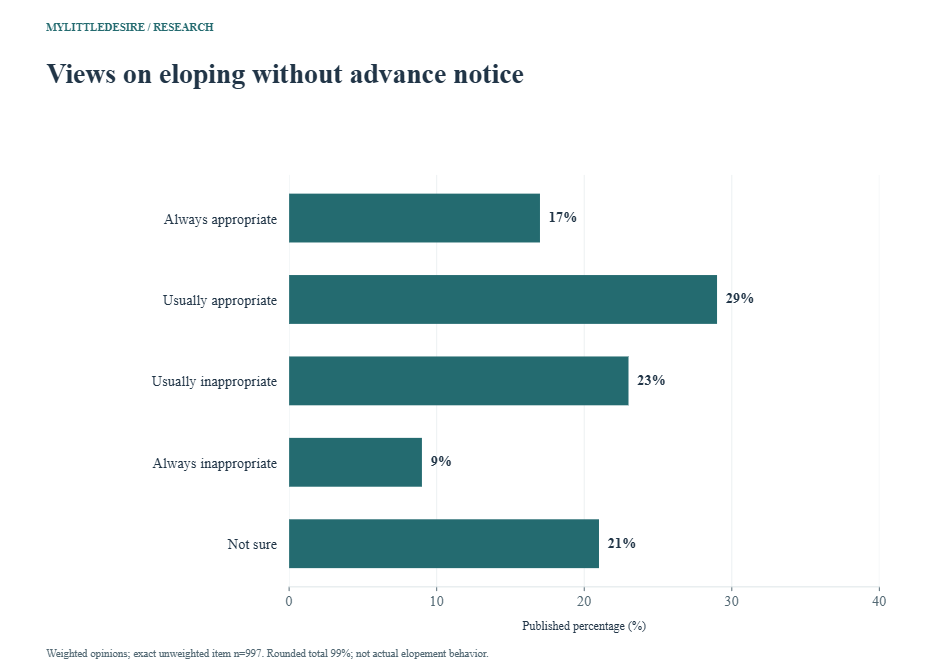
F12 Five responses about whether secret eloping is appropriate. Historical weighted opinions. Exact item unweighted n=997 differs from full n=1,000; original total is 99%. Not behavior, permission from relatives or a rule every couple must follow.
| Measure / response | Published result | Actual period and item base | Source |
|---|---|---|---|
| Always appropriate | 17% | November 6–8, 2023 web interviews Unweighted item n=997 | Original source [S05] PDF printed p.31 / physical p.37, Q14E total |
| Usually appropriate | 29% | November 6–8, 2023 web interviews Unweighted item n=997 | Original source [S05] PDF printed p.31 / physical p.37, Q14E total |
| Usually inappropriate | 23% | November 6–8, 2023 web interviews Unweighted item n=997 | Original source [S05] PDF printed p.31 / physical p.37, Q14E total |
| Always inappropriate | 9% | November 6–8, 2023 web interviews Unweighted item n=997 | Original source [S05] PDF printed p.31 / physical p.37, Q14E total |
| Not sure | 21% | November 6–8, 2023 web interviews Unweighted item n=997 | Original source [S05] PDF printed p.31 / physical p.37, Q14E total |
F13 Four published age-group responses to the same secret-elopement etiquette item. Weighted historical attitudes; exact unweighted age bases retained. Selected response only, not full age-group distributions. No significance or generational behavior change inferred.
| Measure / response | Published result | Actual period and item base | Source |
|---|---|---|---|
| 18–29 | 19% | November 6–8, 2023 web interviews Unweighted item n=119 | Original source [S05] PDF printed p.31 / physical p.37, Q14E age columns |
| 30–44 | 13% | November 6–8, 2023 web interviews Unweighted item n=194 | Original source [S05] PDF printed p.31 / physical p.37, Q14E age columns |
| 45–64 | 21% | November 6–8, 2023 web interviews Unweighted item n=431 | Original source [S05] PDF printed p.31 / physical p.37, Q14E age columns |
| 65+ | 12% | November 6–8, 2023 web interviews Unweighted item n=253 | Original source [S05] PDF printed p.31 / physical p.37, Q14E age columns |
F14 Four published age-group responses to the same secret-elopement etiquette item. Weighted historical attitudes; exact unweighted age bases retained. Selected response only, not full age-group distributions. No significance or generational behavior change inferred.
| Measure / response | Published result | Actual period and item base | Source |
|---|---|---|---|
| 18–29 | 28% | November 6–8, 2023 web interviews Unweighted item n=119 | Original source [S05] PDF printed p.31 / physical p.37, Q14E age columns |
| 30–44 | 33% | November 6–8, 2023 web interviews Unweighted item n=194 | Original source [S05] PDF printed p.31 / physical p.37, Q14E age columns |
| 45–64 | 28% | November 6–8, 2023 web interviews Unweighted item n=431 | Original source [S05] PDF printed p.31 / physical p.37, Q14E age columns |
| 65+ | 28% | November 6–8, 2023 web interviews Unweighted item n=253 | Original source [S05] PDF printed p.31 / physical p.37, Q14E age columns |
YouGov’s original table gives a valid item base of 997, while the full survey has 1,000 respondents. Both numbers are retained in their proper places. The age results concern opinions about advance notice, not whether those respondents have eloped. YouGov [S05].
What changed in the UK report’s reception-size headlines?
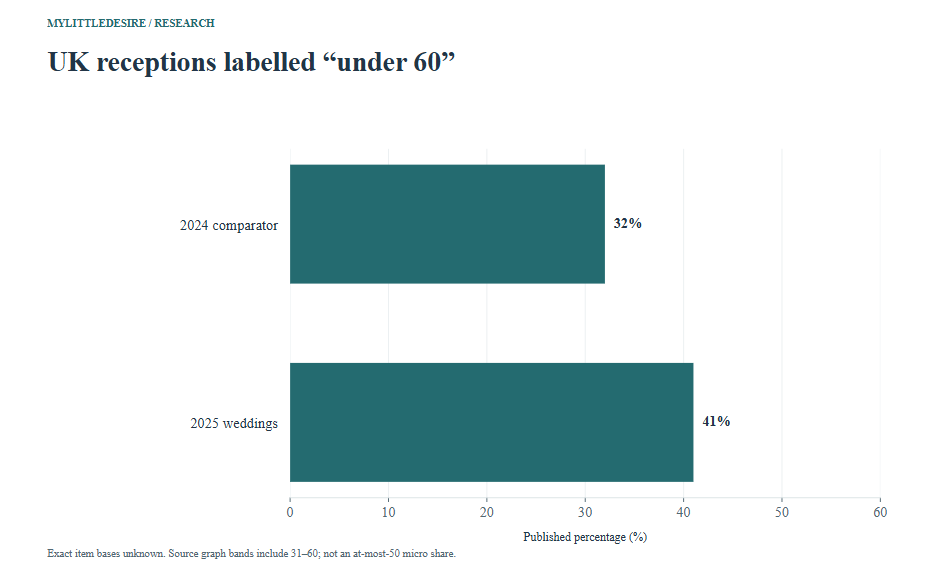
F15 Two explicitly printed headline percentages for reception size. Source says under 60, while chart bins include 31–60; endpoint handling unresolved. Not an at-most-50 micro-wedding share. Unknown exact year/item bases; no estimated bar-height values added.
| Measure / response | Published result | Actual period and item base | Source |
|---|---|---|---|
| 2025 receptions: source-labelled under 60 | 41% | 2025 wedding cohort in 2026 report Exact item n unavailable | Original source [S06] PDF physical/printed p.76, under-60 headline |
| 2024 comparator: source-labelled under 60 | 32% | 2024 wedding-cohort comparator in 2026 report Exact item n unavailable | Original source [S06] PDF physical/printed p.76, under-60 headline |
F16 Two explicitly printed large-evening headline percentages as scale context. Different event stage from reception. Source headline says 120+ while plot bins start 121–150; boundary handling not reconciled. Not a direct micro-wedding measure or exact unknown subgroup n.
| Measure / response | Published result | Actual period and item base | Source |
|---|---|---|---|
| 2025 evenings: source-labelled 120+ | 11% | 2025 wedding cohort in 2026 report Exact item n unavailable | Original source [S06] PDF physical/printed p.76, evening-size headline |
| 2024 comparator: source-labelled 120+ | 41% | 2024 wedding-cohort comparator in 2026 report Exact item n unavailable | Original source [S06] PDF physical/printed p.76, evening-size headline |
Only the explicitly printed headline values are used. Unlabelled bar heights are not estimated as exact observations, and the source’s endpoint ambiguity is disclosed. These reception/evening measures cannot establish an at-most-50 micro-wedding share. Bridebook [S06].
What does the Australian eloping-instead figure mean?
F17 One response within a cost-of-living/engagement-length question. Report edition with unknown exact item dates/n. Does not establish the proportion of all Australian couples eloping or a causal effect of cost pressures.
| Measure / response | Published result | Actual period and item base | Source |
|---|---|---|---|
| Engagement length unchanged, but eloping instead | 2% | 2025 report edition; planning/recent-wedding research, exact question dates unavailable Exact item n unavailable | Original source [S07] PDF physical/printed p.8, engagement-length response |
This answer sits within a question about engagement length and cost of living. Its wording is narrower than asking every Australian couple whether they will elope. The broader elopement rate remains unestablished by this item.
What did the historical engaged-couple survey find?
F18 Overall and female-group openness to considering an elopement-style wedding. 2022 issuer survey, lower-bound full sample and unknown exact female/item n. Different eligible audiences, not actual completed elopements or a measured 2027 rate.
| Measure / response | Published result | Actual period and item base | Source |
|---|---|---|---|
| Engaged respondents overall: open to considering | 62% | Survey reported July 2022; exact interview dates not supplied Exact item n unavailable | Original source [S08] Issuer release opening survey findings |
| Female subgroup: open to considering | 69% | Survey reported July 2022; exact interview dates not supplied Exact item n unavailable | Original source [S08] Issuer release opening survey findings |
The jeweler’s 2022 issuer release provides historical evidence of openness to a scaled-back elopement-style event. The title’s reference to this year means 2022. It is not a measured 2027 outcome or a price comparison for otherwise identical weddings. Helzberg Diamonds [S08].
How can couples and wedding businesses use these findings?
These are editorial applications, not tested interventions. Couples and businesses can use the distinctions to ask clearer questions about privacy, attendance and priorities before treating a survey percentage as a forecast.
| Decision | Evidence distinction | Practical question |
|---|---|---|
| Guest list | Preferred size differs from accepted invitations | Which event and people does the actual count include? |
| Privacy | Private ceremony differs from secret elopement | Who does the couple want to inform, and when? |
| Celebration format | Small ceremony can precede a large party | What is the size of each part of the celebration? |
| Budget | Cost consideration differs from measured savings | What do actual quotes include for this specific plan? |
| Source citation | Full sample differs from valid item n | Which population and denominator belong beside this figure? |
Ten reproducible descriptive comparisons
Each difference is first value minus second and is expressed in percentage points. These ten results reuse published observations and are not extra studies. Workbook formulas require matching unit and measure type, preserve valid zero inputs and return blanks for missing, duplicate, nonnumeric or mismatched inputs. No comparison is a causal effect or booking conversion.
| Comparison | Inputs | Difference | Interpretation |
|---|---|---|---|
| UK small minus large wedding preference | 62% − 22% | 40 percentage points | Same eligible desired-size question; unweighted n=1,200, weighted percentages. |
| UK small minus private-registry preference | 62% − 12% | 50 percentage points | Preferences, not actual small/private event shares. |
| UK small preference: 55+ minus 18–24 | 65% − 51% | 14 percentage points | Cross-sectional age-group contrast; no life-course trend or causal age effect. |
| UK private preference: 45–54 minus 18–24 | 15% − 10% | 5 percentage points | Different age-group bases; preferences without a numeric guest cap. |
| Zola 100–150 minus 30–50 guest-list band | 33% − 5% | 28 percentage points | Original planned bands; not an exact at-most-50 micro adoption share. |
| Intimate ceremony/party minus traditional format | 30% − 27% | 3 percentage points | Selected hypothetical format options in a limited-methods venue survey. |
| Women minus men: cost-related elopement consideration | 39% − 29% | 10 percentage points | Unknown gender/item bases; self-reported consideration, not causal effect. |
| US usually appropriate minus usually inappropriate | 29% − 23% | 6 percentage points | Historical Q14E weighted opinions; exact unweighted item n=997. |
| UK source-labelled under-60 reception: 2025 minus 2024 | 41% − 32% | 9 percentage points | Source headline boundaries retained; exact cohort bases unknown. |
| UK source-labelled 120-plus evening: 2025 minus 2024 | 11% − 41% | -30 percentage points | Different annual cohorts and source boundary caveat; not a micro threshold. |
Common questions
What percentage of weddings are micro weddings?
The selected evidence does not establish one general rate. Some questions measure interest, some ask for relative size preferences, and some report event-stage headcounts. A valid prevalence claim needs a matching numeric threshold, population and completed-event question.
Does eloping mean marrying without guests or telling anyone?
The sources use different wording. Some explicitly ask about secrecy; the Knot report’s contextual definition allows a small guest group. The UK private-registry option describes witnesses but does not ask whether the event is secret. Keep the source meaning attached.
Do small weddings or elopements guarantee savings or no regrets?
The selected percentages do not establish either guarantee. Cost-related consideration is not a causal spending result. A small commercial no-regret story was screened out because its detailed percentage tables do not reconcile with its stated sample size and it does not establish a population outcome.
Research method and limitations
There are 59 percentage observations in 18 groups, drawn from eight numerical records and seven publisher labels. YouGov supplies 27 across two distinct country/year surveys; Zola supplies 11; Maxwell Social 12; Bridebook four; The Knot two; Helzberg two; Easy Weddings one. Response categories and age groups share surveys and are not independent studies. Charts and calculations reuse the observations.
Original publisher tables, issuer releases and report pages were checked. YouGov UK page 15, YouGov US printed page 31/physical page 37, Bridebook page 76 and Easy Weddings page 8 were visually inspected in the original PDFs. The UK size question’s unweighted/weighted bases and US valid item counts were transcribed rather than substituted with full-survey totals.
Exact unweighted item bases are available for 27 observations. Fourteen of those also have a published weighted base in the UK tables. The other 32 exact item bases remain blank. Weighted percentages do not reveal exact raw respondent counts. Commercial summaries with incomplete methods retain those limitations; full samples are not silently assigned to every subgroup.
Excluded claims: Measured 2027 outcomes; a pooled global rate; exact micro adoption reconstructed from overlapping guest bins or an under-60 reception headline; conversion from consideration to secret elopement; unlabeled graph values; universal savings or regret claims; and qualitative theme ranks recast as percentages. A Canadian original micro/elopement benchmark was not verified.
No private survey records, new original survey, respondent-level reanalysis, meta-analysis, causal experiment or new significance tests were performed. No paid search metrics, site performance, outreach placements or backlinks were measured.
Original sources and supporting records
- S01. YouGov. Big Survey on Weddings 2026, GuestNos question tables. Publication: Survey articles published 2026-08-27; original tables copyright 2026. Actual period: August 7–9, 2026 UK adult survey. GuestNos unweighted base 1,200 / weighted base 1,206. Age unweighted/weighted: 18–24 147/159; 25–34 175/192; 35–44 194/220; 45–54 149/154; 55+ 535/481. These published item bases are recorded per observation. Method: Original question table physical/printed p.15 visually checked, with bases and weighted percentages. Full-sample overview and original companion article confirm field dates and full n. Single-choice desired size, with no numeric guest cap in small/private options. Hypothetical wedding-size preference in a marriage-eligible subset, not observed micro-wedding adoption or all-adult prevalence. Smaller means closest friends/family; private means couple and witnesses at registry office. Weighted percentages cannot be multiplied by raw n to recover exact respondent counts. No significance test performed here. Supporting records: record 1, record 2.
- S02. Zola. 2025 Wedding Trends: Zola’s First Look Report Data Deep Dive. Publication: Updated 2025-06-11. Actual period: Couples getting married in 2025; exact survey fieldwork dates unavailable. Exact eloping and guest-list question n unavailable. Full report-wide lower bound is not assigned to either item. Method: Original yes/no eloping question and all nine published guest-list bands checked. Source labels retained, including shared endpoints and a published rounded 0% in the largest band. Plans rather than completed elopements/attendance. Guest bands total 99%, and no under-ten category is published in selected list. Shared endpoints at 30/50/etc. remain unresolved. Do not sum bands into an exact micro-wedding adoption rate or invent missing categories. Supporting records: record 1.
- S03. The Knot Worldwide. 2025 Wedding Trends to Watch Report, microwedding consideration. Publication: 2024-10-14. Actual period: September 2024 planning/dating research in 2025-titled report; exact micro-item dates not separately detailed. Exact denominator for overall 48% and engaged 57% not identified in selected summary. Do not merge the studies or assign another program’s n. Method: Original Strong Demand for Microweddings section and methods checked. Planning respondents recruited via email/onsite membership invitations September 18–30, 2024; dating sample separately recruited. Source contextual definition allows up to 50 micro-wedding guests and up to 15 elopement guests. Considering is not booking/completion or national market share. Report-title year differs from fieldwork. Overall and engaged percentages have different eligible audiences. Threshold descriptions are source conventions, not additional observed statistics or universal definitions.
- S04. Maxwell Social. The Rise of the Wedding Elopement Era. Publication: Page frames findings as 2026; exact publication and fieldwork dates not displayed. Actual period: 2026-framed survey summary; exact survey window and retrospective elopement dates unavailable. Full n=1,006. Exact valid overall, active-planning, prior-two-year-married, format and gender bases unavailable. Method: Original venue publisher summary and short methodology read. Selected secret-elopement consideration/self-report, ideal formats, cost-related consideration and pressure results retained with their own eligibility. Commercial venue study with limited methods, no full questionnaire or weighting/recruitment detail. Not established as nationally representative. Self-report, hypothetical formats and pressure are distinct; no conversion funnel or causal cost effect. No inferred average savings, format residual or population estimate.
- S05. YouGov. Wedding Etiquette Survey 2023, question 14E. Publication: November 2023 survey tables; exact release day not shown in PDF. Actual period: November 6–8, 2023 web interviews. Q14E unweighted total n=997. Age bases: 18–29 n=119; 30–44 n=194; 45–64 n=431; 65+ n=253. Exact weighted item bases not printed. Method: Original Q14E table printed p.31 / physical p.37 visually inspected. Opt-in Internet panel with sample matching; weighted by demographics and political variables per final methods page. Item asks about eloping without informing close family/friends beforehand. Historical attitudes, not elopement behavior or a rule couples must follow. Full n=1,000 differs from item n=997. Percentages weighted; overall categories total 99%, some subgroup totals also differ from 100 due rounding. No raw respondent-count reconstruction or new subgroup significance testing.
- S06. Bridebook. UK Wedding Report 2026, wedding size by stage of day. Publication: 2026 report edition; exact release day not supplied. Actual period: 2025 weddings with source-published 2024 comparators; exact item fieldwork windows unavailable. Exact year/stage item bases not supplied. 2024 comparator base not identified; report-wide total is not every subgroup n. Method: Original publicly linked PDF physical/printed p.76 rendered and visually checked. Four explicitly printed headline percentages selected; unlabeled graph bar heights not estimated as exact data. Receptions and evenings are different event stages. Source says under 60 and 120+ while graph bands include 31–60 and 121–150; endpoint handling not reconciled. Preserve headline wording rather than relabel as at-most-50 micro weddings. Different cohorts, no causal trend or universal micro threshold. Supporting records: record 1, record 2.
- S07. Easy Weddings. 2025 Australian Wedding Industry Report, engagement-length question. Publication: 2025 report edition; exact release day not supplied. Actual period: 2025 report edition; planning/recent-wedding research, exact question dates unavailable. Exact engagement-length question valid n not published; report-wide lower bound is not exact item n. Method: Original PDF physical/printed p.8 visually inspected. One specific response says the engagement length was not changed but the couple is eloping instead. A response within a cost-of-living/engagement question, not a general Australian elopement rate. Planning/past mix, exact dates and routing unavailable. No causal effect of inflation or completed-elopement total inferred.
- S08. Helzberg Diamonds. National survey finds most engaged couples are interested in eloping this year. Publication: 2022-07-11 issuer press release. Actual period: Survey reported July 2022; exact interview dates not supplied. Issuer provides lower-bound full sample only. Exact valid overall/female bases and full instrument unavailable. Method: Original issuer-authored PR Newswire release checked for two scaled-back-elopement consideration percentages. Historical 2022 openness to considering a scaled-back elopement-style event, not actual 2027 elopement adoption. Overall/female eligibility differs. Commercial jeweler research with limited public methods; speculative expense eliminations and contest figures excluded.
Supporting and screened records without additional observations
- R01. YouGov. Big Survey on Weddings 2026 overview and planning chapter. Question/population interpretation for original tables. Describes desired small and private weddings among people who have married or are open to marrying. No additional counted observations; table supplies exact bases. Private ceremony not automatically reclassified as secret elopement.
- R02. Adventure and Vow. Will I Regret Eloping?. Small commercial survey screened. Page describes a 25-couple survey and provides detailed percentage tables plus a no-regret summary. Several percentages do not correspond to whole people at n=25 and no weights/alternate bases are disclosed. Numerical tables and universal no-regret interpretation excluded.
- R03. Adventure Instead. Reasons to Elope, inquiry-response study. Qualitative motivations research screened. Methods describe 3,149 inquiry-form responses, May 25, 2020–October 23, 2023, with professionally coded themes. Considering eloping is not completed elopement. Theme ranks without published percentages not turned into numerical prevalence or counted as additional observations.
How to cite this resource
MyLittleDesire. Micro Wedding And Elopement Statistics 2027. https://mylittledesire.com/micro-wedding-elopement-statistics/.