Digital privacy in relationships involves choices about passwords, devices, accounts and location. Sharing, secret access, pressure and public attitudes require different definitions. This resource keeps the population, period and reporting base beside each finding.
What are the key digital privacy statistics?
- 84% of the September 2026 relationship-experienced sample had shared a streaming login. Check population, date and source.
- 74% had shared a phone passcode. Check population, date and source.
- 36% reported secret access to a partner’s account or messages. Check population, date and source.
- 13% reported sharing a requested password unwillingly. Check population, date and source.
- 64% of currently partnered respondents strongly/completely trusted their partner with passwords. Check population, date and source.
- 85% of the April 2024 married/committed sample shared at least one personal account. Check population, date and source.
- 43% reported some pressure to share digital access. Check population, date and source.
- 30% reported regret about location tracking. Check population, date and source.
- 29% reported at least one listed misuse behavior by an ex. Check population, date and source.
- 34% of partnered U.S. adults in Pew’s 2019 survey reported looking through a current partner’s phone without their knowledge. Check population, date and source.
- 63% of U.S. adult citizens in July 2023 accepted wanting social-media privacy. Check population, date and source.
What do these statistics measure?
| Measure | Interpretation |
|---|---|
| Sharing | Reported password or account access; not necessarily permission for every future use. |
| Secret access | Access without knowledge or permission, using the exact source wording. |
| Pressure | Reported requests, discomfort, insistence or threats; overlapping items. |
| Concern | A worry about possible conduct, not proof that it occurred. |
| Attitude | A public preference or judgement, not observed behavior. |
| Reporting base | All adults, relationship-experienced adults and current partners are distinct populations. |
How much digital access do partners share?
Ever sharing a password, allowing access to a personal account and maintaining a joint account are different measures. The All About Cookies sample includes anyone with romantic-relationship experience; Malwarebytes asks current married/committed partners. Pew’s historical reporting denominator includes partnered technology nonusers.
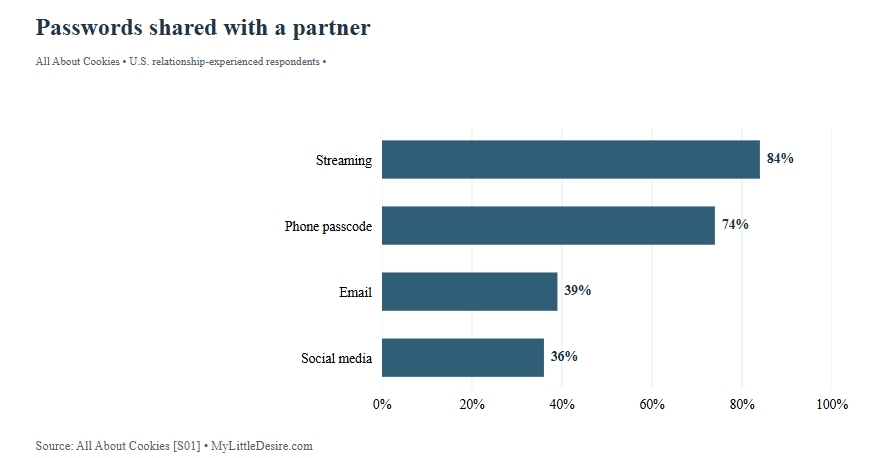
Which passwords have people shared with a partner?
September 2026. Lifetime relationship-experienced sample, not only current couples. Exact item counts unreported; account types overlap. Sharing does not imply unrestricted future permission.
| Finding / scope | Percent | Population and base | Original source |
|---|---|---|---|
| F01 Streaming Relationship privacy | 84% | U.S. respondents with lifetime romantic-relationship experience Exact selected n unavailable | S01 Account-type section and original chart |
| F02 Phone passcode Relationship privacy | 74% | U.S. respondents with lifetime romantic-relationship experience Exact selected n unavailable | S01 Account-type section and original chart |
| F03 Food delivery/shopping Relationship privacy | 59% | U.S. respondents with lifetime romantic-relationship experience Exact selected n unavailable | S01 Account-type section and original chart |
| F04 Banking/financial services Relationship privacy | 48% | U.S. respondents with lifetime romantic-relationship experience Exact selected n unavailable | S01 Account-type section and original chart |
| F05 Email Relationship privacy | 39% | U.S. respondents with lifetime romantic-relationship experience Exact selected n unavailable | S01 Account-type section and original chart |
| F06 Social media Relationship privacy | 36% | U.S. respondents with lifetime romantic-relationship experience Exact selected n unavailable | S01 Account-type section and original chart |
| F07 Cloud photo storage Relationship privacy | 33% | U.S. respondents with lifetime romantic-relationship experience Exact selected n unavailable | S01 Account-type section and original chart |
How do committed partners describe digital sharing?
April 4–9, 2024. These are different questions, not mutually exclusive answers. Both privacy and sharing may be seen as signs of trust. No controlled relationship benefit measured.
| Finding / scope | Percent | Population and base | Original source |
|---|---|---|---|
| F25 Shares at least one personal account Relationship privacy | 85% | U.S. married/committed survey respondents; exact selected item base unavailable Exact selected n unavailable | S02 PDF pp.5–6 |
| F26 Keeping logins private shows trust Relationship privacy | 65% | U.S. married/committed survey respondents; exact selected item base unavailable Exact selected n unavailable | S02 PDF pp.5–6 |
| F27 Sharing logins key to building trust Relationship privacy | 63% | U.S. married/committed survey respondents; exact selected item base unavailable Exact selected n unavailable | S02 PDF pp.5–6 |
| F28 Location sharing makes me feel safer Relationship privacy | 79% | U.S. married/committed survey respondents; exact selected item base unavailable Exact selected n unavailable | S02 PDF pp.5–6 |
| F29 Sharing accounts/logins makes relationship easier Relationship privacy | 71% | U.S. married/committed survey respondents; exact selected item base unavailable Exact selected n unavailable | S02 PDF pp.5–6 |
Which personal communication accounts are shared?
April 4–9, 2024. Account-type ownership/eligibility and exact bases unreported. Personal accounts are different from joint household accounts.
| Finding / scope | Percent | Population and base | Original source |
|---|---|---|---|
| F30 Social media Relationship privacy | 49% | U.S. married/committed survey respondents; exact selected item base unavailable Exact selected n unavailable | S02 PDF p.7 |
| F31 Online forums/community Relationship privacy | 49% | U.S. married/committed survey respondents; exact selected item base unavailable Exact selected n unavailable | S02 PDF p.7 |
| F32 Messaging apps Relationship privacy | 49% | U.S. married/committed survey respondents; exact selected item base unavailable Exact selected n unavailable | S02 PDF p.7 |
| F33 Email Relationship privacy | 48% | U.S. married/committed survey respondents; exact selected item base unavailable Exact selected n unavailable | S02 PDF p.7 |
What did Pew find about sharing passwords?
October 16–28, 2019. Asked among relevant technology users, displayed among ALL partnered adults, including nonusers. Reporting n=2,932 differs from routed question bases.
| Finding / scope | Percent | Population and base | Original source |
|---|---|---|---|
| F50 Cellphone Relationship privacy | 75% | All partnered U.S. adults Published base n=2,932; Published all-partnered reporting base | S03 PDF p.14 / printed p.13; footnote 3; sample table PDF p.28 |
| F51 Email Relationship privacy | 62% | All partnered U.S. adults Published base n=2,932; Published all-partnered reporting base | S03 PDF p.14 / printed p.13; footnote 3; sample table PDF p.28 |
| F52 Social media Relationship privacy | 42% | All partnered U.S. adults Published base n=2,932; Published all-partnered reporting base | S03 PDF p.14 / printed p.13; footnote 3; sample table PDF p.28 |
What do people think couples should keep private?
Views about all passwords, secret phone access and social-media privacy are different questions. Public-opinion findings include people outside current relationships. They do not establish that a particular arrangement is right for every couple or that sharing improves a relationship.
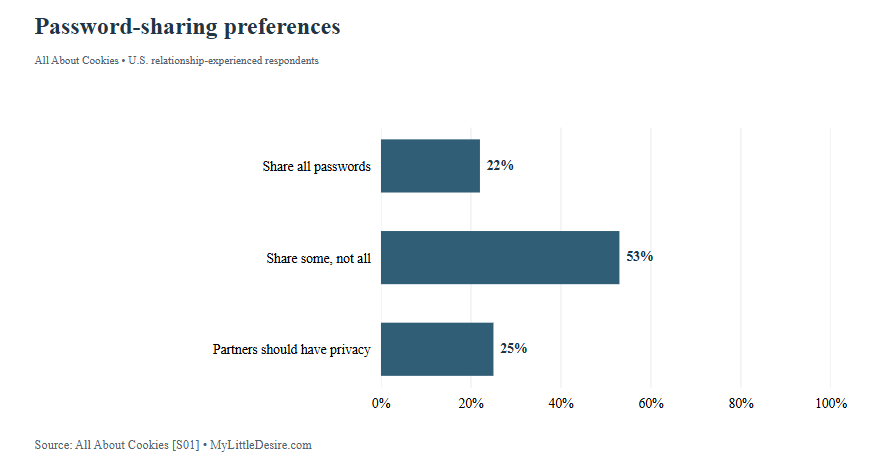
How much password sharing do respondents think couples should do?
September 2026. Attitudes among relationship-experienced respondents. Three options are not observed behavior.
| Finding / scope | Percent | Population and base | Original source |
|---|---|---|---|
| F08 Share every password Relationship privacy | 22% | U.S. respondents with lifetime romantic-relationship experience Exact selected n unavailable | S01 Should couples share all their passwords section |
| F09 Share some, keep others private Relationship privacy | 53% | U.S. respondents with lifetime romantic-relationship experience Exact selected n unavailable | S01 Should couples share all their passwords section |
| F10 Partners should have privacy Relationship privacy | 25% | U.S. respondents with lifetime romantic-relationship experience Exact selected n unavailable | S01 Should couples share all their passwords section |
Do U.S. adults think secret phone access is acceptable?
October 16–28, 2019. All U.S. adults, including people outside relationships. Public attitudes, not personal admissions or legal advice. Rounded categories total 99%; no-answer omitted.
| Finding / scope | Percent | Population and base | Original source |
|---|---|---|---|
| F60 Always acceptable Public attitudes | 8% | All U.S. adults Published base n=4,860; Published asked-all adult base | S03 TRACKPARTNER, PDF p.29 / printed p.28 |
| F61 Sometimes acceptable Public attitudes | 21% | All U.S. adults Published base n=4,860; Published asked-all adult base | S03 TRACKPARTNER, PDF p.29 / printed p.28 |
| F62 Rarely acceptable Public attitudes | 28% | All U.S. adults Published base n=4,860; Published asked-all adult base | S03 TRACKPARTNER, PDF p.29 / printed p.28 |
| F63 Never acceptable Public attitudes | 42% | All U.S. adults Published base n=4,860; Published asked-all adult base | S03 TRACKPARTNER, PDF p.29 / printed p.28 |
Is wanting social-media privacy viewed as an acceptable boundary?
July 11–18, 2023; two surveys July 11–13 and July 12–18. Public attitudes among adult citizens, not only current couples. Does not ask whether all passwords should remain private.
| Finding / scope | Percent | Population and base | Original source |
|---|---|---|---|
| F66 Acceptable Public attitudes | 63% | U.S. adult citizens Published base n=1,993; Published Q8F unweighted item base | S05 Q8F, PDF p.17 / printed p.13 |
| F67 Unacceptable Public attitudes | 17% | U.S. adult citizens Published base n=1,993; Published Q8F unweighted item base | S05 Q8F, PDF p.17 / printed p.13 |
| F68 Not sure Public attitudes | 20% | U.S. adult citizens Published base n=1,993; Published Q8F unweighted item base | S05 Q8F, PDF p.17 / printed p.13 |
How common is secret account or phone access?
Secret access without someone’s knowledge differs from agreed access, and knowledge differs from permission. Ever doing something is also different from weekly behavior. Upsetting discoveries do not automatically establish infidelity, and these surveys cannot verify every reported incident.
What secret access or unwanted requests do respondents report?
September 2026. Different nonexclusive experiences; exact question filters/counts unavailable. Upsetting content does not necessarily mean infidelity. Refusal is distinct from reluctant sharing.
| Finding / scope | Percent | Population and base | Original source |
|---|---|---|---|
| F13 Secretly checked partner’s account/messages Relationship privacy | 36% | U.S. respondents with lifetime romantic-relationship experience Exact selected n unavailable | S01 Snooping/refusals section and original chart |
| F14 Found upsetting/concerning content via partner/ex login Relationship privacy | 36% | U.S. respondents with lifetime romantic-relationship experience Exact selected n unavailable | S01 Snooping/refusals section and original chart |
| F15 Refused a requested password Relationship privacy | 22% | U.S. respondents with lifetime romantic-relationship experience Exact selected n unavailable | S01 Snooping/refusals section and original chart |
| F16 Shared a requested password unwillingly Relationship privacy | 13% | U.S. respondents with lifetime romantic-relationship experience Exact selected n unavailable | S01 Snooping/refusals section and original chart |
How often do current partners check accounts?
September 2026. Publisher’s current-partner section; exact item eligibility/count unavailable. Weekly checking differs from ever secret access; permission and knowledge are different concepts.
| Finding / scope | Percent | Population and base | Original source |
|---|---|---|---|
| F22 Checks weekly Relationship privacy | 15% | Current-partner survey section; exact eligible item group not specified Exact selected n unavailable | S01 Trust/weekly-checking paragraph |
| F23 Checks weekly with permission Relationship privacy | 10% | Current-partner survey section; exact eligible item group not specified Exact selected n unavailable | S01 Trust/weekly-checking paragraph |
| F24 Checks weekly without permission Relationship privacy | 5% | Current-partner survey section; exact eligible item group not specified Exact selected n unavailable | S01 Trust/weekly-checking paragraph |
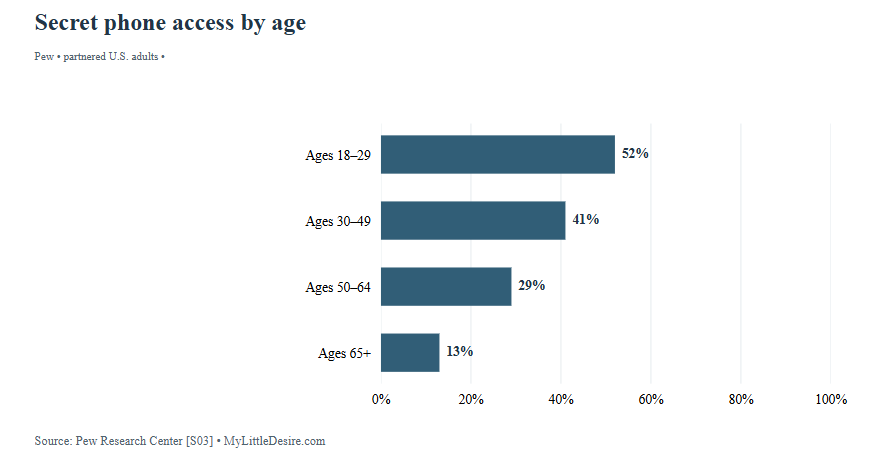
How many partnered adults report secret phone access?
October 16–28, 2019. Asked among those whose partner has a cellphone but displayed among all partnered adults. Knowledge is not the same as permission. Historical 2019 findings; no current trend inferred.
| Finding / scope | Percent | Population and base | Original source |
|---|---|---|---|
| F53 All partnered adults Relationship privacy | 34% | All partnered U.S. adults Published base n=2,932; Published all-partnered reporting base | S03 PDF p.12 / printed p.11; methods and chart footnote |
| F54 Men Relationship privacy | 25% | Partnered U.S. men Exact selected n unavailable | S03 PDF p.12 / printed p.11; methods and chart footnote |
| F55 Women Relationship privacy | 42% | Partnered U.S. women Exact selected n unavailable | S03 PDF p.12 / printed p.11; methods and chart footnote |
| F56 Ages 18–29 Relationship privacy | 52% | Partnered U.S. adults ages 18–29 Exact selected n unavailable | S03 PDF p.12 / printed p.11; methods and chart footnote |
| F57 Ages 30–49 Relationship privacy | 41% | Partnered U.S. adults ages 30–49 Exact selected n unavailable | S03 PDF p.12 / printed p.11; methods and chart footnote |
| F58 Ages 50–64 Relationship privacy | 29% | Partnered U.S. adults ages 50–64 Exact selected n unavailable | S03 PDF p.12 / printed p.11; methods and chart footnote |
| F59 Ages 65+ Relationship privacy | 13% | Partnered U.S. adults ages 65+ Exact selected n unavailable | S03 PDF p.12 / printed p.11; methods and chart footnote |
How do current partners describe trust?
The September 2026 trust question is limited to current relationships, with an undisclosed subgroup count. Its rounded categories total 101%. Trust and occasional account checking can coexist; the published marginals do not identify which respondents overlap.
How much do current couples trust partners with passwords?
September 2026. Only current relationships. Categories round to 101%; do not force 100% or assume full n=1,000.
| Finding / scope | Percent | Population and base | Original source |
|---|---|---|---|
| F17 Strongly/completely trust Relationship privacy | 64% | Currently partnered respondents in selected trust item Exact selected n unavailable | S01 Trust section and original chart |
| F18 Somewhat trust Relationship privacy | 21% | Currently partnered respondents in selected trust item Exact selected n unavailable | S01 Trust section and original chart |
| F19 Neutral Relationship privacy | 7% | Currently partnered respondents in selected trust item Exact selected n unavailable | S01 Trust section and original chart |
| F20 Somewhat distrust Relationship privacy | 4% | Currently partnered respondents in selected trust item Exact selected n unavailable | S01 Trust section and original chart |
| F21 Strongly distrust Relationship privacy | 5% | Currently partnered respondents in selected trust item Exact selected n unavailable | S01 Trust section and original chart |
What pressure and regret do partners report?
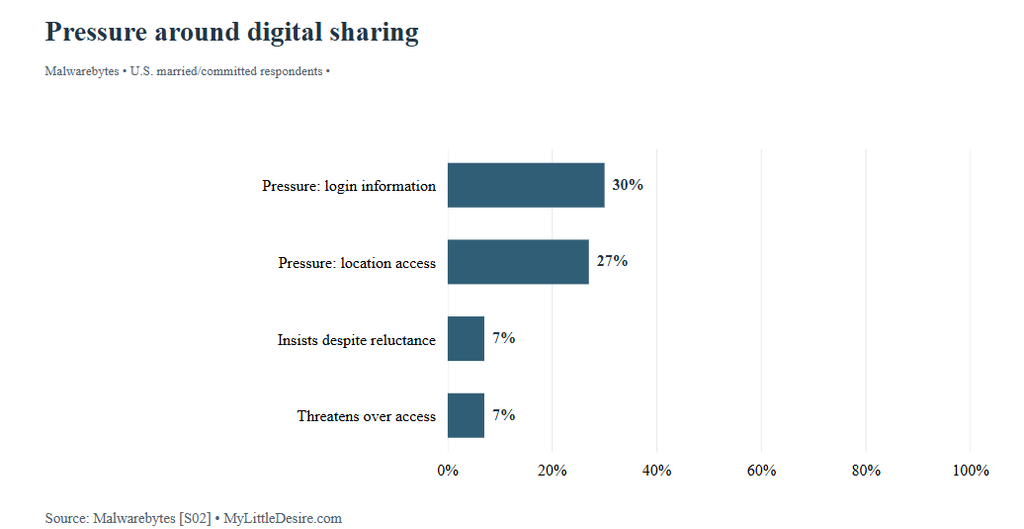
Malwarebytes asks about several forms of pressure, discomfort, insistence and threats. These responses can overlap and must not be added into an abuse rate. Regret about location sharing differs from regret about account access. Sharing itself does not prove coercion.
What pressure to share digital access is reported?
April 4–9, 2024. Related items overlap; cannot be added. Composite overall pressure differs from individual statements. These are reported experiences, not a verified legal abuse prevalence.
| Finding / scope | Percent | Population and base | Original source |
|---|---|---|---|
| F34 Any reported sharing pressure Relationship privacy | 43% | U.S. married/committed survey respondents; exact selected item base unavailable Exact selected n unavailable | S02 PDF pp.3 and 9; threat examples include breakup, harm or being shut out |
| F35 Pressure to share login information Relationship privacy | 30% | U.S. married/committed survey respondents; exact selected item base unavailable Exact selected n unavailable | S02 PDF pp.3 and 9; threat examples include breakup, harm or being shut out |
| F36 Pressure to grant location access Relationship privacy | 27% | U.S. married/committed survey respondents; exact selected item base unavailable Exact selected n unavailable | S02 PDF pp.3 and 9; threat examples include breakup, harm or being shut out |
| F37 Uncomfortable ending personal-account sharing Relationship privacy | 14% | U.S. married/committed survey respondents; exact selected item base unavailable Exact selected n unavailable | S02 PDF pp.3 and 9; threat examples include breakup, harm or being shut out |
| F38 Partner insists despite reluctance Relationship privacy | 7% | U.S. married/committed survey respondents; exact selected item base unavailable Exact selected n unavailable | S02 PDF pp.3 and 9; threat examples include breakup, harm or being shut out |
| F39 Partner threatened over account sharing Relationship privacy | 7% | U.S. married/committed survey respondents; exact selected item base unavailable Exact selected n unavailable | S02 PDF pp.3 and 9; threat examples include breakup, harm or being shut out |
Do people regret digital sharing?
April 4–9, 2024. Location regret and account regret are different questions. Gender subgroup n not published; do not infer valid-item counts from equal sample split.
| Finding / scope | Percent | Population and base | Original source |
|---|---|---|---|
| F40 Regrets location tracking Relationship privacy | 30% | U.S. married/committed survey respondents; exact selected item base unavailable Exact selected n unavailable | S02 PDF p.10 |
| F41 Regrets account access Relationship privacy | 18% | U.S. married/committed survey respondents; exact selected item base unavailable Exact selected n unavailable | S02 PDF p.10 |
| F42 Men: regrets account access Relationship privacy | 30% | Male U.S. married/committed respondents; exact item n unavailable Exact selected n unavailable | S02 PDF p.10 |
| F43 Women: regrets account access Relationship privacy | 13% | Female U.S. married/committed respondents; exact item n unavailable Exact selected n unavailable | S02 PDF p.10 |
What concerns and need for guidance are reported?
A worry about possible tracking or access is different from an observed event. The original Malwarebytes PDF reports 30% worrying that refusing sharing would upset a partner; its companion blog reports 40%. This compilation uses the PDF value and records the inconsistency. Guidance preferences are separate from actual ability to revoke access.
What concerns do current partners express?
April 4–9, 2024. Concerns are not proof of events. The PDF gives 30% for upsetting partner; a companion blog gives 40%. This resource retains the original PDF 30% and discloses discrepancy.
| Finding / scope | Percent | Population and base | Original source |
|---|---|---|---|
| F45 Refusing sharing would upset partner Relationship privacy | 30% | U.S. married/committed survey respondents; exact selected item base unavailable Exact selected n unavailable | S02 PDF p.14; companion-blog discrepancy recorded |
| F46 Partner may have accessed accounts without permission Relationship privacy | 23% | U.S. married/committed survey respondents; exact selected item base unavailable Exact selected n unavailable | S02 PDF p.14; companion-blog discrepancy recorded |
| F47 Ease with which partner could track me Relationship privacy | 31% | U.S. married/committed survey respondents; exact selected item base unavailable Exact selected n unavailable | S02 PDF p.14; companion-blog discrepancy recorded |
Do partners want help managing shared access?
April 4–9, 2024. Different questions, not a single mutually exclusive distribution; wanting guidance does not prove inability to stop sharing.
| Finding / scope | Percent | Population and base | Original source |
|---|---|---|---|
| F48 Would like more guidance Relationship privacy | 56% | U.S. married/committed survey respondents; exact selected item base unavailable Exact selected n unavailable | S02 PDF p.17 |
| F49 Would struggle to know where to begin stopping location sharing Relationship privacy | 45% | U.S. married/committed survey respondents; exact selected item base unavailable Exact selected n unavailable | S02 PDF p.17 |
What happens to digital access after relationships end?
Knowing a still-used password does not prove an ex is using it. Malwarebytes’ composite reports several kinds of ex-partner account misuse, not only stalkerware or stalking. A person may report more than one behavior; the overall percentage is not the sum of separate categories.
Can ex-partners still know current passwords?
September 2026. Only respondents with an ex; not all adults. A suspected known password does not prove continuing account access.
| Finding / scope | Percent | Population and base | Original source |
|---|---|---|---|
| F11 Definitely knows one Relationship privacy | 6% | Survey respondents who have an ex-partner Exact selected n unavailable | S01 Ex-partner paragraph |
| F12 Possibly, not sure Relationship privacy | 12% | Survey respondents who have an ex-partner Exact selected n unavailable | S01 Ex-partner paragraph |
What misuse by ex-partners do respondents report?
April 4–9, 2024. Composite includes tracking, social-account login, impersonation, messages, smart-device spying or financial access. Not every listed behavior has a separate percentage and this is not exclusively stalkerware.
| Finding / scope | Percent | Population and base | Original source |
|---|---|---|---|
| F44 Any listed ex-partner account misuse Relationship privacy | 29% | U.S. married/committed survey respondents; exact selected item base unavailable Exact selected n unavailable | S02 PDF p.12 |
What does the UK regulator’s survey add?
The ICO’s selected question asks all online-population respondents who they share information with. The spouse/partner percentages therefore use a wider denominator than couples-only surveys. The report’s sharing-with-anyone figures are different and are not substituted here.
Also Read:-
Dating Profile Honesty Statistics 2027
Couples And Social Media Statistics 2027
Video Calling Family Connection Statistics 2027
AI Relationship Advice Statistics 2027
AI Romantic Partners Statistics 2027
What does the UK regulator’s study say about sharing with a partner?
2025 report; exact field dates not verified in accessible original extract. All online-population respondents, not only partnered adults. These spouse/partner rates are different from sharing with anyone. Exact dates/method detail not retrieved.
| Finding / scope | Percent | Population and base | Original source |
|---|---|---|---|
| F64 Streaming login with spouse/partner Relationship privacy | 42% | ICO 2025 online-population respondents, all relationship statuses Published base n=8,019; Published Q7 all-online-respondent base | S04 Q7, report p.10; original indexed report prose and base footnote |
| F65 Social-media login with spouse/partner Relationship privacy | 20% | ICO 2025 online-population respondents, all relationship statuses Published base n=8,019; Published Q7 all-online-respondent base | S04 Q7, report p.10; original indexed report prose and base footnote |
What descriptive comparisons can be calculated?
Ten reproducible percentage-point differences are in the workbook. Each stays within a source and preserves its question/base distinctions. These are descriptive contrasts, without significance tests or causal interpretation.
| ID | Comparison | Difference |
|---|---|---|
| C01 | Streaming minus social-media password sharing | 48 percentage points |
| C02 | Phone passcode minus email sharing | 35 percentage points |
| C03 | Some-passwords minus all-passwords preference | 31 percentage points |
| C04 | Strong minus somewhat trust | 43 percentage points |
| C05 | Any weekly checking minus unpermitted weekly checking | 10 percentage points |
| C06 | Privacy-shows-trust minus sharing-builds-trust agreement | 2 percentage points |
| C07 | Men minus women: account-access regret | 17 percentage points |
| C08 | Women minus men: secret phone access | 17 percentage points |
| C09 | Ages 18–29 minus 65+: secret phone access | 39 percentage points |
| C10 | UK spouse/partner streaming minus social-media sharing | 22 percentage points |
Methodology and limitations
MyLittleDesire selected 68 observations: All About Cookies 24, Malwarebytes 25, Pew 14, ICO 2 and YouGov 3. Sixty-one concern relationship privacy behavior, experiences or relationship-experienced attitudes; seven are wider all-adult public attitudes. Subgroups and response categories share samples and are not separate studies.
Published reporting/question bases are available for 13 observations: Pew’s all-partnered or all-adult estimates, the ICO Q7 base and YouGov Q8F. These are not all valid-response-only item counts. Unknown conditional counts remain blank; full survey totals stay separate. No response counts or estimate-specific confidence intervals are reconstructed.
All About Cookies’ September 2026 sample has lifetime relationship experience. Exact current-couple, ex-partner and item counts, recruitment and weights are not published. Its trust categories round to 101%, which is retained. Its weekly-checking question is not the same as lifetime secret access. The reported shares are sample findings, not established probability-based national prevalence.
Malwarebytes surveyed 500 married/committed U.S. adults in April 2024 through Forsta. Full sampling/weights and selected item/gender counts are unavailable. The original PDF’s 30% worry about upsetting a partner differs from the companion blog’s 40%; this resource uses the PDF 30%. Other selected figures follow the PDF rather than imprecise release summaries. Multiple related publications are one survey collection.
Pew’s October 2019 survey is probability-based and weighted, with an LGB oversample. For password sharing and phone snooping, relevant technology filters differ from displayed all-partnered reporting denominators. Its phone-acceptability categories total 99% after rounding and omitted no-answer. These historical results cannot establish current 2027 prevalence.
The ICO’s two selected spouse/partner sharing rates use all online-population respondents, not only couples. They were checked in the original indexed 2025 report text; direct PDF access and complete methods were unavailable. Exact field dates and the selected page’s appearance were not independently verified. YouGov’s July 2023 opt-in matched panel provides public attitudes with a published item base.
The surveys do not verify unauthorized incidents, demonstrate a causal link between sharing and abuse, or measure the same definition of consent. Knowing a password is not equivalent to permission for any use. No pooled worldwide rate, social-media divorce figure or app-security ranking is produced.
Questions readers ask
Does sharing a password prove trust?
Some respondents see sharing as a sign of trust; others see keeping information private that way. These are beliefs, not proof of relationship quality.
Does secret access mean the same thing in every survey?
No. Sources ask about phone browsing, account access, knowledge, permission and timeframes differently. The source wording matters.
Can these surveys show whether sharing causes abuse?
No. They describe reported experiences and concerns. Shared access can exist in many types of relationships; these figures do not identify a causal effect.
Related relationship research
See relationship satisfaction, trust and communication statistics, first-date safety statistics, and online dating and dating-app statistics.
Original sources
- All About Cookies [S01] — Password sharing in relationships survey
Published/updated: Updated November 3, 2026. Fieldwork: September 2026. Full survey/selected arm n=1,000. Commercial online survey report; recruitment provider, weighting and sampling method not disclosed. Full n=1,000 is not the count for current relationships, people with an ex or every selected item. Exact item/subgroup n unknown. Trust categories round to 101%. Shared passwords, ever secret access and weekly checking are different questions. Lifetime relationship experience does not mean currently partnered. No probability-based national prevalence claim. - Malwarebytes [S02] — What’s Mine is Yours: How couples share an all-access pass to their digital lives
Published/updated: June 2024; companion release June 18. Fieldwork: April 4–9, 2024. Full survey/selected arm n=500. Independent research contractor; online survey distributed via Forsta; equally split by gender, with age/region/race spread. Recruitment/weights and exact selected item/gender counts not published. Account-type eligibility may differ. Survey reports perceptions and experiences, not causal proof. PDF p.14 gives 30% worried refusing access would upset partner; companion blog gives 40%. Selected report uses PDF 30% and discloses conflict. Multiple companion releases are one dataset. Publisher companion source. - Pew Research Center [S03] — Dating and Relationships in the Digital Age
Published/updated: May 8, 2020. Fieldwork: October 16–28, 2019. Full survey/selected arm n=4,860. Weighted American Trends Panel probability survey, including LGB oversample from Ipsos KnowledgePanel. Partnered means married, cohabiting or in a committed relationship. Password and phone-snooping items were asked among relevant technology users/owners, but displayed among all partnered adults, including nonusers. Do not replace displayed denominator with routed question n. Phone-access acceptability is among all adults, not only couples. Gender/age intersection counts unknown. Historical evidence, not current 2027 rates. Publisher companion source. - UK Information Commissioner’s Office / Savanta [S04] — Public Attitudes on Information Rights Survey 2025
Published/updated: 2025 report; exact release day not established. Fieldwork: 2025 report; exact field dates not verified in accessible original extract. Full survey/selected arm n=8,019. Commissioned Public Attitudes survey; selected Q7 original report extract identifies base 8,019 and online population. Selected rates concern sharing with spouse/partner specifically. Base is all online respondents, not only partnered people or those who share. Do not confuse with sharing with anyone: streaming 61% and social media 29% are different estimates. Direct original PDF access blocked; original indexed report text checked. Full sampling/fieldwork detail not independently retrieved. Separate digitally disengaged sample not pooled. Publisher companion source. - YouGov [S05] — Boundaries and Therapy poll results
Published/updated: Companion article September 18, 2023. Fieldwork: July 11–18, 2023; two surveys July 11–13 and July 12–18. Full survey/selected arm n=2,000. Weighted opt-in online panel with sample matching; exact Q8F unweighted item base 1,993. Q8F asks whether telling a partner one wants to remain private on social media is an acceptable boundary. It is not a behavior/adherence rate or legal/clinical judgement. Full sample 2,000 is separate from item n=1,993. Other polls in companion article are not additional datasets here. Publisher companion source.
How to cite this resource
MyLittleDesire. Digital Privacy in Relationships Statistics 2027. Proposed URL: https://mylittledesire.com/digital-privacy-relationships-statistics/. Use after publication and add your access date.