Condolences can take the form of a card, a conversation, a visit or practical support. The available research measures different parts of that experience: words printed in cards, reactions to a healthcare team’s anniversary card, and how people approach difficult conversations and bereavement support.
This reference contains 54 observations in 17 groups from four research source collections, with four charts and ten descriptive comparisons. Thirteen observations count card-wording occurrences, ten count anniversary-survey responses, and 31 are percentages about broader conversations, support and traditions. Related categories and age groups are not independent studies.
170 cards
22 of 24
formed the selected English-language Hallmark corpus. This describes one research corpus, not the size of the card market.Original source [S01]
respondents endorsed feeling pleased by a first-anniversary card in one small German ward survey; published response rate 35%.Original source [S02]
28%
16%
reported ever avoiding someone in a very difficult time because they did not know what to say; grief was one example in the GB question.Original source [S03]
were described as receiving no support during bereavement in the Co-op/YouGov report; exact selected base unavailable.Original source [S04]
What do sympathy-card statistics actually measure?
A word-occurrence count describes text. A respondent count describes answers from a specified sample. A survey percentage describes the population and question identified by its publisher. These units cannot be pooled into a universal measure of condolence etiquette.
| Source | Design / population | Actual period | Sample context |
|---|---|---|---|
| Calderwood & Alberton / OMEGA [S01] | Selected corpus of 170 English-language sympathy cards, not people or all cards sold | Card-collection dates not stated; first online publication 2022, issue 2024 | 170 cards, yielding 362 excerpts and 70 unique codes; accompanying interviews with 20 bereaved parents and 11 service providers are not the denominator for word counts. |
| Goebel et al. / BMC Palliative Care [S02] | 24 responding relatives/friends of deceased patients from one palliative-care ward | Questionnaires mailed October 2014–June 2015; first-anniversary cards | 24 completed questionnaires out of 68 deliverable, from 87 sent (19 undeliverable). Published response rate 35%; six follow-up interviews. |
| YouGov [S03] | GB adults age 18+, overall and four age groups | October 23, 2023 | 2,244 GB adults, published full asked base; exact item-valid and age-group bases unconfirmed. |
| Co-op Funeralcare / YouGov [S04] | GB adults age 18+; bereavement-support items and selected age groups as described | December 22, 2025–January 20, 2026 | 11,957 GB adults in online survey. Exact selected item, bereaved-subset and age-group counts not published in inspected report. |
Support often comes through existing relationships. Our friendship statistics cover broader relationship measures. Here, direct card research and related support evidence are identified separately.
Also Read:-
Thank You Notes Appreciation Statistics 2027
Social Support During Life Changes Statistics 2027
Neighbor Relationships And Community Connection Statistics 2027
Online vs In Person Friendship Statistics 2027
What did researchers find in sympathy-card wording?
F01 Selected author-reported counts; comfort uses the paper’s unique-occurrence definition. Reported frequencies in one 170-card corpus, not percentages or unique-card counts. Repeated wording and overlapping themes possible; no recipient preference or clinical effect measured. Collection dates unreported.
| Measure / group | Published result and unit | Population, period and base | Original source |
|---|---|---|---|
| Love: word occurrences | 104 reported occurrences | Selected corpus of 170 English-language sympathy cards, not people or all cards sold Card-collection dates not stated; first online publication 2022, issue 2024 · Corpus context: 170 cards; not a percentage denominator | Original source [S01] Findings From Sympathy Card Analysis; caring/comfort paragraphs |
| Comfort: reported unique occurrences | 84 reported occurrences | Selected corpus of 170 English-language sympathy cards, not people or all cards sold Card-collection dates not stated; first online publication 2022, issue 2024 · Corpus context: 170 cards; not a percentage denominator | Original source [S01] Findings From Sympathy Card Analysis; caring/comfort paragraphs |
| Heart: word occurrences | 74 reported occurrences | Selected corpus of 170 English-language sympathy cards, not people or all cards sold Card-collection dates not stated; first online publication 2022, issue 2024 · Corpus context: 170 cards; not a percentage denominator | Original source [S01] Findings From Sympathy Card Analysis; caring/comfort paragraphs |
| Care/caring: word occurrences | 28 reported occurrences | Selected corpus of 170 English-language sympathy cards, not people or all cards sold Card-collection dates not stated; first online publication 2022, issue 2024 · Corpus context: 170 cards; not a percentage denominator | Original source [S01] Findings From Sympathy Card Analysis; caring/comfort paragraphs |
F02 Selected reported term/expression frequencies. Reported frequencies in one 170-card corpus, not percentages or unique-card counts. Repeated wording and overlapping themes possible; no recipient preference or clinical effect measured. Collection dates unreported.
| Measure / group | Published result and unit | Population, period and base | Original source |
|---|---|---|---|
| Sympathy expressions/variants | 77 reported occurrences | Selected corpus of 170 English-language sympathy cards, not people or all cards sold Card-collection dates not stated; first online publication 2022, issue 2024 · Corpus context: 170 cards; not a percentage denominator | Original source [S01] Findings From Sympathy Card Analysis, opening paragraph |
| Thinking/thoughts references | 73 reported occurrences | Selected corpus of 170 English-language sympathy cards, not people or all cards sold Card-collection dates not stated; first online publication 2022, issue 2024 · Corpus context: 170 cards; not a percentage denominator | Original source [S01] Findings From Sympathy Card Analysis, opening paragraph |
| Sorry expressions | 17 reported occurrences | Selected corpus of 170 English-language sympathy cards, not people or all cards sold Card-collection dates not stated; first online publication 2022, issue 2024 · Corpus context: 170 cards; not a percentage denominator | Original source [S01] Findings From Sympathy Card Analysis, opening paragraph |
| Expressions about lacking words | 15 reported occurrences | Selected corpus of 170 English-language sympathy cards, not people or all cards sold Card-collection dates not stated; first online publication 2022, issue 2024 · Corpus context: 170 cards; not a percentage denominator | Original source [S01] Findings From Sympathy Card Analysis, opening paragraph |
F03 Reported word counts, with zero use of death or died combined. Reported frequencies in one 170-card corpus, not percentages or unique-card counts. Repeated wording and overlapping themes possible; no recipient preference or clinical effect measured. Collection dates unreported.
| Measure / group | Published result and unit | Population, period and base | Original source |
|---|---|---|---|
| Time: word occurrences | 77 reported occurrences | Selected corpus of 170 English-language sympathy cards, not people or all cards sold Card-collection dates not stated; first online publication 2022, issue 2024 · Corpus context: 170 cards; not a percentage denominator | Original source [S01] Findings From Sympathy Card Analysis, opening/time/peace paragraphs |
| Peace: word occurrences | 72 reported occurrences | Selected corpus of 170 English-language sympathy cards, not people or all cards sold Card-collection dates not stated; first online publication 2022, issue 2024 · Corpus context: 170 cards; not a percentage denominator | Original source [S01] Findings From Sympathy Card Analysis, opening/time/peace paragraphs |
| Death/died: occurrences | 0 reported occurrences | Selected corpus of 170 English-language sympathy cards, not people or all cards sold Card-collection dates not stated; first online publication 2022, issue 2024 · Corpus context: 170 cards; not a percentage denominator | Original source [S01] Findings From Sympathy Card Analysis, opening/time/peace paragraphs |
F04 Original selected religious-word counts. Reported frequencies in one 170-card corpus, not percentages or unique-card counts. Repeated wording and overlapping themes possible; no recipient preference or clinical effect measured. Collection dates unreported. Religious wording frequency does not establish whether any recipient welcomes it.
| Measure / group | Published result and unit | Population, period and base | Original source |
|---|---|---|---|
| Pray/prayer/praying: occurrences | 48 reported occurrences | Selected corpus of 170 English-language sympathy cards, not people or all cards sold Card-collection dates not stated; first online publication 2022, issue 2024 · Corpus context: 170 cards; not a percentage denominator | Original source [S01] Findings From Sympathy Card Analysis, opening paragraph |
| God: word occurrences | 39 reported occurrences | Selected corpus of 170 English-language sympathy cards, not people or all cards sold Card-collection dates not stated; first online publication 2022, issue 2024 · Corpus context: 170 cards; not a percentage denominator | Original source [S01] Findings From Sympathy Card Analysis, opening paragraph |
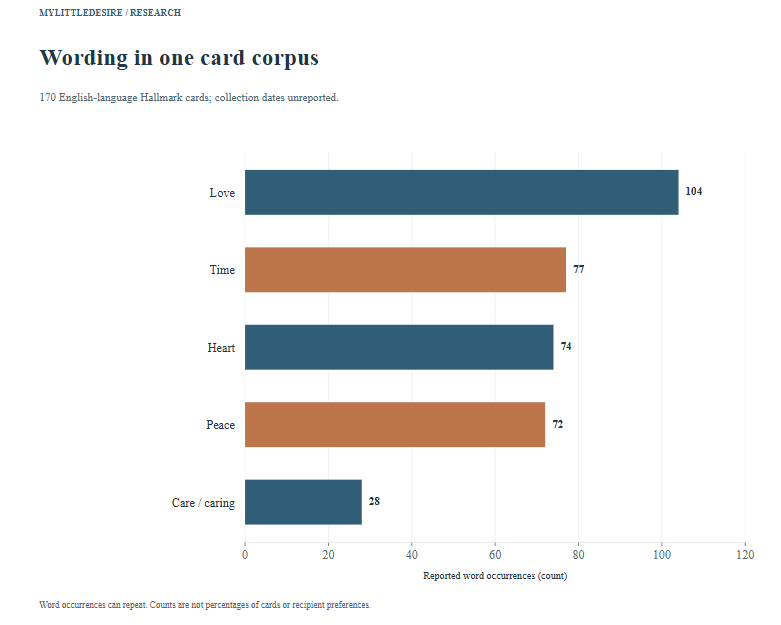
The card study found repeated language about care, time and peace. A count such as 104 occurrences of love does not mean 104 different cards or 104 people preferred that wording. Some selected values count expressions or unique occurrences, so their definitions remain beside each row. Collection dates were not reported.
The researchers interpreted card messages alongside interviews with bereaved parents and service providers. That design can explore messaging; it cannot establish that a particular printed word causes a recipient to feel better or worse. No fixed timetable for grief is inferred.
How did recipients react to anniversary cards?
F05 Strongly agree plus agree, reported together in original Results prose. Respondent counts, not percentages. One German ward, voluntary n=24 and published 35% response rate; nonrespondents’ views unknown. No control group or clinical outcome benefit established. Grateful has n=23 responses including one can’t remember; pleased/consoled each n=24.
| Measure / group | Published result and unit | Population, period and base | Original source |
|---|---|---|---|
| Pleased: agreed or strongly agreed | 22 respondents | 24 responding relatives/friends of deceased patients from one palliative-care ward Questionnaires mailed October 2014–June 2015; first-anniversary cards · Reported response n=24; includes can’t remember where present | Original source [S02] Table 1 and Results paragraph on reactions |
| Grateful: agreed or strongly agreed | 22 respondents | 24 responding relatives/friends of deceased patients from one palliative-care ward Questionnaires mailed October 2014–June 2015; first-anniversary cards · Reported response n=23; includes can’t remember where present | Original source [S02] Table 1 and Results paragraph on reactions |
| Consoled: agreed or strongly agreed | 21 respondents | 24 responding relatives/friends of deceased patients from one palliative-care ward Questionnaires mailed October 2014–June 2015; first-anniversary cards · Reported response n=24; includes can’t remember where present | Original source [S02] Table 1 and Results paragraph on reactions |
F06 Mixed reactions and selected explicit response categories, not exclusive groups. Respondent counts, not percentages. One German ward, voluntary n=24 and published 35% response rate; nonrespondents’ views unknown. No control group or clinical outcome benefit established. Nine reported sadness; this is not a treatment-harm estimate. Strongly disagree is retained separately from other responses.
| Measure / group | Published result and unit | Population, period and base | Original source |
|---|---|---|---|
| Sad: agreed or strongly agreed | 9 respondents | 24 responding relatives/friends of deceased patients from one palliative-care ward Questionnaires mailed October 2014–June 2015; first-anniversary cards · Reported response n=24; includes can’t remember where present | Original source [S02] Table 1 and Results on positive/sad reactions |
| Annoyed: agreed or strongly agreed | 0 respondents | 24 responding relatives/friends of deceased patients from one palliative-care ward Questionnaires mailed October 2014–June 2015; first-anniversary cards · Reported response n=24; includes can’t remember where present | Original source [S02] Table 1 and Results on positive/sad reactions |
| No particular meaning: strongly disagreed | 24 respondents | 24 responding relatives/friends of deceased patients from one palliative-care ward Questionnaires mailed October 2014–June 2015; first-anniversary cards · Reported response n=24; includes can’t remember where present | Original source [S02] Table 1 and Results on positive/sad reactions |
| Disappointed: strongly disagreed | 23 respondents | 24 responding relatives/friends of deceased patients from one palliative-care ward Questionnaires mailed October 2014–June 2015; first-anniversary cards · Reported response n=24; includes can’t remember where present | Original source [S02] Table 1 and Results on positive/sad reactions |
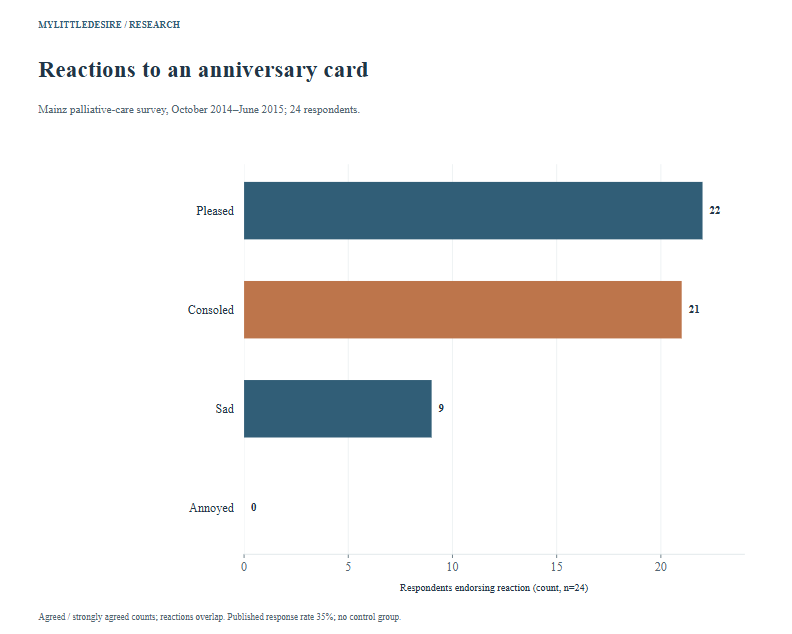
The Mainz survey received 24 completed questionnaires from 68 deliverable mailings, a published response rate of 35%. Most respondents endorsed positive reactions, while nine also reported sadness. Those answers overlap; sadness does not by itself show that a card was unwanted. Nonrespondents’ views remain unknown.
Different answers and missing data. Grateful has 23 recorded responses, including one can’t remember; layout and text each also have one missing answer. The disappointment item has 23 strongly-disagree answers and one can’t remember. We retain those categories rather than treating every missing or uncertain answer as disagreement.
What did recipients think about card format and timing?
F07 Adequacy endorsements and first-anniversary timing responses. Respondent counts, not percentages. One German ward, voluntary n=24 and published 35% response rate; nonrespondents’ views unknown. No control group or clinical outcome benefit established. Layout/text each have one missing answer, so n=23. Timing n=24 comes from Results prose; these do not establish a universal deadline.
| Measure / group | Published result and unit | Population, period and base | Original source |
|---|---|---|---|
| Layout adequate: agreed or strongly agreed | 23 respondents | 24 responding relatives/friends of deceased patients from one palliative-care ward Questionnaires mailed October 2014–June 2015; first-anniversary cards · Reported response n=23; includes can’t remember where present | Original source [S02] Table 2 and Results paragraph following Table 2 |
| Text adequate: agreed or strongly agreed | 23 respondents | 24 responding relatives/friends of deceased patients from one palliative-care ward Questionnaires mailed October 2014–June 2015; first-anniversary cards · Reported response n=23; includes can’t remember where present | Original source [S02] Table 2 and Results paragraph following Table 2 |
| First-anniversary mailing most suitable | 24 respondents | 24 responding relatives/friends of deceased patients from one palliative-care ward Questionnaires mailed October 2014–June 2015; first-anniversary cards · Reported response n=24; includes can’t remember where present | Original source [S02] Table 2 and Results paragraph following Table 2 |
Respondents’ views concern a card from one palliative-care team on the first anniversary of a death. They do not establish a universal deadline, preferred format, or ideal timing for an ordinary sympathy card. The study had no untreated comparison group.
Appreciating a gesture also differs from a demonstrated clinical effect. A separate small Australian ICU trial of letter, telephone contact or no contact did not establish reduced six-month anxiety/depression. That healthcare follow-up setting does not prove ordinary condolence cards cause harm. Original CATHARTIC trial.
How common was not knowing what to say?
F08 Ever avoidance during a very difficult time, with grieving given as an example. Not a bereavement-only or card-sending question. Full asked n=2,244; exact item-valid n unconfirmed. Rounded total 101 retained.
| Measure / group | Published result and unit | Population, period and base | Original source |
|---|---|---|---|
| I have | 28% percent | GB adults age 18+, overall and four age groups October 23, 2023 · Full asked n=2,244; item-valid n unconfirmed | Original source [S03] October 23, 2023 question 2, All adults |
| I have not | 62% percent | GB adults age 18+, overall and four age groups October 23, 2023 · Full asked n=2,244; item-valid n unconfirmed | Original source [S03] October 23, 2023 question 2, All adults |
| Don’t know | 11% percent | GB adults age 18+, overall and four age groups October 23, 2023 · Full asked n=2,244; item-valid n unconfirmed | Original source [S03] October 23, 2023 question 2, All adults |
F09 I have response within original age groups. Same question/sample as F08. Cross-sectional groups; exact subgroup n/CIs unknown. Broader difficult situations, not grief alone.
| Measure / group | Published result and unit | Population, period and base | Original source |
|---|---|---|---|
| Age 18-24 | 28% percent | GB adults age 18-24 October 23, 2023 · Exact item/subgroup n unavailable | Original source [S03] Original Age tab / I have |
| Age 25-49 | 33% percent | GB adults age 25-49 October 23, 2023 · Exact item/subgroup n unavailable | Original source [S03] Original Age tab / I have |
| Age 50-64 | 27% percent | GB adults age 50-64 October 23, 2023 · Exact item/subgroup n unavailable | Original source [S03] Original Age tab / I have |
| Age 65+ | 18% percent | GB adults age 65+ October 23, 2023 · Exact item/subgroup n unavailable | Original source [S03] Original Age tab / I have |
F10 I have not response within original age groups. Same question/sample as F08. Cross-sectional groups; exact subgroup n/CIs unknown. Broader difficult situations, not grief alone.
| Measure / group | Published result and unit | Population, period and base | Original source |
|---|---|---|---|
| Age 18-24 | 46% percent | GB adults age 18-24 October 23, 2023 · Exact item/subgroup n unavailable | Original source [S03] Original Age tab / I have not |
| Age 25-49 | 54% percent | GB adults age 25-49 October 23, 2023 · Exact item/subgroup n unavailable | Original source [S03] Original Age tab / I have not |
| Age 50-64 | 66% percent | GB adults age 50-64 October 23, 2023 · Exact item/subgroup n unavailable | Original source [S03] Original Age tab / I have not |
| Age 65+ | 78% percent | GB adults age 65+ October 23, 2023 · Exact item/subgroup n unavailable | Original source [S03] Original Age tab / I have not |
F11 Don’t know response within original age groups. Same question/sample as F08. Cross-sectional groups; exact subgroup n/CIs unknown. Broader difficult situations, not grief alone.
| Measure / group | Published result and unit | Population, period and base | Original source |
|---|---|---|---|
| Age 18-24 | 26% percent | GB adults age 18-24 October 23, 2023 · Exact item/subgroup n unavailable | Original source [S03] Original Age tab / Don’t know |
| Age 25-49 | 13% percent | GB adults age 25-49 October 23, 2023 · Exact item/subgroup n unavailable | Original source [S03] Original Age tab / Don’t know |
| Age 50-64 | 6% percent | GB adults age 50-64 October 23, 2023 · Exact item/subgroup n unavailable | Original source [S03] Original Age tab / Don’t know |
| Age 65+ | 4% percent | GB adults age 65+ October 23, 2023 · Exact item/subgroup n unavailable | Original source [S03] Original Age tab / Don’t know |
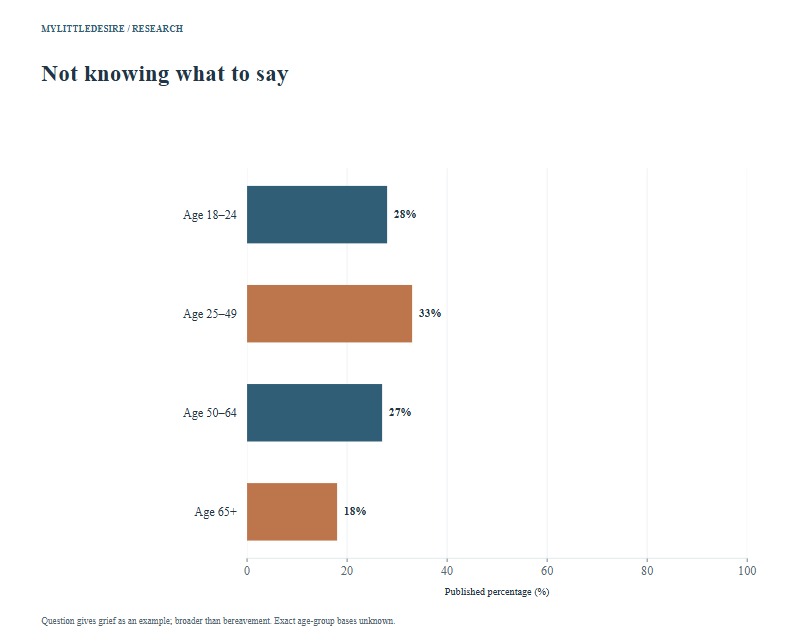
YouGov asked about a very difficult time, giving grieving as an example. It did not ask whether respondents avoided every bereaved person or failed to send a card. The overall percentages sum to 101 because original rounding is retained. Age comparisons describe different groups at one point in time.
Who felt comfortable talking about grief, and who offered support?
F12 Reported comfort by conversation partner. Original report wording; exact selected item/subgroup bases unknown, not replaced with full survey n=11,957. Fieldwork December 2025–January 2026. Broader support/conversation evidence, not card sending or clinical efficacy.
| Measure / group | Published result and unit | Population, period and base | Original source |
|---|---|---|---|
| Friends | 68% percent | GB adults age 18+; bereavement-support items and selected age groups as described December 22, 2025–January 20, 2026 · Exact item/subgroup n unavailable | Original source [S04] Printed/PDF page 7, Talking about grief prose and callout 6 |
| Family | 66% percent | GB adults age 18+; bereavement-support items and selected age groups as described December 22, 2025–January 20, 2026 · Exact item/subgroup n unavailable | Original source [S04] Printed/PDF page 7, Talking about grief prose and callout 6 |
| Employer | 49% percent | GB adults age 18+; bereavement-support items and selected age groups as described December 22, 2025–January 20, 2026 · Exact item/subgroup n unavailable | Original source [S04] Printed/PDF page 7, Talking about grief prose and callout 6 |
F13 Reported comfort discussing grief with family within age groups. Original report wording; exact selected item/subgroup bases unknown, not replaced with full survey n=11,957. Fieldwork December 2025–January 2026. Broader support/conversation evidence, not card sending or clinical efficacy. Cross-sectional groups, not a causal age effect.
| Measure / group | Published result and unit | Population, period and base | Original source |
|---|---|---|---|
| Age 18–34 | 60% percent | GB adults age 18+; bereavement-support items and selected age groups as described December 22, 2025–January 20, 2026 · Exact item/subgroup n unavailable | Original source [S04] Page 7, callout 7 |
| Age 65+ | 73% percent | GB adults age 18+; bereavement-support items and selected age groups as described December 22, 2025–January 20, 2026 · Exact item/subgroup n unavailable | Original source [S04] Page 7, callout 7 |
F14 Publisher-reported support providers and no-support response. Original report wording; exact selected item/subgroup bases unknown, not replaced with full survey n=11,957. Fieldwork December 2025–January 2026. Broader support/conversation evidence, not card sending or clinical efficacy. Categories are not shown as exclusive; do not add them. Support-provider measures are broader than sympathy cards.
| Measure / group | Published result and unit | Population, period and base | Original source |
|---|---|---|---|
| Family members | 63% percent | GB adults age 18+; bereavement-support items and selected age groups as described December 22, 2025–January 20, 2026 · Exact item/subgroup n unavailable | Original source [S04] Page 7, Where the nation turns for bereavement support; national comparison callouts |
| Friends | 43% percent | GB adults age 18+; bereavement-support items and selected age groups as described December 22, 2025–January 20, 2026 · Exact item/subgroup n unavailable | Original source [S04] Page 7, Where the nation turns for bereavement support; national comparison callouts |
| No support provided | 16% percent | GB adults age 18+; bereavement-support items and selected age groups as described December 22, 2025–January 20, 2026 · Exact item/subgroup n unavailable | Original source [S04] Page 7, Where the nation turns for bereavement support; national comparison callouts |
| Mental-health professionals | 6% percent | GB adults age 18+; bereavement-support items and selected age groups as described December 22, 2025–January 20, 2026 · Exact item/subgroup n unavailable | Original source [S04] Page 7, Where the nation turns for bereavement support; national comparison callouts |
| Religious/spiritual leaders | 5% percent | GB adults age 18+; bereavement-support items and selected age groups as described December 22, 2025–January 20, 2026 · Exact item/subgroup n unavailable | Original source [S04] Page 7, Where the nation turns for bereavement support; national comparison callouts |
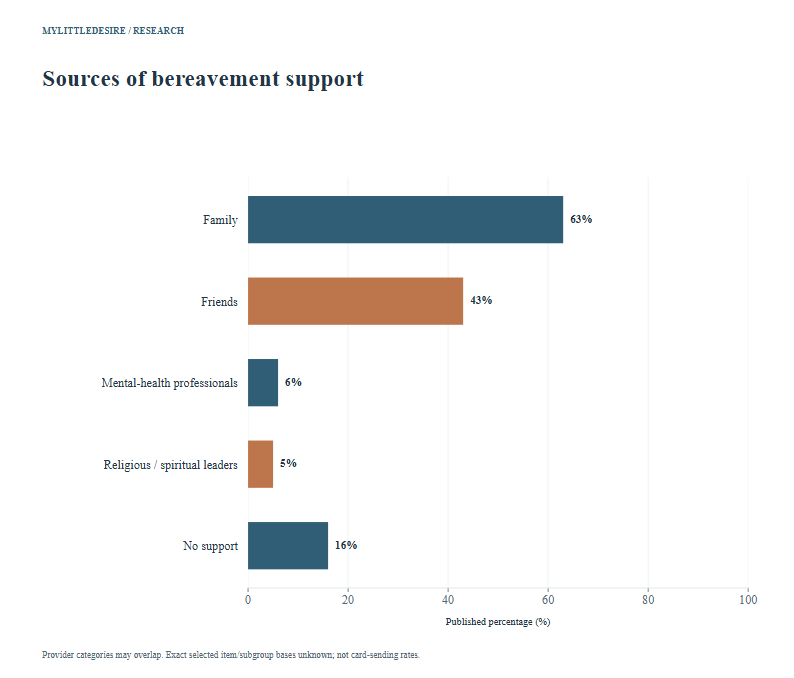
The Co-op report distinguishes comfort talking about a loss from support received. Friends and family can both help the same person, so provider categories should not be added as if mutually exclusive. Exact item/subgroup bases and full routing are unavailable; the full survey total is not substituted.
What do surveys show about cultural context and gathering?
F15 Own reported knowledge of death/funeral traditions outside own culture or faith. Original report wording; exact selected item/subgroup bases unknown, not replaced with full survey n=11,957. Fieldwork December 2025–January 2026. Broader support/conversation evidence, not card sending or clinical efficacy. Selected categories only; no new combined rate or claim about willingness to offer condolences.
| Measure / group | Published result and unit | Population, period and base | Original source |
|---|---|---|---|
| Little or no knowledge | 58% percent | GB adults age 18+; bereavement-support items and selected age groups as described December 22, 2025–January 20, 2026 · Exact item/subgroup n unavailable | Original source [S04] Page 8, knowledge section |
| Good knowledge | 6% percent | GB adults age 18+; bereavement-support items and selected age groups as described December 22, 2025–January 20, 2026 · Exact item/subgroup n unavailable | Original source [S04] Page 8, knowledge section |
F16 Perceived knowledge held by other cultures/faiths about respondent’s traditions. Original report wording; exact selected item/subgroup bases unknown, not replaced with full survey n=11,957. Fieldwork December 2025–January 2026. Broader support/conversation evidence, not card sending or clinical efficacy. At least some includes good knowledge; not independent of that narrower response. Perception, not a knowledge test.
| Measure / group | Published result and unit | Population, period and base | Original source |
|---|---|---|---|
| At least some knowledge | 43% percent | GB adults age 18+; bereavement-support items and selected age groups as described December 22, 2025–January 20, 2026 · Exact item/subgroup n unavailable | Original source [S04] Page 8, perceived knowledge paragraph and callouts |
| Little or no knowledge | 37% percent | GB adults age 18+; bereavement-support items and selected age groups as described December 22, 2025–January 20, 2026 · Exact item/subgroup n unavailable | Original source [S04] Page 8, perceived knowledge paragraph and callouts |
F17 Two separate questions about important traditions before and during a funeral. Original report wording; exact selected item/subgroup bases unknown, not replaced with full survey n=11,957. Fieldwork December 2025–January 2026. Broader support/conversation evidence, not card sending or clinical efficacy. Separate stages and wording; not a prevalence rate of attendance or a paired change.
| Measure / group | Published result and unit | Population, period and base | Original source |
|---|---|---|---|
| Before funeral: spending time with loved ones/community | 53% percent | GB adults age 18+; bereavement-support items and selected age groups as described December 22, 2025–January 20, 2026 · Exact item/subgroup n unavailable | Original source [S04] Page 5, Funeral traditions prose |
| Funeral day: family/community gathering | 59% percent | GB adults age 18+; bereavement-support items and selected age groups as described December 22, 2025–January 20, 2026 · Exact item/subgroup n unavailable | Original source [S04] Page 5, Funeral traditions prose |
Knowledge of other traditions, perceptions of others’ knowledge, and the importance of gathering are different questions. These results provide context for condolence practices; they do not establish a single religious rule or show how every member of a community wants to be approached.
Ten reproducible descriptive comparisons
Nine calculations report percentage-point differences. The final comparison subtracts word-occurrence counts. Each stays within a source and compatible construct. They are descriptive arithmetic, without new significance tests or causal claims.
| ID | Comparison | First | Second | Difference / unit | Qualification |
|---|---|---|---|---|---|
| C01 | Avoidance overall: no minus yes | 62% | 28% | +34 percentage points | Response-category difference within broad difficult-situation question. Descriptive subtraction of reported inputs. |
| C02 | Reported avoidance: age 25–49 minus 65+ | 33% | 18% | +15 percentage points | Age subgroup n unknown; no causal aging inference. Descriptive subtraction of reported inputs. |
| C03 | No avoidance: age 65+ minus 18–24 | 78% | 46% | +32 percentage points | Age subgroup n unknown; same original question. Descriptive subtraction of reported inputs. |
| C04 | Avoidance uncertainty: age 18–24 minus 65+ | 26% | 4% | +22 percentage points | Don’t know is not an avoidance endorsement. Descriptive subtraction of reported inputs. |
| C05 | Comfort discussing grief: friends minus family | 68% | 66% | +2 percentage points | Partner questions; no new significance test. Descriptive subtraction of reported inputs. |
| C06 | Family-conversation comfort: age 65+ minus 18–34 | 73% | 60% | +13 percentage points | Cross-sectional groups; exact n unknown. Descriptive subtraction of reported inputs. |
| C07 | Bereavement support: family minus friends | 63% | 43% | +20 percentage points | Potentially overlapping provider categories, not unique recipients. Descriptive subtraction of reported inputs. |
| C08 | Knowledge of other traditions: little/no minus good | 58% | 6% | +52 percentage points | Selected response categories, not a complete distribution. Descriptive subtraction of reported inputs. |
| C09 | Perceived others’ knowledge: some minus little/no | 43% | 37% | +6 percentage points | Perception about others, not tested knowledge. Descriptive subtraction of reported inputs. |
| C10 | Card-corpus word occurrences: love minus heart | 104 | 74 | +30 reported occurrences | Word occurrences, not percentage points, cards or people. Descriptive subtraction of reported inputs. |
Common questions
What percentage of adults send sympathy cards?
This resource does not claim a current national sending rate; a suitable original population estimate was not established in the inspected evidence.
Does 104 love mentions mean 104 cards?
No. It counts word occurrences in a selected corpus and may include repetition.
Did every anniversary-card respondent feel only positive emotions?
No. Positive reactions and sadness overlapped. Missing and can’t-remember answers are also retained.
Do positive card reactions prove a treatment benefit?
No. Liking a gesture and clinical symptom change are different outcomes and require different evidence.
Is the YouGov avoidance figure about grief alone?
No. Grief is one example of a very difficult time in the question.
Can support-provider percentages be added?
No. A person can receive support from more than one source, and the full routing is unavailable.
Is there one correct anniversary or condolence deadline?
The selected anniversary study addresses one healthcare practice; it does not establish a universal deadline.
Research method and limitations
Selection. Four source collections contribute 54 observations: card-content analysis 13, anniversary-card survey ten, YouGov Daily Question 15 and Co-op/YouGov report 16. They contain related counts, responses and age groups, not 54 independent findings. MyLittleDesire conducted no survey.
Verification. Original article frequencies, anniversary tables/Results, exact YouGov public result cells and Co-op report prose/callouts were checked. Twenty-six rows have reported bases or corpus context: 13 corpus rows, ten response rows and three full asked poll rows. Twenty-eight selected bases remain unknown. All selected weighted counts and estimate-specific intervals remain unavailable. No card-corpus recount, microdata audit or new uncertainty calculation is claimed.
Limits. Evidence is from a selected North American card corpus, one German healthcare ward and GB surveys. It is not a worldwide etiquette sample. The Co-op survey was commissioned by a funeral-services provider. Preserve differences between people, text occurrences, unknown bases, collection years and response categories. Neither clinical efficacy nor universal card preferences are inferred.
Original sources
- Calderwood & Alberton / OMEGA. Consoling the Bereaved: Exploring How Sympathy Cards Influence What People Say [S01]
Published: First published online January 26, 2022; volume 88(4), 2024.
Period: Card-collection dates not stated; first online publication 2022, issue 2024.
Population: Selected corpus of 170 English-language sympathy cards, not people or all cards sold.
Sample: 170 cards, yielding 362 excerpts and 70 unique codes; accompanying interviews with 20 bereaved parents and 11 service providers are not the denominator for word counts.
Bases: 170 is corpus context, not the denominator of a percentage. Selected occurrences can repeat within or across cards; no unique-card prevalence reconstructed.
Method: Original open-access article checked on publisher site and in Europe PMC full-text XML. Researchers transcribed card text and coded excerpts; recurring terms were counted. Selected values retain the reported counting definitions.
Limits: Single brand and selected online corpus, not a sales-weighted or representative market sample. Word occurrences, expressions and unique comfort occurrences have different counting definitions; no percentages of cards or recipients inferred. Collection dates unreported. Article cannot establish that card wording causes distress or that grief follows a fixed timetable. Inconsistent God/comfort subcounts 26 versus 27 are withheld.
Supporting record 1 · Supporting record 2 - Goebel et al. / BMC Palliative Care. Family members of deceased palliative care patients receiving bereavement anniversary cards: a survey on the recipient’s reactions and opinions [S02]
Published: April 19, 2017.
Period: Questionnaires mailed October 2014–June 2015; first-anniversary cards.
Population: 24 responding relatives/friends of deceased patients from one palliative-care ward.
Sample: 24 completed questionnaires out of 68 deliverable, from 87 sent (19 undeliverable). Published response rate 35%; six follow-up interviews.
Bases: Most selected reaction rows n=24; grateful, layout and text each have one missing answer, so reported response n=23 includes can’t remember where present. Timing n=24 from Results prose. Counts not converted to population rates.
Method: Original open-access article and Tables 1–2 checked in full-text XML. Positive endorsements combine strongly agree/agree as explicitly described in Results prose; strongly-disagree cells are retained as that response category. Counts, missing answers and source narrative discrepancies checked.
Limits: Small single-ward voluntary response survey; 35% response and unknown nonrespondents’ views. No untreated comparison group, unvalidated questionnaire, retrospective timing. Sadness can coexist with appreciation; no clinical benefit or harm inferred. Discussion says none disappointed, but Table 1 includes one can’t remember; table categories preserved. Not a consumer preference poll.
Supporting record 1 · Supporting record 2 - YouGov. Daily Question: avoiding someone in a very difficult time because of not knowing what to say [S03]
Published: October 23, 2023.
Period: October 23, 2023.
Population: GB adults age 18+, overall and four age groups.
Sample: 2,244 GB adults, published full asked base; exact item-valid and age-group bases unconfirmed.
Bases: Three overall rows retain full asked n=2,244, not asserted complete-answer n. Twelve age-group bases unknown; full n not substituted.
Method: Exact original archived question object and overall/age result cells checked. General official YouGov methods describe online nonprobability panel sampling and weighted final Daily Agenda results excluding open app/website opt-ins. Historical item-specific weights/counts unavailable.
Limits: Question includes difficult situations such as grieving, not bereavement alone and not card sending. Self-reported ever avoidance, not observation or motive diagnosis. Age groups are cross-sectional. Original rounded overall total 101 preserved. Exact subgroup n, weighted bases and estimate-specific CIs unknown.
Supporting record 1 - Co-op Funeralcare / YouGov. How the nation grieves: Media Report 2026 [S04]
Published: 2026 report; precise issue date not established.
Period: December 22, 2025–January 20, 2026.
Population: GB adults age 18+; bereavement-support items and selected age groups as described.
Sample: 11,957 GB adults in online survey. Exact selected item, bereaved-subset and age-group counts not published in inspected report.
Bases: All sixteen exact selected item/subgroup bases unknown. Full n=11,957 is source context and is not assigned to every item.
Method: Original 14-page report, selected prose/callouts and Notes to Editor checked. Online survey weighted by region, social grade, age/gender and ethnic group; described as representative of GB adults 18+. Report text used where full questionnaire/response tables unavailable.
Limits: Commissioned by funeral-services provider. Broader conversation/support and funeral-tradition evidence, not sympathy-card sending behavior or clinical efficacy. Selected support categories can overlap. Wording/bereavement eligibility follows report descriptions; exact question routing and selected bases unavailable. Family/friend/age differences are descriptive; no causal aging claim. Great Britain differs from UK.
Supporting record 1 · Supporting record 2
How to cite this resource
MyLittleDesire. Sympathy Card & Condolence Practices Statistics 2027. https://mylittledesire.com/sympathy-card-condolence-practices-statistics/.