
Premarital counseling statistics are most useful when they identify the service, population and outcome. A recalled church preparation class, a licensed counselor’s work with a couple, and a structured education program can all appear under the same broad label while measuring different experiences.
This resource presents 58 published numeric observations in 15 grouped findings from three original research records: 51 percentages, three duration summaries, one odds ratio and three adjusted coefficients. It also reviews five supporting research records and one professional guidance source. Categories and subgroups within one study are not independent studies.
44%
OR 0.69
Reported education among the 1990–2001 marriage cohort in one four-state survey.Recalled in 2001; exact cohort n unavailable. Stanley, Amato, Johnson and Markman [S02]
Adjusted annual divorce odds associated with education in an observational model.Not a 31-point absolute reduction or causal guarantee. Stanley, Amato, Johnson and Markman [S02]
74%
48.1%
Rated multi-night preparation classes somewhat or very helpful.Married US Catholic class users, June 2007; exact unweighted n unavailable. CARA, Georgetown University / USCCB [S01]
Wanted more preparation for the realities or stages of marriage.Coded interviews with 52 selected divorced former PREP participants, 2010–2012. Scott, Rhoades, Stanley, Allen and Markman [S03]
What counts as premarital counseling in these statistics?
| Term / measure | What it describes | Qualification |
|---|---|---|
| Premarital counseling | Work focused on preparing a particular couple for marriage. | Provider qualifications, clinical scope and methods vary. |
| Premarital education | Classes, workshops or other structured preparation. | The four-state survey explicitly includes classes, workshops and counseling. |
| Church marriage preparation | Inventories, classes, reading, mentoring and priest meetings in a defined Catholic sample. | These activities overlap and are not all clinical therapy. |
| Helpful to marriage | A user’s retrospective rating. | Different from measured improvement or prevented divorce. |
| Adjusted divorce odds | A model association conditional on included covariates. | Odds are different from probability; observational adjustment does not prove causation. |
| Coded feedback | Themes identified in interviews with a selected group. | Not a representative program satisfaction or failure rate. |
For research about treatment after difficulties arise, see our couples therapy and counseling statistics. Its treatment outcomes should retain their own populations and should not be relabeled premarital prevention.
Also Read:-
Relationship Arguments And Conflict Statistics 2027
First Date Safety Statistics 2027
How Couples Meet Statistics 2027
Dating After Divorce Statistics 2027
Dating Over 50 Statistics 2027
How many people reported premarital education?
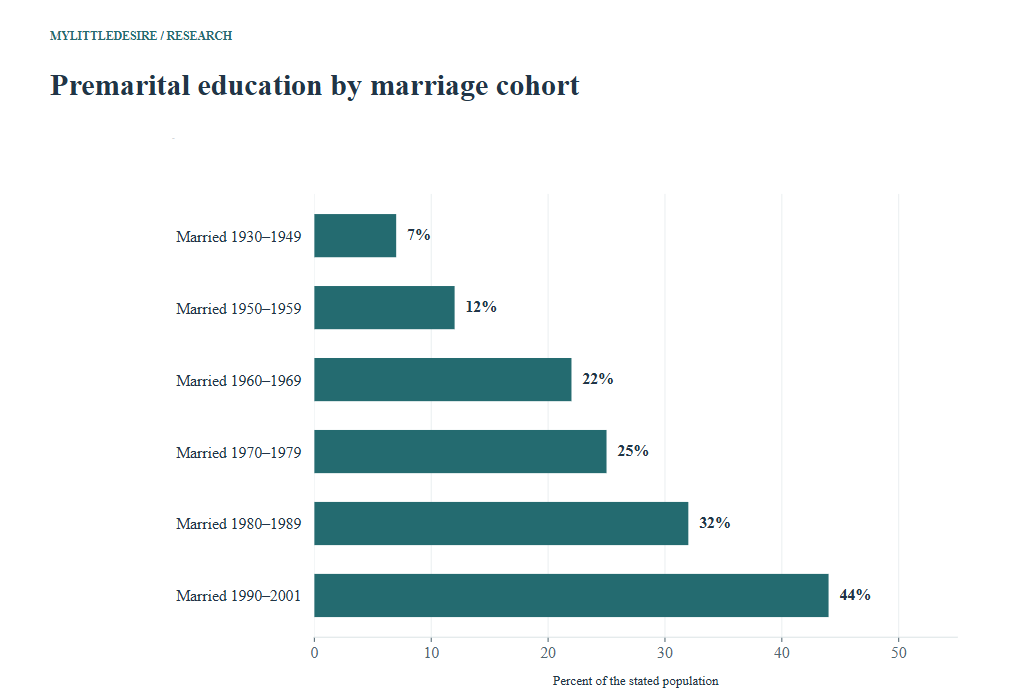
Stanley and colleagues surveyed 3,344 adults in Oklahoma and three neighboring states in 2001. In the currently married case file, 31% reported premarital education. The paper also reports participation by the historical period of marriage. Those estimates describe retrospective cohorts within this sample. Stanley, Amato, Johnson and Markman [S02].
F07 Any recalled premarital classes, workshop or counseling for the current marriage. 2001 four-state survey, not all US couples and not a 2027 participation rate. The source counts individuals rather than couples.
| Measure / group | Published result | Population and actual period | Original source |
|---|---|---|---|
| Currently married respondents reporting premarital education | 31% | Currently married adult respondents in Oklahoma, Arkansas, Kansas and Texas Eligible analysis n=1,977. 2001 survey; retrospective marriage cohorts 1930–1949 through 1990–2001 | Original source [S02] Original article p.119, Table 1 and Sample Characteristics |
F08 The proportion reporting premarital education within each historical marriage cohort. All cohorts were recalled in the 2001 four-state survey. These are marriage-cohort estimates, not annual prevalence or a current national trend. Exact cohort n unavailable.
| Measure / group | Published result | Population and actual period | Original source |
|---|---|---|---|
| Married 1930–1949 | 7% | Four-state survey respondents within each historical marriage cohort Exact unweighted item/subgroup n unavailable. 2001 survey; retrospective marriage cohorts 1930–1949 through 1990–2001 | Original source [S02] Original article p.120, Variables Associated With Premarital Education |
| Married 1950–1959 | 12% | Four-state survey respondents within each historical marriage cohort Exact unweighted item/subgroup n unavailable. 2001 survey; retrospective marriage cohorts 1930–1949 through 1990–2001 | Original source [S02] Original article p.120, Variables Associated With Premarital Education |
| Married 1960–1969 | 22% | Four-state survey respondents within each historical marriage cohort Exact unweighted item/subgroup n unavailable. 2001 survey; retrospective marriage cohorts 1930–1949 through 1990–2001 | Original source [S02] Original article p.120, Variables Associated With Premarital Education |
| Married 1970–1979 | 25% | Four-state survey respondents within each historical marriage cohort Exact unweighted item/subgroup n unavailable. 2001 survey; retrospective marriage cohorts 1930–1949 through 1990–2001 | Original source [S02] Original article p.120, Variables Associated With Premarital Education |
| Married 1980–1989 | 32% | Four-state survey respondents within each historical marriage cohort Exact unweighted item/subgroup n unavailable. 2001 survey; retrospective marriage cohorts 1930–1949 through 1990–2001 | Original source [S02] Original article p.120, Variables Associated With Premarital Education |
| Married 1990–2001 | 44% | Four-state survey respondents within each historical marriage cohort Exact unweighted item/subgroup n unavailable. 2001 survey; retrospective marriage cohorts 1930–1949 through 1990–2001 | Original source [S02] Original article p.120, Variables Associated With Premarital Education |
Which marriage-preparation activities did people use?
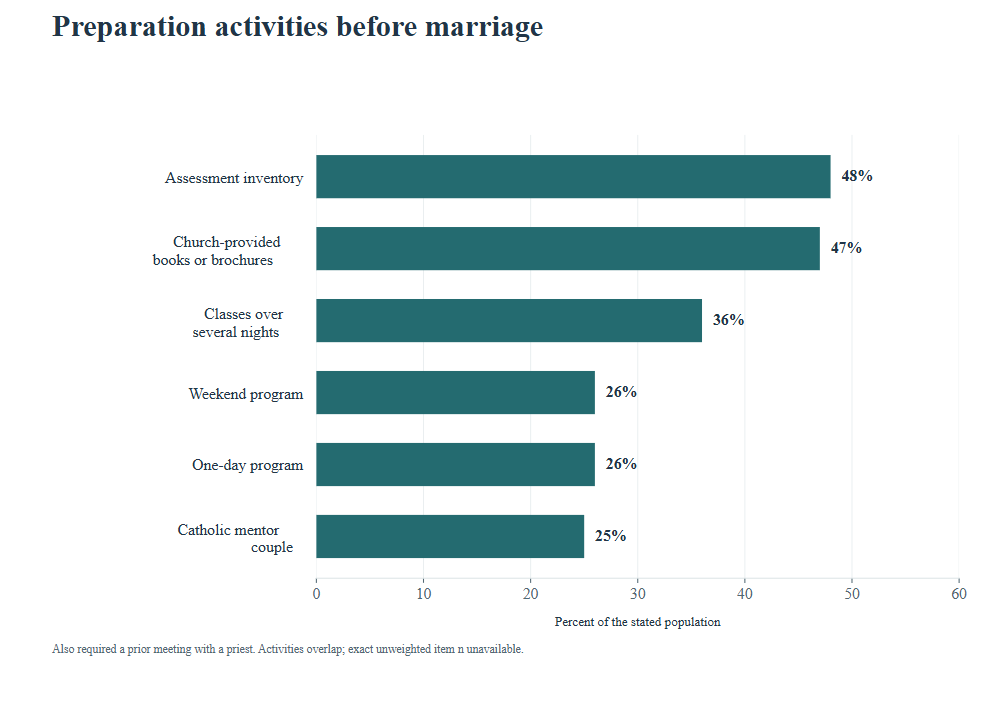
CARA surveyed adult self-identified US Catholics in June 2007. The priest-meeting question narrows to currently married people who married in the Catholic Church. The activity question narrows further to those who met a priest. A full-survey sample of 1,008 is not the valid unweighted base for each conditional result. CARA, Georgetown University / USCCB [S01].
F01 Whether the respondent and spouse met a Catholic priest to discuss the sacrament before marrying. June 2007 retrospective survey. Conditional on current marriage and a Catholic Church wedding; not all Catholics or all couples. Exact unweighted item n unavailable.
| Measure / group | Published result | Population and actual period | Original source |
|---|---|---|---|
| Met a priest before marriage | 90% | Currently married adult US Catholics who married in the Catholic Church Exact unweighted item/subgroup n unavailable. 2007-06-13 to 2007-06-25; retrospective marriage-preparation experiences | Original source [S01] Body printed p.70 (physical p.74) |
| Did not meet a priest before marriage | 10% | Currently married adult US Catholics who married in the Catholic Church Exact unweighted item/subgroup n unavailable. 2007-06-13 to 2007-06-25; retrospective marriage-preparation experiences | Original source [S01] Body printed p.70 (physical p.74) |
F02 Additional activities undertaken before marriage, beyond meeting with a priest. Conditional June 2007 population; activities overlap. No exact unweighted n beside the body table. Appendix percentages include nonresponse; body estimates are preserved rather than mixing reporting bases.
| Measure / group | Published result | Population and actual period | Original source |
|---|---|---|---|
| Pre-marriage assessment inventory | 48% | Currently married adult US Catholics who married in the Catholic Church and met with a priest before marriage Exact unweighted item/subgroup n unavailable. 2007-06-13 to 2007-06-25; retrospective marriage-preparation experiences | Original source [S01] Body printed p.71 (physical p.75) |
| Church-provided books or brochures | 47% | Currently married adult US Catholics who married in the Catholic Church and met with a priest before marriage Exact unweighted item/subgroup n unavailable. 2007-06-13 to 2007-06-25; retrospective marriage-preparation experiences | Original source [S01] Body printed p.71 (physical p.75) |
| Classes over several nights | 36% | Currently married adult US Catholics who married in the Catholic Church and met with a priest before marriage Exact unweighted item/subgroup n unavailable. 2007-06-13 to 2007-06-25; retrospective marriage-preparation experiences | Original source [S01] Body printed p.71 (physical p.75) |
| Weekend program | 26% | Currently married adult US Catholics who married in the Catholic Church and met with a priest before marriage Exact unweighted item/subgroup n unavailable. 2007-06-13 to 2007-06-25; retrospective marriage-preparation experiences | Original source [S01] Body printed p.71 (physical p.75) |
| One-day program | 26% | Currently married adult US Catholics who married in the Catholic Church and met with a priest before marriage Exact unweighted item/subgroup n unavailable. 2007-06-13 to 2007-06-25; retrospective marriage-preparation experiences | Original source [S01] Body printed p.71 (physical p.75) |
| Catholic mentor couple | 25% | Currently married adult US Catholics who married in the Catholic Church and met with a priest before marriage Exact unweighted item/subgroup n unavailable. 2007-06-13 to 2007-06-25; retrospective marriage-preparation experiences | Original source [S01] Body printed p.71 (physical p.75) |
F09 Receiving premarital education in a religious setting. Among 595 currently married education participants, not all respondents. Setting-selection differences cannot establish that a religious program is more effective.
| Measure / group | Published result | Population and actual period | Original source |
|---|---|---|---|
| Premarital education received in a religious setting | 93% | Currently married four-state respondents reporting premarital education Eligible analysis n=595. 2001 survey; retrospective marriage cohorts 1930–1949 through 1990–2001 | Original source [S02] Original article p.122, Setting and Duration of Premarital Education |
The four-state study’s religious-setting percentage also has a conditional population: people who had received preparation. Religious and secular participants differ in background. The paper’s initial setting associations did not remain significant after controls, so the result does not establish superiority of either setting. Stanley, Amato, Johnson and Markman [S02].
How helpful did participants find marriage preparation?
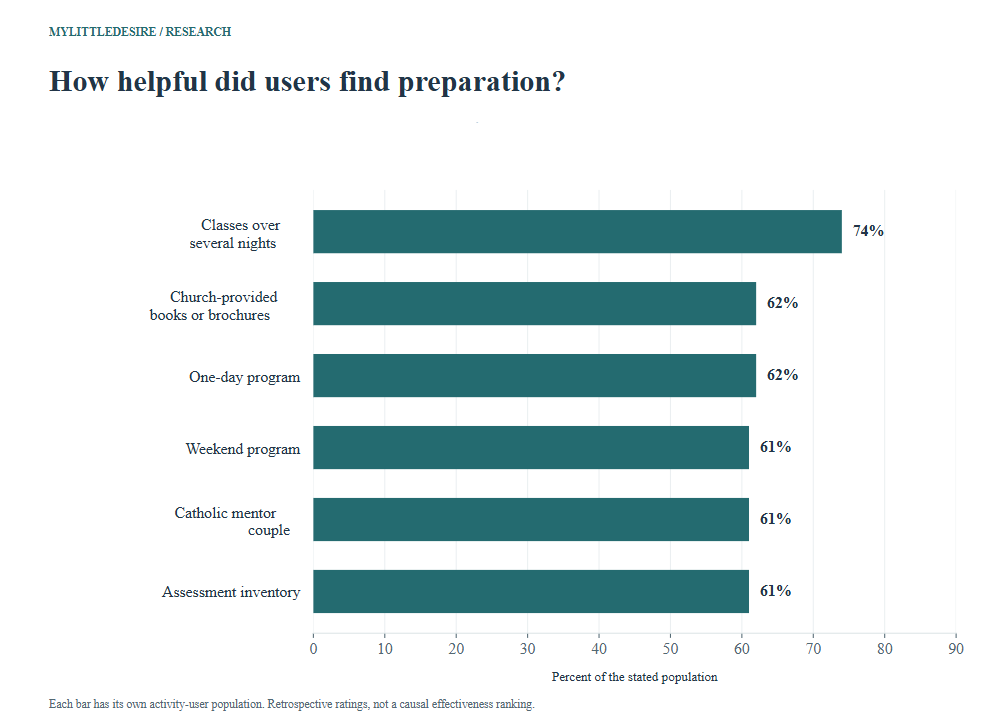
In CARA’s survey, respondents rated only activities they had experienced. The somewhat-or-very-helpful NET includes very helpful. The two columns answer different levels of the same question and must not be added. These retrospective opinions do not identify a causal best program. CARA, Georgetown University / USCCB [S01].
F03 Retrospective ratings of how helpful each experienced activity was to the respondent’s marriage. Currently married users of each activity in June 2007; six different conditional bases, exact unweighted n unavailable. Very helpful is included in the NET, not an additional exclusive group. No causal effectiveness ranking or divorce-prevention rate.
| Measure / group | Published result | Population and actual period | Original source |
|---|---|---|---|
| Classes over several nights | 74% | Currently married adult US Catholics who experienced the specified preparation activity Exact unweighted item/subgroup n unavailable. 2007-06-13 to 2007-06-25; retrospective marriage-preparation experiences | Original source [S01] Body printed p.73 (physical p.77) |
| Church-provided books or brochures | 62% | Currently married adult US Catholics who experienced the specified preparation activity Exact unweighted item/subgroup n unavailable. 2007-06-13 to 2007-06-25; retrospective marriage-preparation experiences | Original source [S01] Body printed p.73 (physical p.77) |
| One-day program | 62% | Currently married adult US Catholics who experienced the specified preparation activity Exact unweighted item/subgroup n unavailable. 2007-06-13 to 2007-06-25; retrospective marriage-preparation experiences | Original source [S01] Body printed p.73 (physical p.77) |
| Weekend program | 61% | Currently married adult US Catholics who experienced the specified preparation activity Exact unweighted item/subgroup n unavailable. 2007-06-13 to 2007-06-25; retrospective marriage-preparation experiences | Original source [S01] Body printed p.73 (physical p.77) |
| Catholic mentor couple | 61% | Currently married adult US Catholics who experienced the specified preparation activity Exact unweighted item/subgroup n unavailable. 2007-06-13 to 2007-06-25; retrospective marriage-preparation experiences | Original source [S01] Body printed p.73 (physical p.77) |
| Pre-marriage assessment inventory | 61% | Currently married adult US Catholics who experienced the specified preparation activity Exact unweighted item/subgroup n unavailable. 2007-06-13 to 2007-06-25; retrospective marriage-preparation experiences | Original source [S01] Body printed p.73 (physical p.77) |
F04 Retrospective ratings of how helpful each experienced activity was to the respondent’s marriage. Currently married users of each activity in June 2007; six different conditional bases, exact unweighted n unavailable. Very helpful is included in the NET, not an additional exclusive group. No causal effectiveness ranking or divorce-prevention rate.
| Measure / group | Published result | Population and actual period | Original source |
|---|---|---|---|
| Classes over several nights | 24% | Currently married adult US Catholics who experienced the specified preparation activity Exact unweighted item/subgroup n unavailable. 2007-06-13 to 2007-06-25; retrospective marriage-preparation experiences | Original source [S01] Body printed p.73 (physical p.77) |
| Church-provided books or brochures | 21% | Currently married adult US Catholics who experienced the specified preparation activity Exact unweighted item/subgroup n unavailable. 2007-06-13 to 2007-06-25; retrospective marriage-preparation experiences | Original source [S01] Body printed p.73 (physical p.77) |
| One-day program | 16% | Currently married adult US Catholics who experienced the specified preparation activity Exact unweighted item/subgroup n unavailable. 2007-06-13 to 2007-06-25; retrospective marriage-preparation experiences | Original source [S01] Body printed p.73 (physical p.77) |
| Weekend program | 28% | Currently married adult US Catholics who experienced the specified preparation activity Exact unweighted item/subgroup n unavailable. 2007-06-13 to 2007-06-25; retrospective marriage-preparation experiences | Original source [S01] Body printed p.73 (physical p.77) |
| Catholic mentor couple | 26% | Currently married adult US Catholics who experienced the specified preparation activity Exact unweighted item/subgroup n unavailable. 2007-06-13 to 2007-06-25; retrospective marriage-preparation experiences | Original source [S01] Body printed p.73 (physical p.77) |
| Pre-marriage assessment inventory | 18% | Currently married adult US Catholics who experienced the specified preparation activity Exact unweighted item/subgroup n unavailable. 2007-06-13 to 2007-06-25; retrospective marriage-preparation experiences | Original source [S01] Body printed p.73 (physical p.77) |
How did participation and ratings differ across groups?
CARA’s source-defined birth cohorts provide historical context on activity use. The younger married groups were combined because few Millennial respondents were married. Gender comparisons describe respondents’ ratings among users of a specified activity. Neither comparison is a matched-couple experiment. CARA, Georgetown University / USCCB [S01].
F05 Inventory and weekend-program participation within the source’s generation groups. Same conditional activity population as F02. Pre-Vatican II born before 1943; Vatican II 1943–1960; Post-Vatican II 1961–1981 and Millennial 1982 onward combined because few were married. These are birth cohorts observed in 2007, not national annual trends. Subgroup n unavailable.
| Measure / group | Published result | Population and actual period | Original source |
|---|---|---|---|
| Inventory: Post-Vatican II / Millennial | 64% | Currently married adult US Catholics who married in the Catholic Church and met with a priest before marriage, by source-defined birth cohort Exact unweighted item/subgroup n unavailable. 2007-06-13 to 2007-06-25; retrospective marriage-preparation experiences | Original source [S01] Body printed p.71, generation discussion; definitions printed p.14 |
| Inventory: Vatican II | 40% | Currently married adult US Catholics who married in the Catholic Church and met with a priest before marriage, by source-defined birth cohort Exact unweighted item/subgroup n unavailable. 2007-06-13 to 2007-06-25; retrospective marriage-preparation experiences | Original source [S01] Body printed p.71, generation discussion; definitions printed p.14 |
| Inventory: Pre-Vatican II | 29% | Currently married adult US Catholics who married in the Catholic Church and met with a priest before marriage, by source-defined birth cohort Exact unweighted item/subgroup n unavailable. 2007-06-13 to 2007-06-25; retrospective marriage-preparation experiences | Original source [S01] Body printed p.71, generation discussion; definitions printed p.14 |
| Weekend: Post-Vatican II / Millennial | 44% | Currently married adult US Catholics who married in the Catholic Church and met with a priest before marriage, by source-defined birth cohort Exact unweighted item/subgroup n unavailable. 2007-06-13 to 2007-06-25; retrospective marriage-preparation experiences | Original source [S01] Body printed p.71, generation discussion; definitions printed p.14 |
| Weekend: Vatican II | 13% | Currently married adult US Catholics who married in the Catholic Church and met with a priest before marriage, by source-defined birth cohort Exact unweighted item/subgroup n unavailable. 2007-06-13 to 2007-06-25; retrospective marriage-preparation experiences | Original source [S01] Body printed p.71, generation discussion; definitions printed p.14 |
| Weekend: Pre-Vatican II | 9% | Currently married adult US Catholics who married in the Catholic Church and met with a priest before marriage, by source-defined birth cohort Exact unweighted item/subgroup n unavailable. 2007-06-13 to 2007-06-25; retrospective marriage-preparation experiences | Original source [S01] Body printed p.71, generation discussion; definitions printed p.14 |
F06 Very-helpful ratings among married activity users, by respondent gender. Retrospective June 2007 results. Different activity-user and gender subgroup bases; exact n unavailable. Not a matched-couple comparison or proof of different treatment effects.
| Measure / group | Published result | Population and actual period | Original source |
|---|---|---|---|
| Weekend program: women | 40% | Currently married adult US Catholic users of the specified activity, by respondent gender Exact unweighted item/subgroup n unavailable. 2007-06-13 to 2007-06-25; retrospective marriage-preparation experiences | Original source [S01] Body printed pp.73–74 (physical pp.77–78) |
| Weekend program: men | 16% | Currently married adult US Catholic users of the specified activity, by respondent gender Exact unweighted item/subgroup n unavailable. 2007-06-13 to 2007-06-25; retrospective marriage-preparation experiences | Original source [S01] Body printed pp.73–74 (physical pp.77–78) |
| Books/brochures: women | 28% | Currently married adult US Catholic users of the specified activity, by respondent gender Exact unweighted item/subgroup n unavailable. 2007-06-13 to 2007-06-25; retrospective marriage-preparation experiences | Original source [S01] Body printed pp.73–74 (physical pp.77–78) |
| Books/brochures: men | 12% | Currently married adult US Catholic users of the specified activity, by respondent gender Exact unweighted item/subgroup n unavailable. 2007-06-13 to 2007-06-25; retrospective marriage-preparation experiences | Original source [S01] Body printed pp.73–74 (physical pp.77–78) |
How long did premarital education last?
The four-state survey’s most common reported duration was two hours, its median was eight hours and its longest report was 40 hours. These describe different features of one recalled distribution. Hours are not sessions, and none of these numbers prescribes an effective treatment dose. Stanley, Amato, Johnson and Markman [S02].
F10 The source’s mode, median and longest reported duration. Retrospective 2001 reports; exact duration-item n unavailable. Mode, median and maximum are distinct summaries of one distribution, not recommended doses or session counts.
| Measure / group | Published result | Population and actual period | Original source |
|---|---|---|---|
| Most commonly reported duration | 2 hours | Four-state premarital-education participants answering the hours question Exact unweighted item/subgroup n unavailable. 2001 survey; retrospective marriage cohorts 1930–1949 through 1990–2001 | Original source [S02] Original article p.122, Setting and Duration of Premarital Education |
| Median reported duration | 8 hours | Four-state premarital-education participants answering the hours question Exact unweighted item/subgroup n unavailable. 2001 survey; retrospective marriage cohorts 1930–1949 through 1990–2001 | Original source [S02] Original article p.122, Setting and Duration of Premarital Education |
| Longest reported duration | 40 hours | Four-state premarital-education participants answering the hours question Exact unweighted item/subgroup n unavailable. 2001 survey; retrospective marriage cohorts 1930–1949 through 1990–2001 | Original source [S02] Original article p.122, Setting and Duration of Premarital Education |
Does premarital counseling reduce divorce by 31%?
The widely repeated 31% claim comes from the four-state observational study, published in 2006 using 2001 survey histories. Its adjusted annual divorce odds ratio was 0.69. One minus 0.69 is 0.31, so the interpretation is 31% lower annual odds in that model. It is not 31 percentage points fewer divorces, a directly observed lifetime risk reduction or proof that counseling caused the association. Stanley, Amato, Johnson and Markman [S02].
The paper illustrates its model with five-year divorce probabilities of 14% without education and 10% with education, holding control variables at their means. Their four-percentage-point difference is a model illustration, not the absolute effect of a randomized trial. Table 3 uses 2,533 people and 44,519 person-years; person-years are repeated exposure time, not additional people.
F11 Adjusted annual divorce odds and illustrative five-year probabilities from the source’s model. Observational, retrospective first-marriage histories. Table 3 uses 2,533 people and 44,519 person-years. OR 0.69 means 31% lower annual odds, not 31 percentage points or a proven causal risk reduction. The 14%/10% predictions hold controls at their means and are not raw trial outcomes.
| Measure / group | Published result | Population and actual period | Original source |
|---|---|---|---|
| Adjusted annual divorce odds ratio: education versus none | OR 0.69 | First-marriage histories in the four-state survey; model illustration at mean controls Eligible analysis n=2,533. 2001 survey; retrospective marriage cohorts 1930–1949 through 1990–2001 | Original source [S02] Original article pp.120–121, model illustration and Table 3 |
| Model-predicted five-year divorce probability: no education | 14% | First-marriage histories in the four-state survey; model illustration at mean controls Eligible analysis n=2,533. 2001 survey; retrospective marriage cohorts 1930–1949 through 1990–2001 | Original source [S02] Original article pp.120–121, model illustration and Table 3 |
| Model-predicted five-year divorce probability: education | 10% | First-marriage histories in the four-state survey; model illustration at mean controls Eligible analysis n=2,533. 2001 survey; retrospective marriage cohorts 1930–1949 through 1990–2001 | Original source [S02] Original article pp.120–121, model illustration and Table 3 |
The trial evidence needs its own description. A 2013 trial followed first marriages for eight years and found no overall divorce-rate difference among naturally occurring services, clergy-delivered PREP and university-delivered PREP. Outcomes varied with premarital negative communication. The comparison was between types of services. It does not establish that all counseling is ineffective, and the survey association does not override the trial’s result. Markman et al. [R02].
What were the associations with marital quality?
The same four-state study reports adjusted associations with satisfaction, conflict and commitment. The outcomes were standardized, making the coefficients interpretable in outcome SD units. A coefficient of +0.15 is not a 15% success or improvement rate. Stanley, Amato, Johnson and Markman [S02].
F12 Unstandardized b coefficients with outcomes standardized to mean zero and SD one. Currently married n=1,977. Positive satisfaction/commitment and negative conflict coefficients favor education but remain observational. These are SD-unit differences, not percentages, correlations or unadjusted experimental effect sizes.
| Measure / group | Published result | Population and actual period | Original source |
|---|---|---|---|
| Marital satisfaction: premarital education coefficient | +0.15 SD units | Currently married adult respondents in the four-state survey Eligible analysis n=1,977. 2001 survey; retrospective marriage cohorts 1930–1949 through 1990–2001 | Original source [S02] Original article pp.120–121, Table 4 and accompanying interpretation |
| Marital conflict: premarital education coefficient | −0.17 SD units | Currently married adult respondents in the four-state survey Eligible analysis n=1,977. 2001 survey; retrospective marriage cohorts 1930–1949 through 1990–2001 | Original source [S02] Original article pp.120–121, Table 4 and accompanying interpretation |
| Commitment: premarital education coefficient | +0.21 SD units | Currently married adult respondents in the four-state survey Eligible analysis n=1,977. 2001 survey; retrospective marriage cohorts 1930–1949 through 1990–2001 | Original source [S02] Original article pp.120–121, Table 4 and accompanying interpretation |
What do reviews and newer trials add?
Fawcett and colleagues’ 2010 meta-analysis coded 47 studies. Its abstract reports a more favorable pattern for communication than for relationship quality/satisfaction once unpublished evaluations were included. It also notes how rarely studies followed couples beyond the honeymoon stage. This package does not reproduce pooled numerical effects without access to the full outcome tables. Original university record [R01].
A Turkish pilot first published online in 2023 and assigned to a 2024 journal volume reports relationship-score changes in a small selected university sample, with follow-up measured in weeks. A publisher abstract from September 2026 concerns short-term communication and attachment outcomes in a selected Iranian sample. Neither checked record supplies a long-term divorce-prevention rate. Publication dates do not establish fieldwork dates. Pilot [R03]; 2026 publisher abstract [R05].
We also checked a 2025 Iranian paper in full. Its table shows avoiding scores increasing while its abstract describes a reduction; its sample description and analysis unit require care as well. Those numerical outcomes are withheld pending clarification. The existence of a recent paper does not remove the need to reconcile its measures. Original paper [R04].
What did divorced former participants want improved?
Scott and colleagues interviewed 52 divorced former PREP participants in 2010–2012. Researchers coded themes in their open-ended accounts. These selected participants can illuminate what they wanted improved, but they cannot reveal how often PREP users divorce because the study did not include a comparable nondivorced group. Scott, Rhoades, Stanley, Allen and Markman [S03].
F13 Frequencies of themes coded from open-ended interviews, rather than a prompted representative satisfaction poll. 52 selected divorced PREP participants interviewed in 2010–2012, without a nondivorced comparison. Themes overlap. These are not failure rates among everyone who took PREP or population-wide unmet needs.
| Measure / group | Published result | Population and actual period | Original source |
|---|---|---|---|
| Wanted more preparation for realities/stages of marriage | 48.1% | Selected divorced former PREP participants interviewed individually Eligible analysis n=52. 1996 parent-study baseline; post-divorce interviews 2010–2012, with divorce within following 14 years | Original source [S03] Original article Results, Feedback on PREP; NIH manuscript pp.9–11 |
| Wished they had known more about their former spouse | 42.3% | Selected divorced former PREP participants interviewed individually Eligible analysis n=52. 1996 parent-study baseline; post-divorce interviews 2010–2012, with divorce within following 14 years | Original source [S03] Original article Results, Feedback on PREP; NIH manuscript pp.9–11 |
| Wished they had recognized warning signs before marrying | 30.8% | Selected divorced former PREP participants interviewed individually Eligible analysis n=52. 1996 parent-study baseline; post-divorce interviews 2010–2012, with divorce within following 14 years | Original source [S03] Original article Results, Feedback on PREP; NIH manuscript pp.9–11 |
| Reported difficulty using program skills in daily life | 30.8% | Selected divorced former PREP participants interviewed individually Eligible analysis n=52. 1996 parent-study baseline; post-divorce interviews 2010–2012, with divorce within following 14 years | Original source [S03] Original article Results, Feedback on PREP; NIH manuscript pp.9–11 |
| Reported wedding/relationship constraints during the program | 25% | Selected divorced former PREP participants interviewed individually Eligible analysis n=52. 1996 parent-study baseline; post-divorce interviews 2010–2012, with divorce within following 14 years | Original source [S03] Original article Results, Feedback on PREP; NIH manuscript pp.9–11 |
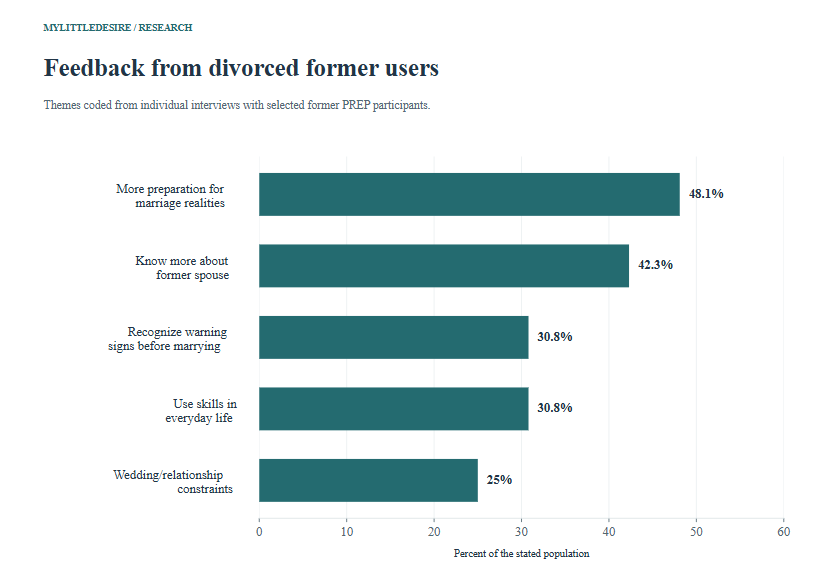
The wedding-constraints theme concerned commitments already in place during preparation, such as wedding plans. It is a retrospective theme rather than a tested deadline for starting counseling. For separate evidence on spending and budgets, see our wedding cost and budget statistics.
Did former partners give the same feedback?
Eighteen former couples had both partners interviewed. The at-least-one-partner percentages describe those 18 couples. Conditional agreement percentages use only the subset of former couples who mentioned the theme; exact subset counts are unavailable in the selected narrative and are not reconstructed from rounded percentages. Scott, Rhoades, Stanley, Allen and Markman [S03].
F14 At least one interviewed partner from each matched former couple expressed the theme. 18 matched former couples, not 52 couples. Individual and couple percentages describe different units; themes overlap. No divorce-prevention effect follows.
| Measure / group | Published result | Population and actual period | Original source |
|---|---|---|---|
| At least one partner wanted to know more about former spouse | 77.8% | 18 former couples with both ex-partners interviewed in selected divorced PREP sample Eligible analysis n=18. 1996 parent-study baseline; post-divorce interviews 2010–2012, with divorce within following 14 years | Original source [S03] Original article Results, Feedback on PREP; NIH manuscript pp.9–11 |
| At least one partner wanted more marriage-realities preparation | 72.2% | 18 former couples with both ex-partners interviewed in selected divorced PREP sample Eligible analysis n=18. 1996 parent-study baseline; post-divorce interviews 2010–2012, with divorce within following 14 years | Original source [S03] Original article Results, Feedback on PREP; NIH manuscript pp.9–11 |
| At least one partner reported difficulty implementing skills | 38.9% | 18 former couples with both ex-partners interviewed in selected divorced PREP sample Eligible analysis n=18. 1996 parent-study baseline; post-divorce interviews 2010–2012, with divorce within following 14 years | Original source [S03] Original article Results, Feedback on PREP; NIH manuscript pp.9–11 |
F15 Both partners mentioned a theme, conditional on at least one partner having mentioned it. Conditional bases differ by theme and exact counts are not stated in the selected narrative. These are not agreement rates among all 18 couples. No counts are reconstructed from rounded percentages.
| Measure / group | Published result | Population and actual period | Original source |
|---|---|---|---|
| Partner-knowledge theme: both partners agreed | 28.6% | Matched former couples where at least one partner expressed the specified feedback theme Exact unweighted item/subgroup n unavailable. 1996 parent-study baseline; post-divorce interviews 2010–2012, with divorce within following 14 years | Original source [S03] Original article Results, Feedback on PREP; NIH manuscript pp.9–11 |
| Marriage-realities theme: both partners agreed | 38.5% | Matched former couples where at least one partner expressed the specified feedback theme Exact unweighted item/subgroup n unavailable. 1996 parent-study baseline; post-divorce interviews 2010–2012, with divorce within following 14 years | Original source [S03] Original article Results, Feedback on PREP; NIH manuscript pp.9–11 |
| Skill-implementation theme: both partners agreed | 42.9% | Matched former couples where at least one partner expressed the specified feedback theme Exact unweighted item/subgroup n unavailable. 1996 parent-study baseline; post-divorce interviews 2010–2012, with divorce within following 14 years | Original source [S03] Original article Results, Feedback on PREP; NIH manuscript pp.9–11 |
What can readers ask when choosing preparation?
AAMFT recommends asking about a therapist’s credentials, relevant training and experience, fit, payment and how progress is assessed. Those are practical selection questions, separate from the statistical observations. AAMFT guidance [G01].
- Does the service provide clinical counseling, education, an assessment inventory, religious preparation or a combination?
- Which goals and outcomes will you discuss, and how will progress be reviewed?
- What qualifications and experience does the provider have for your needs?
- What do fees cover, and is any insurance or other assistance applicable?
- How will you practice skills outside sessions and revisit questions that remain unresolved?
Financial expectations can be one discussion topic. Our couples’ money management statistics cover money practices separately. A preparation program’s ability to discuss a topic is different from evidence that it prevents every related problem.
Which comparisons can readers reproduce?
The workbook reproduces eight descriptive percentage-point differences. They subtract compatible numerical units within a source. Program-user comparisons still have different populations and selection; overlapping themes are not mutually exclusive. No new significance test, causal effect or pooled international estimate is calculated.
| Comparison | First | Second | Difference | Qualification |
|---|---|---|---|---|
| Education participation: 1990–2001 minus 1930–1949 marriage cohort | 44% | 7% | +37 percentage points | Historical cohorts recalled in 2001; not a current national trend. |
| Catholic preparation: inventory minus mentor-couple participation | 48% | 25% | +23 percentage points | Same conditional population, overlapping activities; no effectiveness ranking. |
| Somewhat/very helpful: multi-night classes minus inventory | 74% | 61% | +13 percentage points | Different activity-user bases and self-selection; not a causal program comparison. |
| Weekend very helpful: women minus men | 40% | 16% | +24 percentage points | Gender subgroups, unknown n; retrospective ratings, not differential treatment efficacy. |
| Books very helpful: women minus men | 28% | 12% | +16 percentage points | Different user/gender subgroups; no matched-couple inference. |
| Inventory participation: later Catholic cohorts minus Pre-Vatican II | 64% | 29% | +35 percentage points | Birth cohorts observed in 2007, not the same people tracked over time. |
| Model-predicted five-year divorce probability: no education minus education | 14% | 10% | +4 percentage points | Model illustration at mean controls in an observational survey, not a causal absolute risk reduction. |
| Coded feedback: marriage realities minus wedding constraints | 48.1% | 25% | +23.1 percentage points | Overlapping themes among 52 selected divorced former participants, not a population deficit. |
Common questions
What percentage of couples attend premarital counseling?
The verified sources do not provide a current all-couples rate. One 2001 four-state survey found 31% among currently married respondents, while its 1990–2001 marriage cohort reported 44%. These were individual reports of broad preparation, not national 2027 clinical-counseling attendance.
Does premarital counseling reduce divorce by 31%?
That statement needs qualification. The historical observational study reports 31% lower adjusted annual odds, equivalent to OR 0.69. It does not prove a causal risk reduction. The separately reviewed trial found no overall difference between its service groups.
Is a helpfulness rating a counseling success rate?
No. CARA asked married users how helpful a preparation activity had been. A rating does not establish a prevented divorce or a measured clinical outcome.
How long should premarital counseling last?
The historical eight-hour median is descriptive, not a prescription. The appropriate service and duration depend on its scope and the couple’s needs; ask the provider about the plan and progress review.
Do the divorced participants’ complaints mean PREP failed at those rates?
No. The interviews deliberately selected people who had already divorced. Their coded feedback is useful for program improvement but cannot estimate failure among all participants.
Research method and limitations
MyLittleDesire compiled selected published aggregates from original survey reports and journal articles. AI assisted retrieval, organization and drafting. No new survey, respondent-level reanalysis, treatment recommendation, clinical assessment or causal meta-analysis was conducted. This is a source-based compilation, rather than an exhaustive systematic review.
The 58 observations comprise 30 CARA activity/ratings records, 17 four-state survey records and 11 coded-feedback records. Fifty-one values are percentages; seven retain hours, odds-ratio or SD units. Five supporting research records add interpretation without inflating the observation count. The US intervention papers arise from related research programs and are not automatically independent replications.
- Eligibility: all-survey sample sizes are not substituted for conditional activity-user or subgroup bases. CARA appendix frequencies are weighted and rounded, not unweighted respondent counts.
- Evidence design: reported participation, helpfulness, observational associations, modeled probabilities, coded feedback and randomized comparisons remain distinct.
- Units: odds ratios and SD-unit coefficients are not percentages. Hours are not sessions. Individual and couple counts are not interchangeable.
- Timing: actual 2001, June 2007 and 2010–2012 periods remain visible. A recent publication year is not used as an interview date.
- Scope: the numerical findings are historical US evidence, including a Catholic subgroup. They are not worldwide or representative of every religious, ethnic, income or relationship group.
- Selection and overlap: current married users can differ from divorced former users; the feedback sample lacks a nondivorced comparison. Themes and activity choices overlap.
- Verification: original selected tables/text were checked; numerical results with unresolved conflicts or unavailable full tables are withheld. Unknown answering counts remain unavailable.
Original sources and supporting research
- S01. CARA, Georgetown University / USCCB. Marriage in the Catholic Church: A Survey of U.S. Catholics. Publication: October 2007 on cover; ©2008 in report. Actual period: 2007-06-13 to 2007-06-25; retrospective marriage-preparation experiences. Full record sample: 1,008. Eligible bases: Full survey 1,008 completed responses. Selected body tables use conditional populations; exact unweighted item/subgroup n is not supplied beside them. Appendix frequencies are weighted and rounded, not unweighted respondent counts. Method: Knowledge Networks probability-recruited Internet panel, originally recruited by random telephone methods, with weighting. Methods printed pp.10–12. Selected body results printed pp.70–74. Participation is conditional on currently married, married in the Catholic Church and having met a priest; helpfulness is conditional on having experienced each activity. Historical US Catholic results, not all couples or current counseling uptake. Activities overlap and include books, inventories, classes and mentoring rather than only clinical therapy. Retrospective helpfulness is not causal efficacy. Body percentages retained consistently; appendix percentages include nonresponse and cannot be substituted without denominator checks. No outcome comparison by program or survivor-status causal claim.
- S02. Stanley, Amato, Johnson and Markman. Premarital education, marital quality, and marital stability: Findings from a large, random household survey. Publication: 2006-03. Actual period: 2001 survey; retrospective marriage cohorts 1930–1949 through 1990–2001. Full record sample: 3,344. Eligible bases: Full sample 3,344 individuals, not couples. Currently married case file n=1,977. First-marriage model uses 2,533 individuals and 44,519 person-years (Table 3); the descriptive person-year file is larger. Setting result uses 595 currently married premarital-education participants. Cohort-specific and duration-item answering n unavailable. Method: Random-digit-dial telephone survey, weighted by education, race, gender and age within state; reported response rate 58%. Retrospective self-reports. Logistic discrete-time event-history model and adjusted OLS outcome-standardized coefficients. Original author-provided full-text article checked on ResearchGate and bibliographic record checked in PubMed. Observational associations do not establish that counseling caused a reduction in divorce. The famous 31% refers to lower adjusted annual odds, not a 31-point absolute reduction or a guarantee. Five-year 14%/10% are model predictions at mean controls, not raw trial outcomes. Quality coefficients are SD units, not percentages. Cohorts are retrospectively observed in 2001, not annual national uptake. Some authors have PREP-related interests documented in related work. Supporting records: record 1, record 2.
- S03. Scott, Rhoades, Stanley, Allen and Markman. Reasons for Divorce and Recollections of Premarital Intervention: Implications for Improving Relationship Education. Publication: 2013-06; author manuscript available 2014-06-01. Actual period: 1996 parent-study baseline; post-divorce interviews 2010–2012, with divorce within following 14 years. Full record sample: 52. Eligible bases: Individual coded themes n=52. Couple-level at-least-one-partner themes n=18 matched former couples, not 52 couples. Conditional agreement uses only former couples where at least one partner mentioned the theme; exact conditional counts are not reported in the selected narrative. Method: Retrospective 30-minute telephone interviews with selected divorced participants from a 306-couple premarital study. PREP received through religious organizations (24 people) or university (28). Open-ended feedback was coded into themes; percentages are frequencies of qualitative codes. Original NIH author manuscript and full PMC text checked. No nondivorced comparison group; these percentages cannot estimate PREP failure, all-couples dissatisfaction or national divorce reasons. Mostly White, originally opposite-sex couples marrying mainly through Christian organizations. Themes overlap; recollection averaged 12.2 years after intervention. Individual, couple and conditional-agreement percentages have different denominators. Authors disclose PREP business/royalty interests. Supporting records: record 1, record 2.
Supporting reviews and intervention records
- R01. Fawcett, Hawkins, Blanchard and Carroll. Do Premarital Education Programs Really Work? A Meta-analytic Study. 2010-07-08. Meta-analysis of 47 studies; original university abstract and publisher abstract read, full numerical tables unavailable. Including unpublished evaluations changed conclusions about relationship quality/satisfaction; communication findings were more favorable. Long follow-up was rare. No pooled numerical effects reproduced without full tables. The 47 studies are review metadata, not 47 observations in this package.
- R02. Markman, Rhoades, Stanley and Peterson. A randomized clinical trial of the effectiveness of premarital intervention: Moderators of divorce outcomes. 2013-02. Original indexed abstract; first eight years of first marriage; 193 couples across three service groups. No overall divorce-rate differences between natural services, clergy PREP and university PREP; premarital negative communication moderated results. Active-service comparisons, not a universal counseling-versus-nothing test. Higher-negativity couples had a different pattern. Full outcome tables not retrieved; no trial divorce percentages reproduced. Related parent program can overlap S03 recruitment.
- R03. Yavuzer and Doğanülkü. Development of a systemic premarital counselling programme and evaluating its impact on young adults’ couple relationships: A pilot study. 2023-05-09 online; 2024 journal volume. Original publisher abstract only; 24 selected Turkish university students; eight-session program. Reported changes in communication, romance-sexuality, conflict resolution and acceptance of differences, with follow-up at 12 and 24 weeks. Small selected pilot and relationship-score outcomes, not long-term divorce prevention. Exact fieldwork and full outcome tables unavailable; no numerical effect estimates counted.
- R04. Asadpour, Sharei and Salmani. Premarital intervention based on attachment and differentiation improves communication and conflict management in Iranian couples. 2025-08-09. Original full text checked; 2024 Tehran university counseling population, 20 selected couples. The paper reports short-term communication changes. Its Table 2 shows avoiding scores rising while the abstract describes a reduction; engagement wording and married-dormitory residence also need context. Selected small sample, no long-term follow-up, joint couple questionnaires and unclear analysis-unit handling. Numerical outcome estimates withheld pending clarification; no national or divorce-prevention conclusion.
- R05. Sexual and Relationship Therapy — publisher abstract. Towards improving communication skills and attachment styles in Iranian couples: The attachment-differentiation premarital model. Original publisher abstract checked; 40 individuals / 20 couples in selected Tehran university-center sample. Recent short-term communication and attachment research; no long-term divorce result in the checked abstract. Full outcome tables and exact fieldwork not retrieved. A displayed p≥.001 wording is not silently corrected. Potential sample overlap with earlier research not resolved; no numerical outcomes counted.
Professional guidance
- G01. American Association for Marriage and Family Therapy: Marriage & Family Therapists Therapy Topic — choosing a therapist. Practical guidance for checking credentials, training, experience, fit and payment; generic therapy statistics not adopted.
How to cite this resource
MyLittleDesire. Premarital Counseling Statistics 2027. https://mylittledesire.com/premarital-counseling-statistics/.