
Women’s friendships can be described through their size, composition, everyday contact and sources of support. In Pew’s September 2024 U.S. survey, 54% of women said they would be extremely or very likely to turn to a friend for emotional support. A different July 2023 question found 71% of women with a close friend said all or most of those friends were women. These measures describe different aspects of friendship. Pew Research Center [S01]; Pew Research Center [S02].
This resource contains 77 published observations in 18 groups: 50 female-group findings and 27 male comparators from four studies and three publishers. Four charts and ten descriptive comparisons reuse those inputs. Pew and YouGov provide U.S. adult evidence; a separately labelled AARP section reports summary findings among women age 60+.
54%
71%
of U.S. women would be extremely or very likely to turn to a friend for emotional support in Pew’s September 2024 survey.Original source [S01]
of female friendship holders said all or most of their close friends were women in Pew’s July 2023 survey.Original source [S02]
18%
43%
of female U.S. adult citizens reported no close friends in YouGov’s June 2026 survey.Original source [S03]
of women age 60+ wished for more social connections in AARP’s published study summary. Summary-level evidence; detailed methods unavailable.Original source [S04]
What do women’s friendship statistics measure?
Friend counts describe network size. Same-gender composition describes who is in a network. Contact measures interaction, while support questions may ask about something someone would do or something they have already experienced. Satisfaction, desired closeness and occasional loneliness add further dimensions. No single measure describes the whole friendship experience. See our broader friendship statistics for all-adult context.
Would women turn to friends for emotional support?
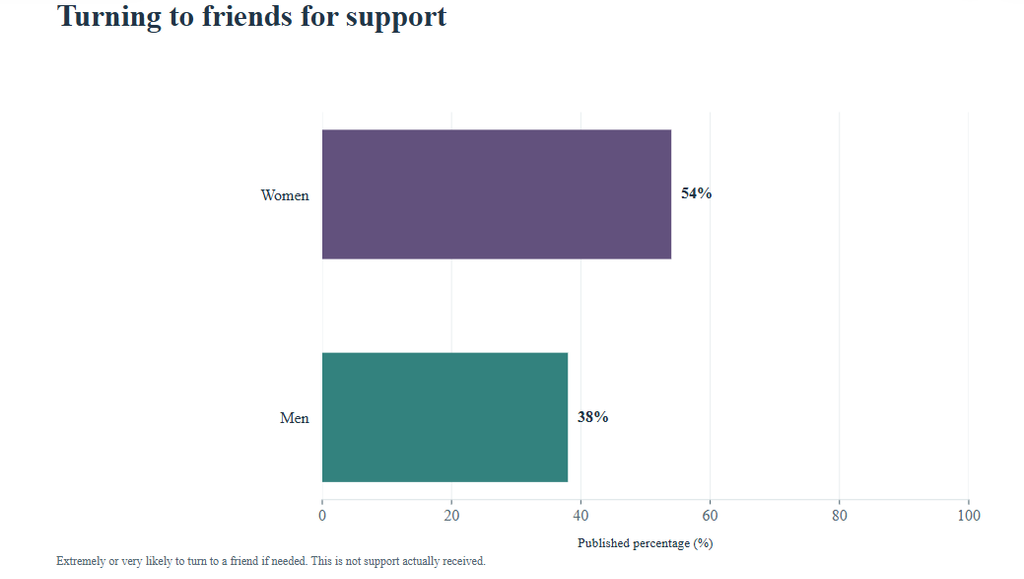
Pew’s 54% female figure measures hypothetical willingness to turn to a friend, compared with 38% among men. It applies to all adults in that question, not only friendship holders. The 16-point difference does not measure the percentage of women receiving support or the number of men lacking it.
F01 Would turn to a friend: extremely/very likely (Pew 2024). Hypothetical likelihood among all adults, not actual support received or a male-friend-only relationship.
| Measure / group | Published result | Population, fieldwork and base | Original source |
|---|---|---|---|
| Would turn to a friend — women | 54% | U.S. adults age 18+; women September 3–15, 2024 · Exact valid subgroup/item n unavailable | Original source [S01] EMOSUPPOTH a; report printed page 5 and chapter 2 |
| Would turn to a friend — men | 38% | U.S. adults age 18+; men September 3–15, 2024 · Exact valid subgroup/item n unavailable | Original source [S01] EMOSUPPOTH a; report printed page 5 and chapter 2 |
Also Read:-
Male Friendship Statistics 2027
Parent Teen Communication Statistics 2027
Multigenerational Household Statistics 2027
Family Time Togetherness Statistics 2027
How many close friends do women have?
In Pew’s July 2023 survey, 55% of women reported one to four close friends outside family and 36% reported five or more. YouGov’s June 2026 question found 18% of female adult citizens reported none and 13% reported exactly one. These are different surveys and populations, so the tables do not form a clean trend.
F04 One to four close friends outside family (Pew 2023). Selected bins are not the full distribution. Do not calculate the no-friend share from a rounded remainder.
| Measure / group | Published result | Population, fieldwork and base | Original source |
|---|---|---|---|
| One to four close friends — women | 55% | U.S. adults age 18+; women July 17–23, 2023 · Exact valid subgroup/item n unavailable | Original source [S02] MANYFRI; article Number of close friends |
| One to four close friends — men | 50% | U.S. adults age 18+; men July 17–23, 2023 · Exact valid subgroup/item n unavailable | Original source [S02] MANYFRI; article Number of close friends |
| Five or more close friends — women | 36% | U.S. adults age 18+; women July 17–23, 2023 · Exact valid subgroup/item n unavailable | Original source [S02] MANYFRI; article Number of close friends |
| Five or more close friends — men | 40% | U.S. adults age 18+; men July 17–23, 2023 · Exact valid subgroup/item n unavailable | Original source [S02] MANYFRI; article Number of close friends |
F12 No close friends (YouGov 2026). Question does not explicitly exclude family. Male/female distributions each sum to 98% after rounding; do not renormalize or reconstruct counts. Item bases male 499, female 564.
| Measure / group | Published result | Population, fieldwork and base | Original source |
|---|---|---|---|
| No close friends — women | 18% | U.S. adult citizens age 18+; women June 5–9, 2026 · Published unweighted item n=564 | Original source [S03] Q6 gender table, printed cross-tab page 7 (PDF page 10) |
| No close friends — men | 14% | U.S. adult citizens age 18+; men June 5–9, 2026 · Published unweighted item n=499 | Original source [S03] Q6 gender table, printed cross-tab page 7 (PDF page 10) |
| Exactly one close friend — women | 13% | U.S. adult citizens age 18+; women June 5–9, 2026 · Published unweighted item n=564 | Original source [S03] Q6 gender table, printed cross-tab page 7 (PDF page 10) |
| Exactly one close friend — men | 13% | U.S. adult citizens age 18+; men June 5–9, 2026 · Published unweighted item n=499 | Original source [S03] Q6 gender table, printed cross-tab page 7 (PDF page 10) |
Are women’s close friends mostly women?
All or most close friends sharing a woman’s gender is different from having only female friends. Pew’s age comparisons also describe separate groups of women and men; they do not track the same person over time.
F05 All/most same-gender friends overall (Pew 2023). Among friendship holders only. A majority same gender is not an all-male network.
| Measure / group | Published result | Population, fieldwork and base | Original source |
|---|---|---|---|
| All or most same-gender friends — women | 71% | U.S. adults age 18+ with at least one close friend outside family; women July 17–23, 2023 · Exact valid subgroup/item n unavailable | Original source [S02] GENFRI; article Gender of friends |
| All or most same-gender friends — men | 61% | U.S. adults age 18+ with at least one close friend outside family; men July 17–23, 2023 · Exact valid subgroup/item n unavailable | Original source [S02] GENFRI; article Gender of friends |
F06 All/most same-gender friends age 50+ (Pew 2023). Cross-sectional groups, not changes as the same men age. Selected subgroup n unknown.
| Measure / group | Published result | Population, fieldwork and base | Original source |
|---|---|---|---|
| All or most same gender, age 50+ — women | 74% | U.S. adults age 50+ with at least one close friend outside family; women July 17–23, 2023 · Exact valid subgroup/item n unavailable | Original source [S02] GENFRI; article Gender of friends, age-by-gender paragraph |
| All or most same gender, age 50+ — men | 59% | U.S. adults age 50+ with at least one close friend outside family; men July 17–23, 2023 · Exact valid subgroup/item n unavailable | Original source [S02] GENFRI; article Gender of friends, age-by-gender paragraph |
| All or most same gender, under 50 — women | 67% | U.S. adults age 18–49 with at least one close friend outside family; women July 17–23, 2023 · Exact valid subgroup/item n unavailable | Original source [S02] GENFRI; article Gender of friends, age-by-gender paragraph |
| All or most same gender, under 50 — men | 63% | U.S. adults age 18–49 with at least one close friend outside family; men July 17–23, 2023 · Exact valid subgroup/item n unavailable | Original source [S02] GENFRI; article Gender of friends, age-by-gender paragraph |
How often do women keep in touch with friends?
Among female friendship holders in the 2024 survey, 66% texted a close friend daily or a few times a week, 45% interacted through social media, 38% used phone/video chat and 28% met in person that frequently. The any-mode figure was 77%. Modes overlap; adding them would count some people more than once.
F02 Frequent see a close friend in person (Pew 2024). Modes overlap. Does not measure daily contact only, time spent or contact with every friend. Retain published male texting NET 56, not rounded 21+34=55.
| Measure / group | Published result | Population, fieldwork and base | Original source |
|---|---|---|---|
| See a close friend in person — women | 28% | U.S. adults age 18+ with at least one close friend outside family; women September 3–15, 2024 · Exact valid subgroup/item n unavailable | Original source [S01] COMMFRI a–d; report printed page 12, gender chart |
| See a close friend in person — men | 31% | U.S. adults age 18+ with at least one close friend outside family; men September 3–15, 2024 · Exact valid subgroup/item n unavailable | Original source [S01] COMMFRI a–d; report printed page 12, gender chart |
| Phone or video chat — women | 38% | U.S. adults age 18+ with at least one close friend outside family; women September 3–15, 2024 · Exact valid subgroup/item n unavailable | Original source [S01] COMMFRI a–d; report printed page 12, gender chart |
| Phone or video chat — men | 32% | U.S. adults age 18+ with at least one close friend outside family; men September 3–15, 2024 · Exact valid subgroup/item n unavailable | Original source [S01] COMMFRI a–d; report printed page 12, gender chart |
| Interact on social media — women | 45% | U.S. adults age 18+ with at least one close friend outside family; women September 3–15, 2024 · Exact valid subgroup/item n unavailable | Original source [S01] COMMFRI a–d; report printed page 12, gender chart |
| Interact on social media — men | 33% | U.S. adults age 18+ with at least one close friend outside family; men September 3–15, 2024 · Exact valid subgroup/item n unavailable | Original source [S01] COMMFRI a–d; report printed page 12, gender chart |
| Text a close friend — women | 66% | U.S. adults age 18+ with at least one close friend outside family; women September 3–15, 2024 · Exact valid subgroup/item n unavailable | Original source [S01] COMMFRI a–d; report printed page 12, gender chart |
| Text a close friend — men | 56% | U.S. adults age 18+ with at least one close friend outside family; men September 3–15, 2024 · Exact valid subgroup/item n unavailable | Original source [S01] COMMFRI a–d; report printed page 12, gender chart |
| Any of the four contact modes — women | 77% | U.S. adult women with at least one close friend outside family September 3–15, 2024 · Exact valid subgroup/item n unavailable | Original source [S01] COMMFRI derived any-mode NET; original report printed page 12 |
| Any of the four contact modes — men | 70% | U.S. adult men with at least one close friend outside family September 3–15, 2024 · Exact valid subgroup/item n unavailable | Original source [S01] COMMFRI derived any-mode NET; original report printed page 12 |
How does women’s friend contact differ by age?
Pew’s 2024 gender-by-age chart reports lower frequent texting and social-media contact among older female friendship holders. For example, texting was 73% at ages 18–29 and 53% at 65+, a descriptive 20-point difference. This is an age-group comparison, not a finding that an individual woman’s contact must decline as she gets older.
F03 At least daily or a few times a week, among women with a close friend outside family. Cross-sectional age groups, not changes in the same women over time. Modes overlap; subgroup bases unknown.
| Measure / group | Published result | Population, fieldwork and base | Original source |
|---|---|---|---|
| Text a close friend — women 18–29 | 73% | U.S. women age 18–29 with at least one close friend outside family September 3–15, 2024 · Exact valid subgroup/item n unavailable | Original source [S01] Original report printed page 13, gender-by-age chart |
| Text a close friend — women 30–49 | 72% | U.S. women age 30–49 with at least one close friend outside family September 3–15, 2024 · Exact valid subgroup/item n unavailable | Original source [S01] Original report printed page 13, gender-by-age chart |
| Text a close friend — women 50–64 | 63% | U.S. women age 50–64 with at least one close friend outside family September 3–15, 2024 · Exact valid subgroup/item n unavailable | Original source [S01] Original report printed page 13, gender-by-age chart |
| Text a close friend — women 65+ | 53% | U.S. women age 65+ with at least one close friend outside family September 3–15, 2024 · Exact valid subgroup/item n unavailable | Original source [S01] Original report printed page 13, gender-by-age chart |
| Interact on social media — women 18–29 | 62% | U.S. women age 18–29 with at least one close friend outside family September 3–15, 2024 · Exact valid subgroup/item n unavailable | Original source [S01] Original report printed page 13, gender-by-age chart |
| Interact on social media — women 30–49 | 55% | U.S. women age 30–49 with at least one close friend outside family September 3–15, 2024 · Exact valid subgroup/item n unavailable | Original source [S01] Original report printed page 13, gender-by-age chart |
| Interact on social media — women 50–64 | 37% | U.S. women age 50–64 with at least one close friend outside family September 3–15, 2024 · Exact valid subgroup/item n unavailable | Original source [S01] Original report printed page 13, gender-by-age chart |
| Interact on social media — women 65+ | 27% | U.S. women age 65+ with at least one close friend outside family September 3–15, 2024 · Exact valid subgroup/item n unavailable | Original source [S01] Original report printed page 13, gender-by-age chart |

What do women discuss with close friends?
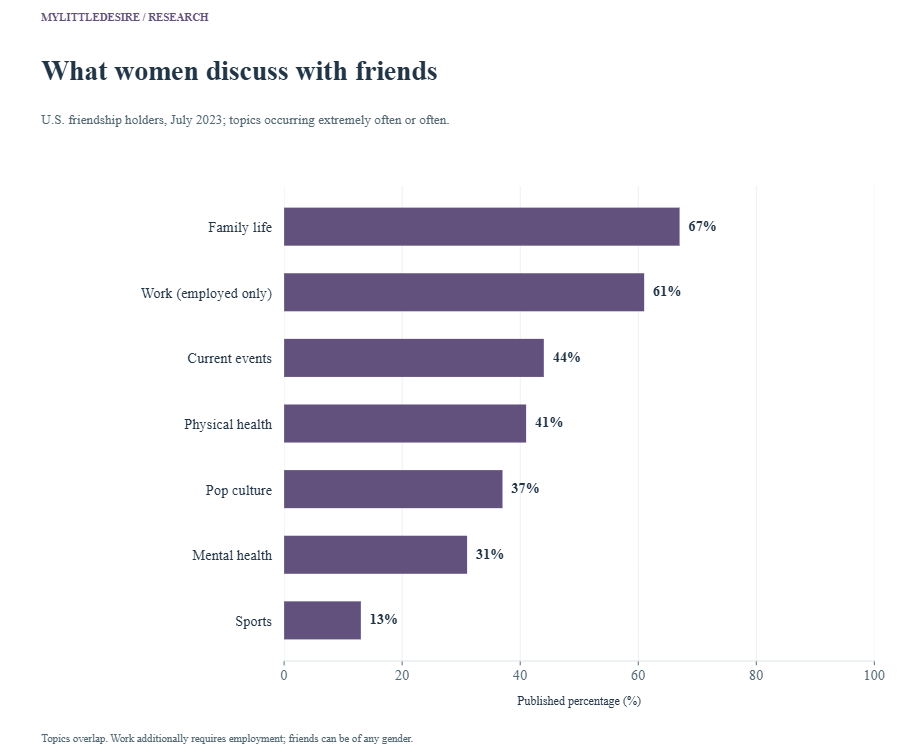
Family life, work, current events and health were among the conversation topics studied by Pew. Each topic can appear alongside others. Work figures require employment in addition to having a close friend. The mental-health finding for women under 50 covers ages 18–49, not only young adults.
F07 Discuss pop culture extremely often/often (Pew 2023). Topics overlap. Work is restricted to employed friendship holders; other topics use all friendship holders. Frequency is not topic importance or friendship quality.
| Measure / group | Published result | Population, fieldwork and base | Original source |
|---|---|---|---|
| Pop culture — women | 37% | U.S. adults age 18+ with at least one close friend outside family; women July 17–23, 2023 · Exact valid subgroup/item n unavailable | Original source [S02] TOPICTALK a–g; article Topics of conversation / Differences by gender |
| Pop culture — men | 32% | U.S. adults age 18+ with at least one close friend outside family; men July 17–23, 2023 · Exact valid subgroup/item n unavailable | Original source [S02] TOPICTALK a–g; article Topics of conversation / Differences by gender |
| Current events — women | 44% | U.S. adults age 18+ with at least one close friend outside family; women July 17–23, 2023 · Exact valid subgroup/item n unavailable | Original source [S02] TOPICTALK a–g; article Topics of conversation / Differences by gender |
| Current events — men | 53% | U.S. adults age 18+ with at least one close friend outside family; men July 17–23, 2023 · Exact valid subgroup/item n unavailable | Original source [S02] TOPICTALK a–g; article Topics of conversation / Differences by gender |
| Family life — women | 67% | U.S. adults age 18+ with at least one close friend outside family; women July 17–23, 2023 · Exact valid subgroup/item n unavailable | Original source [S02] TOPICTALK a–g; article Topics of conversation / Differences by gender |
| Family life — men | 47% | U.S. adults age 18+ with at least one close friend outside family; men July 17–23, 2023 · Exact valid subgroup/item n unavailable | Original source [S02] TOPICTALK a–g; article Topics of conversation / Differences by gender |
| Mental health — women | 31% | U.S. adults age 18+ with at least one close friend outside family; women July 17–23, 2023 · Exact valid subgroup/item n unavailable | Original source [S02] TOPICTALK a–g; article Topics of conversation / Differences by gender |
| Mental health — men | 15% | U.S. adults age 18+ with at least one close friend outside family; men July 17–23, 2023 · Exact valid subgroup/item n unavailable | Original source [S02] TOPICTALK a–g; article Topics of conversation / Differences by gender |
| Physical health — women | 41% | U.S. adults age 18+ with at least one close friend outside family; women July 17–23, 2023 · Exact valid subgroup/item n unavailable | Original source [S02] TOPICTALK a–g; article Topics of conversation / Differences by gender |
| Physical health — men | 31% | U.S. adults age 18+ with at least one close friend outside family; men July 17–23, 2023 · Exact valid subgroup/item n unavailable | Original source [S02] TOPICTALK a–g; article Topics of conversation / Differences by gender |
| Sports — women | 13% | U.S. adults age 18+ with at least one close friend outside family; women July 17–23, 2023 · Exact valid subgroup/item n unavailable | Original source [S02] TOPICTALK a–g; article Topics of conversation / Differences by gender |
| Sports — men | 37% | U.S. adults age 18+ with at least one close friend outside family; men July 17–23, 2023 · Exact valid subgroup/item n unavailable | Original source [S02] TOPICTALK a–g; article Topics of conversation / Differences by gender |
| Work — women | 61% | U.S. employed adults age 18+ with at least one close friend outside family; women July 17–23, 2023 · Exact valid subgroup/item n unavailable | Original source [S02] TOPICTALK a–g; article Topics of conversation / Differences by gender |
| Work — men | 54% | U.S. employed adults age 18+ with at least one close friend outside family; men July 17–23, 2023 · Exact valid subgroup/item n unavailable | Original source [S02] TOPICTALK a–g; article Topics of conversation / Differences by gender |
F08 Frequent mental-health discussion age under 50 (Pew 2023). Under 50 means ages 18–49, not only young adults or Gen Z. No causal interpretation.
| Measure / group | Published result | Population, fieldwork and base | Original source |
|---|---|---|---|
| Mental-health discussion, under 50 — women | 43% | U.S. adults age 18–49 with at least one close friend outside family; women July 17–23, 2023 · Exact valid subgroup/item n unavailable | Original source [S02] TOPICTALK f; article Differences by gender |
| Mental-health discussion, under 50 — men | 20% | U.S. adults age 18–49 with at least one close friend outside family; men July 17–23, 2023 · Exact valid subgroup/item n unavailable | Original source [S02] TOPICTALK f; article Differences by gender |
How difficult is making friends in 2026?
YouGov’s 2026 survey separates perceived difficulty from enjoyment. Women reporting friend-making as somewhat difficult (17%) or very difficult (15%) selected different categories on one question; 27% said they enjoyed making friends a lot on another. Those are separate experiences, and the gender comparisons do not establish statistical significance.
F09 Somewhat difficult to make new friends (YouGov 2026). Somewhat and very difficult are separate published categories. No new combined estimate or significance test. Item bases male 502, female 564.
| Measure / group | Published result | Population, fieldwork and base | Original source |
|---|---|---|---|
| Somewhat difficult — women | 17% | U.S. adult citizens age 18+; women June 5–9, 2026 · Published unweighted item n=564 | Original source [S03] Q1 gender table, printed cross-tab page 1 (PDF page 4) |
| Somewhat difficult — men | 23% | U.S. adult citizens age 18+; men June 5–9, 2026 · Published unweighted item n=502 | Original source [S03] Q1 gender table, printed cross-tab page 1 (PDF page 4) |
| Very difficult — women | 15% | U.S. adult citizens age 18+; women June 5–9, 2026 · Published unweighted item n=564 | Original source [S03] Q1 gender table, printed cross-tab page 1 (PDF page 4) |
| Very difficult — men | 14% | U.S. adult citizens age 18+; men June 5–9, 2026 · Published unweighted item n=502 | Original source [S03] Q1 gender table, printed cross-tab page 1 (PDF page 4) |
F10 Enjoy making new friends a lot (YouGov 2026). Enjoyment is different from ease, actual success or the number of friends. Item bases male 501, female 562.
| Measure / group | Published result | Population, fieldwork and base | Original source |
|---|---|---|---|
| Enjoy making new friends a lot — women | 27% | U.S. adult citizens age 18+; women June 5–9, 2026 · Published unweighted item n=562 | Original source [S03] Q2 gender table, printed cross-tab page 2 (PDF page 5) |
| Enjoy making new friends a lot — men | 29% | U.S. adult citizens age 18+; men June 5–9, 2026 · Published unweighted item n=501 | Original source [S03] Q2 gender table, printed cross-tab page 2 (PDF page 5) |
What do women want from friendships?
Preferences are not ratings of existing friendships. In YouGov’s survey, 30% of female adult citizens preferred very close friendships. Selected desired-count responses included 6% preferring none and 8% preferring eleven or more. Actual and desired counts have different item bases, so their difference cannot identify which individual women have fewer friends than they want.
F11 Ideal friendship closeness: very close (YouGov 2026). Preference is not a rating of existing friendships. Item bases male 501, female 563.
| Measure / group | Published result | Population, fieldwork and base | Original source |
|---|---|---|---|
| Prefer very close friendships — women | 30% | U.S. adult citizens age 18+; women June 5–9, 2026 · Published unweighted item n=563 | Original source [S03] Q3 gender table, printed cross-tab page 3 (PDF page 6) |
| Prefer very close friendships — men | 25% | U.S. adult citizens age 18+; men June 5–9, 2026 · Published unweighted item n=501 | Original source [S03] Q3 gender table, printed cross-tab page 3 (PDF page 6) |
F13 Ideal number of close friends: 11+ (YouGov 2026). Selected categories, not a full distribution or average. Actual and ideal counts use separate item bases, so differences do not identify unmet wishes of individual people. Item bases male 500, female 563.
| Measure / group | Published result | Population, fieldwork and base | Original source |
|---|---|---|---|
| Ideally eleven or more close friends — women | 8% | U.S. adult citizens age 18+; women June 5–9, 2026 · Published unweighted item n=563 | Original source [S03] Q7 gender table, printed cross-tab page 9 (PDF page 12) |
| Ideally eleven or more close friends — men | 14% | U.S. adult citizens age 18+; men June 5–9, 2026 · Published unweighted item n=500 | Original source [S03] Q7 gender table, printed cross-tab page 9 (PDF page 12) |
| Ideally no close friends — women | 6% | U.S. adult citizens age 18+; women June 5–9, 2026 · Published unweighted item n=563 | Original source [S03] Q7 gender table, printed cross-tab page 9 (PDF page 12) |
| Ideally no close friends — men | 5% | U.S. adult citizens age 18+; men June 5–9, 2026 · Published unweighted item n=500 | Original source [S03] Q7 gender table, printed cross-tab page 9 (PDF page 12) |
What does AARP report about women’s connections after 60?
Summary evidence, with limits. The following 15 observations come from AARP’s original publisher summaries of a survey of 1,400 women age 40+. Selected findings concern women age 60+; 1,400 is not their valid subgroup base. Underlying fact-sheet, questionnaire and methodology PDFs were identified but were inaccessible. Exact subgroup bases, weighting, detailed routing and geographic target were not independently established. Read these as findings in the stated AARP study, without extending them to all older women or claiming national representativeness. The separate Ethel Facebook-group member survey is excluded.
AARP defines these social connections as friends and acquaintances outside family, a broader scope than close friends. Its weekly-or-more contact figures use a different threshold from Pew’s daily-or-several-times-weekly measures. The two sets should not be directly subtracted.
F14 Weekly-or-more contact with friends/acquaintances outside family, as summarized by the publisher. Published AARP summary only. Exact age-60+ item n, detailed routing, weighting and geographic target not independently established; full 1,400 is not this subgroup base. Broader than close friends; weekly threshold differs from Pew’s daily-or-several-times-weekly threshold. Modes overlap.
| Measure / group | Published result | Population, fieldwork and base | Original source |
|---|---|---|---|
| Text messaging weekly or more often | 81% | Women age 60+ in AARP’s broader study of women age 40+; friends and acquaintances outside family October 24–November 1, 2024, as identified in AARP’s research overview · Exact valid subgroup/item n unavailable | Original source [S04] AARP original summary, Making time to connect paragraph |
| Phone contact weekly or more often | 62% | Women age 60+ in AARP’s broader study of women age 40+; friends and acquaintances outside family October 24–November 1, 2024, as identified in AARP’s research overview · Exact valid subgroup/item n unavailable | Original source [S04] AARP original summary, Making time to connect paragraph |
| Social-media contact weekly or more often | 60% | Women age 60+ in AARP’s broader study of women age 40+; friends and acquaintances outside family October 24–November 1, 2024, as identified in AARP’s research overview · Exact valid subgroup/item n unavailable | Original source [S04] AARP original summary, Making time to connect paragraph |
| In-person contact weekly or more often | 59% | Women age 60+ in AARP’s broader study of women age 40+; friends and acquaintances outside family October 24–November 1, 2024, as identified in AARP’s research overview · Exact valid subgroup/item n unavailable | Original source [S04] AARP original summary, Making time to connect paragraph |

F15 Selected social activities as described in AARP’s publisher summary. Published AARP summary only. Exact age-60+ item n, detailed routing, weighting and geographic target not independently established; full 1,400 is not this subgroup base. Exact recall window/response threshold not provided in the retrieved summary; categories may overlap.
| Measure / group | Published result | Population, fieldwork and base | Original source |
|---|---|---|---|
| Planned social events or gatherings | 45% | Women age 60+ in AARP’s broader study of women age 40+; friends and acquaintances outside family October 24–November 1, 2024, as identified in AARP’s research overview · Exact valid subgroup/item n unavailable | Original source [S04] AARP original summary, Socializing outside the home, activity paragraph |
| Participated through hobbies/special-interest groups | 40% | Women age 60+ in AARP’s broader study of women age 40+; friends and acquaintances outside family October 24–November 1, 2024, as identified in AARP’s research overview · Exact valid subgroup/item n unavailable | Original source [S04] AARP original summary, Socializing outside the home, activity paragraph |
| Organized physical activities or classes | 36% | Women age 60+ in AARP’s broader study of women age 40+; friends and acquaintances outside family October 24–November 1, 2024, as identified in AARP’s research overview · Exact valid subgroup/item n unavailable | Original source [S04] AARP original summary, Socializing outside the home, activity paragraph |
| Volunteered in the community | 29% | Women age 60+ in AARP’s broader study of women age 40+; friends and acquaintances outside family October 24–November 1, 2024, as identified in AARP’s research overview · Exact valid subgroup/item n unavailable | Original source [S04] AARP original summary, Socializing outside the home, activity paragraph |
F16 Support, understanding and quality-satisfaction measures as summarized by AARP. Published AARP summary only. Exact age-60+ item n, detailed routing, weighting and geographic target not independently established; full 1,400 is not this subgroup base. Exact response-scale cutoffs unavailable. These are three different measures; no complement, causal effect or individual-level overlap inferred.
| Measure / group | Published result | Population, fieldwork and base | Original source |
|---|---|---|---|
| Reported a strong support system among friends | 81% | Women age 60+ in AARP’s broader study of women age 40+; friends and acquaintances outside family October 24–November 1, 2024, as identified in AARP’s research overview · Exact valid subgroup/item n unavailable | Original source [S04] AARP original summary, Deep connections paragraph |
| Believed friends understood them well | 92% | Women age 60+ in AARP’s broader study of women age 40+; friends and acquaintances outside family October 24–November 1, 2024, as identified in AARP’s research overview · Exact valid subgroup/item n unavailable | Original source [S04] AARP original summary, Deep connections paragraph |
| Satisfied with quality of social connections | 91% | Women age 60+ in AARP’s broader study of women age 40+; friends and acquaintances outside family October 24–November 1, 2024, as identified in AARP’s research overview · Exact valid subgroup/item n unavailable | Original source [S04] AARP original summary, Deep connections paragraph |
F17 Connection wishes, perceived friend-making difficulty and occasional loneliness as summarized by AARP. Published AARP summary only. Exact age-60+ item n, detailed routing, weighting and geographic target not independently established; full 1,400 is not this subgroup base. Distinct constructs, not an exclusive distribution. Occasional loneliness is not a validated clinical threshold; exact item scales not retrieved.
| Measure / group | Published result | Population, fieldwork and base | Original source |
|---|---|---|---|
| Wished for more social connections | 43% | Women age 60+ in AARP’s broader study of women age 40+; friends and acquaintances outside family October 24–November 1, 2024, as identified in AARP’s research overview · Exact valid subgroup/item n unavailable | Original source [S04] AARP original summary, But social interaction paragraph |
| Said making friends could be difficult | 40% | Women age 60+ in AARP’s broader study of women age 40+; friends and acquaintances outside family October 24–November 1, 2024, as identified in AARP’s research overview · Exact valid subgroup/item n unavailable | Original source [S04] AARP original summary, But social interaction paragraph |
| Experienced loneliness from time to time | 34% | Women age 60+ in AARP’s broader study of women age 40+; friends and acquaintances outside family October 24–November 1, 2024, as identified in AARP’s research overview · Exact valid subgroup/item n unavailable | Original source [S04] AARP original summary, But social interaction paragraph |
F18 Social connections were important to well-being, in AARP’s original women’s-research overview. Published AARP summary only. Exact age-60+ item n, detailed routing, weighting and geographic target not independently established; full 1,400 is not this subgroup base. Stated importance, not evidence of a treatment effect; detailed response threshold not independently verified.
| Measure / group | Published result | Population, fieldwork and base | Original source |
|---|---|---|---|
| Social connections important to well-being | 90% | Women age 60+ in AARP’s broader study of women age 40+; friends and acquaintances outside family October 24–November 1, 2024, as identified in AARP’s research overview · Exact valid subgroup/item n unavailable | Original source [S04] AARP Research Insights on Women, Mental Health and Social Well-Being; same October 2024 study |
How should these findings be interpreted?
Choose the statistic whose question, population and fieldwork match the statement being made. A finding about women’s friends of any gender should not become a claim about exclusively female–female relationships. Neither frequent contact nor having many friends proves friendship quality.
Friend count is also different from loneliness. A woman can have friends and still want closer or more satisfying connection. AARP’s occasional-loneliness wording is not interchangeable with another study’s frequency scale or validated index. See our loneliness statistics for those distinctions.
Ten reproducible descriptive comparisons
Each result subtracts the second published percentage from the first and is expressed in percentage points. The inputs are rounded published estimates. No new confidence interval, significance test or causal effect is calculated. The workbook retrieves inputs by stable observation ID and checks units and measure types.
| ID | Comparison | First | Second | Difference | Qualification |
|---|---|---|---|---|---|
| C01 | Would turn to a friend: women minus men | 54% | 38% | +16 percentage points | Hypothetical support likelihood among all adults, not actual receipt. Rounded inputs; descriptive arithmetic without a new significance test. |
| C02 | Frequent texting: women minus men | 66% | 56% | +10 percentage points | Friendship holders; published male NET 56 retained despite rounded component sum. Rounded inputs; descriptive arithmetic without a new significance test. |
| C03 | Frequent in-person contact: women minus men | 28% | 31% | -3 percentage points | At least a few times a week among friendship holders, not time spent. Rounded inputs; descriptive arithmetic without a new significance test. |
| C04 | One to four close friends: women minus men | 55% | 50% | +5 percentage points | Counts exclude family; selected response bin, not an average count. Rounded inputs; descriptive arithmetic without a new significance test. |
| C05 | Frequent mental-health discussion: women minus men | 31% | 15% | +16 percentage points | Extremely often/often among friendship holders. Rounded inputs; descriptive arithmetic without a new significance test. |
| C06 | Same-gender majority age 50+: women minus men | 74% | 59% | +15 percentage points | Age 50+ friendship holders, not an effect of aging or friendship quality. Rounded inputs; descriptive arithmetic without a new significance test. |
| C07 | Women’s frequent texting: age 18–29 minus 65+ | 73% | 53% | +20 percentage points | Separate age groups, not change over an individual woman’s life. Rounded inputs; descriptive arithmetic without a new significance test. |
| C08 | Women’s frequent social-media contact: age 18–29 minus 65+ | 62% | 27% | +35 percentage points | Separate age groups and unknown valid subgroup bases. Rounded inputs; descriptive arithmetic without a new significance test. |
| C09 | No close friends in 2026: women minus men | 18% | 14% | +4 percentage points | U.S. adult citizens; unweighted item bases 564 women and 499 men. Rounded inputs; descriptive arithmetic without a new significance test. |
| C10 | Exactly one close friend in 2026: women minus men | 13% | 13% | +0 percentage points | Equal rounded rates do not mean equivalent individual experiences. Rounded inputs; descriptive arithmetic without a new significance test. |
Common questions about women’s friendship
What percentage of women have no close friends?
YouGov’s June 5–9, 2026 survey found 18% of female U.S. adult citizens reported no close friends. The unweighted female item base was 564. This specific survey question does not explicitly exclude family.
Are women’s close friends mainly other women?
In Pew’s July 2023 survey, 71% of female adults with a close friend outside family said all or most of those friends were women. All or most is not the same as having exclusively female friends.
How often do women discuss mental health with friends?
Pew found 31% of female friendship holders discussed mental health extremely often or often in July 2023. Among female friendship holders younger than 50, the figure was 43%; that age band spans 18–49.
Do women text close friends more often than men?
In Pew’s September 2024 survey, 66% of female and 56% of male friendship holders texted a close friend daily or a few times a week. The 10-point difference is descriptive arithmetic.
Do older women necessarily lose connection as they age?
The selected studies do not track the same women over time. Cross-sectional age differences in contact should not be read as a universal individual trajectory.
Is AARP’s 1,400 the sample for every women-60+ figure?
No. The full study covered women age 40+. Exact selected age-60+ item bases were not established, and the underlying PDFs were inaccessible. The summary findings are labelled separately.
Do social connections in the AARP section mean close friends?
No. AARP’s definition includes friends and acquaintances outside family. Its contact threshold and study scope differ from the Pew close-friend questions.
Research method and limitations
Selection and concentration. We selected original-publisher evidence about friend counts, composition, support, communication, formation, preferences and older women’s social connections. There are 77 observations in 18 groups from four studies and three publishers: Pew 2024 has 20, Pew 2023 has 26, YouGov 2026 has 16 and AARP 2024 has 15. Fifty observations describe female groups and 27 are male comparators. Related categories and subgroup cells are not independent studies; charts and comparisons reuse the inputs. MyLittleDesire conducted no survey.
Verification levels. Original Pew articles, report graphics, toplines and methods were checked, along with YouGov’s original gender tables and methods. The AARP section uses 15 original publisher-summary observations, clearly distinguished from table-verified evidence. AARP research-overview dates and the full study identities were checked; inaccessible underlying PDFs mean exact routing, weighting, geographic coverage and response cutoffs were not independently verified. No Ethel member-survey findings were selected. Confidential respondent-level data were not audited.
Sample bases and uncertainty. Sixteen YouGov observations preserve published unweighted gender-by-item bases. Sixty-one selected bases remain unknown, and all weighted item bases and selected estimate intervals remain unavailable. Full study sizes and mixed-gender route totals are not substituted for valid subgroup n. No respondent counts, intervals or significance tests are reconstructed, and no overall margin is attached to a gender cell.
Definitions and coverage. Pew’s friend counts and contact routes exclude family. YouGov’s question does not explicitly do so and targets adult citizens. Work-topic figures require employment. AARP’s older-women definition includes acquaintances outside family and should remain confined to the stated study. Contact thresholds, satisfaction, support, preferences and occasional loneliness remain separate. Most figures do not specify the friend’s gender. Published combined NETs are retained where rounded components differ.
Interpretation and maintenance. These descriptive, cross-sectional findings do not establish causal gender effects, individual change with age, a universal female-friendship pattern, clinical benefit or an ideal friend count. No pooled global estimate or cross-survey trend is presented. Recheck original questions, routes, sample bases and fieldwork before updating; use genuinely comparable future waves to describe change. Keep the evergreen URL and change the review date after substantive source work.
Original sources and supporting records
- Pew Research Center. Men, Women and Social Connections: support and friend contact [S01]
Published: January 16, 2025. Actual fieldwork: September 3–15, 2024.
Population: U.S. adults age 18+; communication questions only for those with at least one close friend outside family.
Full study sample: 6,204. 6,204 adults in the full study; COMMFRI route n=5,107 across all genders, not the selected male/female valid bases..
Bases: Exact selected gender-by-item n not established. Friend-support likelihood asks all adults; communication is restricted to friendship holders.
Method: Probability-based American Trends Panel plus Black/Hispanic oversample from SSRS Opinion Panel. Web or live telephone interviews; weighted to the U.S. adult population. Original article, report, topline and methods checked.
Limits: Hypothetical support likelihood differs from receiving support. Frequent contact means daily or a few times a week, not every day. Modes overlap and contact with any close friend does not imply a male friend or contact with every friend. Published texting NET for men is 56, despite rounded component sum 21+34=55. Selected subgroup n unknown; 5,107 is not the male base.
Supporting record 1 · Supporting record 2 · Supporting record 3 - Pew Research Center. What does friendship look like in America? [S02]
Published: October 12, 2023. Actual fieldwork: July 17–23, 2023.
Population: U.S. adults age 18+; counts exclude family; composition/topics among those with at least one close friend; work topic also requires employment.
Full study sample: 5,057. 5,057 adults; full-study men n=2,807, women n=2,191. Friendship-holder route n=4,618; employed friendship-holder work route n=2,880. These are not every selected valid subgroup/item base..
Bases: Selected gender-by-item and gender-by-age n unknown. Full gender samples are eligibility context, not item-complete bases.
Method: American Trends Panel probability sample recruited through residential addresses; weighted for gender, race/ethnicity, party, education and other factors. Original article and three-page topline checked; linked Wave 131 methods checked despite its women-in-politics page title.
Limits: Friend counts, same-gender composition and topic frequency are different constructs. Topic NET is extremely often/often; work applies to employed friendship holders only. Same-gender majority does not mean all friends are men. All/most published combined figures retained instead of recomputing rounded components. Age comparisons are cross-sectional.
Supporting record 1 · Supporting record 2 - YouGov. Friendship and Loneliness: gender cross-tabulations [S03]
Published: 2026; exact release day not stated in the retrieved tables. Actual fieldwork: June 5–9, 2026.
Population: U.S. adult citizens age 18+; male and female columns of the published cross-tabulations.
Full study sample: 1,066. 1,066 adult citizens overall. Item-valid male/female bases vary by question and are preserved per observation..
Bases: Q1 male/female n=502/564; Q2 n=501/562; Q3 n=501/563; Q6 n=499/564; Q7 n=500/563. Weighted item bases not published.
Method: Web interviews from YouGov’s opt-in panel, weighted by demographics, region, political variables and registration. Original gender tables and methods checked. Publisher reports overall weighting-adjusted margin of error ±4.3 points; not assigned to gender cells or interpreted as proof of probability sampling.
Limits: Citizen population differs from Pew/APS all-adult targets. Responses and totals are rounded; the full Q6 gender distributions sum to 98%. No renormalization, reconstructed counts, new intervals or significance tests. Actual versus desired counts are separate item distributions with different bases, not the percentage of individuals whose wishes are unmet. - AARP Research. The Vital Role of Social Connections in Women’s Lives — publisher summaries [S04]
Published: December 18, 2024. Actual fieldwork: October 24–November 1, 2024, as identified in AARP’s research overview.
Population: Women age 60+ in the broader study of women age 40+; social connections include friends and acquaintances outside family.
Full study sample: 1,400. 1,400 women age 40+ overall. This is not the selected age-60+ or valid item base. Separate September Ethel Facebook-group survey n=1,696 excluded..
Bases: Selected age-60+ unweighted and weighted bases unknown; exact item routing and response-scale details not established from the summaries.
Method: Original AARP Research summary retrieved through search, plus AARP’s original women’s-research overview for exact fieldwork span and importance item. Full fact sheet/questionnaire/methods identities and URLs confirmed through Crossref publisher-deposited DOI metadata. Direct page and PDF access was denied; PDF contents, weighting, geographic target and detailed routing not independently verified. Do not describe this selection as nationally representative.
Limits: Summary-level evidence only, labelled separately from fully inspected survey tables. Older women only, not all women. Friends/acquaintances broader than close friends. Activity recall windows and exact agreement/satisfaction cutoffs unavailable. No causal health benefit or effect of Facebook membership inferred. Separate Ethel member survey and its promotion metrics excluded.
Supporting record 1 · Supporting record 2 · Supporting record 3 · Supporting record 4
How to cite this resource
MyLittleDesire. Women’s Friendship Statistics 2027. https://mylittledesire.com/womens-friendship-statistics/.