In Pew’s October 2019 US survey, 23% of partnered adults whose current partner used social media said they had ever felt jealous or unsure because of that partner’s interactions with other people on these platforms. The percentage rose to 34% among respondents aged 18–29. The question combines jealousy and uncertainty; it is not a rate for all adults or a count of cheating incidents. Pew Research Center [S01].
This resource contains 54 published observations in 17 grouped findings, with four charts. It separates 23 jealousy-response observations from 19 related findings about relationship posts, checking an ex and connection benefits, plus 12 research correlations or scale means. Four original research records contribute the observations; one university summary and two guidance organizations add context.
23%
34%
Ever felt jealous or unsure about a current partner’s social-media interactions.US partnered adults whose partner uses social media; October 2019; n=2,187. Pew Research Center [S01]
The same jealousy-or-uncertainty response among ages 18–29.US conditional partnered subgroup; October 2019; subgroup n unavailable. Pew Research Center [S01]
27%
−0.26
Social media made them feel jealous or unsure a little or a lot.US social-media-using teens with dating experience; 2014–2015; n=317. Pew Research Center [S02]
Correlation of T2 jealousy with T3 relationship satisfaction.Selected continuing-relationship cohort; published 2025. A coefficient, not a percentage. Métellus, Vaillancourt-Morel, Brassard and Daspe [S03]
What do social media jealousy statistics measure?
This page focuses on romantic jealousy linked to social-media activity. Feeling threatened by a possible romantic rival differs from envying someone’s lifestyle, feeling excluded by friends, or resenting time spent on a phone. Checking a profile is a behavior; feeling worse after seeing a relationship post is a reaction. Neither alone establishes jealousy. Pew’s separate questions [S01]; the longitudinal study’s measures [S03].
| Measure | What it describes | Interpretation limit |
|---|---|---|
| Jealous or unsure response | Ever-experience with a current partner in the adult survey; a feeling response in the teen survey. | The combined wording does not isolate jealousy or establish a diagnosis. |
| Relationship-post reaction | Feeling better, worse or little difference about one’s own relationship/dating life. | Related comparison context, rather than jealousy prevalence. |
| Checking an ex | Ever looking up a former romantic partner through social media. | Does not establish motive, compulsive monitoring or unwanted contact. |
| Research correlation | How two measured scores vary together in a selected sample. | A coefficient is not a percentage or causal effect. |
| Scale mean | Average reported score under a particular questionnaire. | Not the share of people who are jealous; scale versions cannot be compared casually. |
For broader measures of relationship quality, see our relationship satisfaction, trust and communication statistics.
ALSO READ:-
Relationship Arguments And Conflict Statistics 2027
First Date Safety Statistics 2027
How Couples Meet Statistics 2027
Dating After Divorce Statistics 2027
Dating Over 50 Statistics 2027
How common is jealousy linked to a partner’s social media?
Keep both the eligibility and the ever-experience wording with the headline. Most eligible respondents had not reported this combined experience. The item does not ask whether a partner was actually unfaithful. Pew Research Center [S01].
F01 SNSFEEL asks about ever feeling jealous or unsure because of how the current partner interacts with others on social media. Eligible n=2,187, not all partnered adults or all US adults. The combined response does not isolate jealousy from uncertainty; it is not a monthly or annual rate.
| Measure / group | Published result | Population and actual period | Original source |
|---|---|---|---|
| Ever felt jealous or unsure | 23% | US partnered adults whose current spouse or partner uses social media; married, cohabiting or in a committed relationship Eligible n=2,187. 2019-10-16 to 2019-10-28 | Original source [S01] Original report printed p.21; original SNSFEEL questionnaire printed p.30 |
| Had not felt this way | 77% | US partnered adults whose current spouse or partner uses social media; married, cohabiting or in a committed relationship Eligible n=2,187. 2019-10-16 to 2019-10-28 | Original source [S01] Original report printed p.21; original SNSFEEL questionnaire printed p.30 |
Which age groups report jealousy or uncertainty?
The published age pattern is descriptive. It may reflect relationship circumstances, online exposure and other differences that this comparison does not isolate. Pew Research Center [S01].
F02 Yes responses to the same SNSFEEL item, by respondent age. Exact age subgroup n unavailable. Different respondent generations and relationship circumstances; no causal age effect.
| Measure / group | Published result | Population and actual period | Original source |
|---|---|---|---|
| Ages 18–29 | 34% | US partnered adults whose current spouse or partner uses social media; married, cohabiting or in a committed relationship Exact eligible item/subgroup or pairwise n unavailable. 2019-10-16 to 2019-10-28 | Original source [S01] Original report printed p.21, age rows |
| Ages 30–49 | 26% | US partnered adults whose current spouse or partner uses social media; married, cohabiting or in a committed relationship Exact eligible item/subgroup or pairwise n unavailable. 2019-10-16 to 2019-10-28 | Original source [S01] Original report printed p.21, age rows |
| Ages 50–64 | 19% | US partnered adults whose current spouse or partner uses social media; married, cohabiting or in a committed relationship Exact eligible item/subgroup or pairwise n unavailable. 2019-10-16 to 2019-10-28 | Original source [S01] Original report printed p.21, age rows |
| Ages 65+ | 4% | US partnered adults whose current spouse or partner uses social media; married, cohabiting or in a committed relationship Exact eligible item/subgroup or pairwise n unavailable. 2019-10-16 to 2019-10-28 | Original source [S01] Original report printed p.21, age rows |

What do women and men report?
These are respondent gender groups. The survey does not compare independently reconciled accounts from the same couples or assume the gender of anyone’s partner. Pew Research Center [S01].
F03 Yes responses by respondent gender. Subgroup n unavailable. Separate respondents, not matched couples; respondent gender does not establish partner gender.
| Measure / group | Published result | Population and actual period | Original source |
|---|---|---|---|
| Women | 29% | US partnered adults whose current spouse or partner uses social media; married, cohabiting or in a committed relationship Exact eligible item/subgroup or pairwise n unavailable. 2019-10-16 to 2019-10-28 | Original source [S01] Original report printed p.21, gender rows |
| Men | 17% | US partnered adults whose current spouse or partner uses social media; married, cohabiting or in a committed relationship Exact eligible item/subgroup or pairwise n unavailable. 2019-10-16 to 2019-10-28 | Original source [S01] Original report printed p.21, gender rows |
How do relationship-status groups differ?
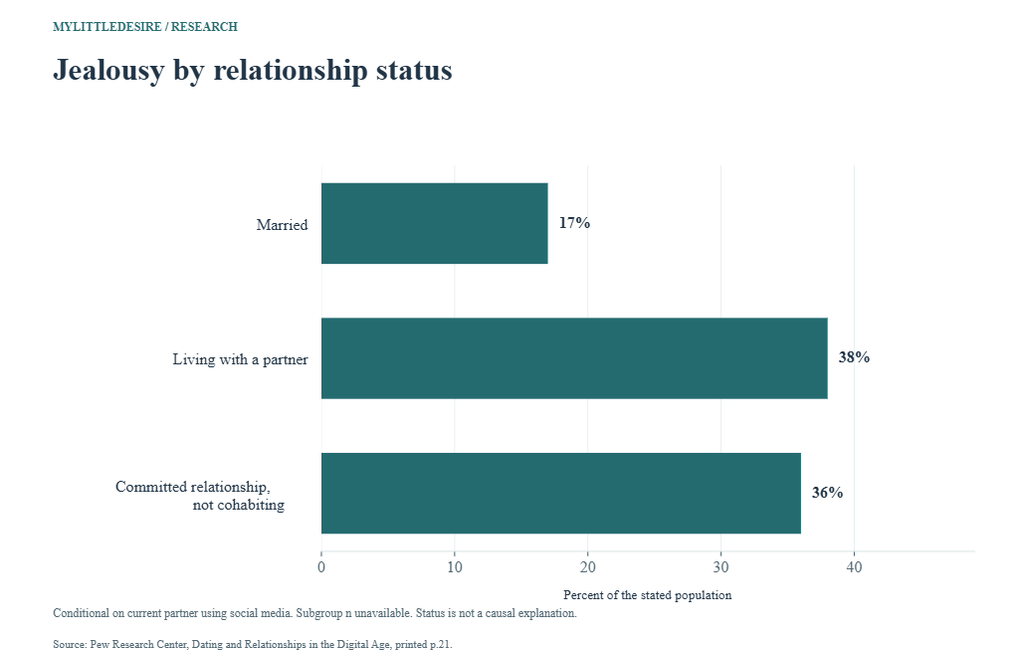
Married, cohabiting and non-cohabiting committed respondents gave different answers in this one survey. The combined unmarried-partnered percentage is also retained for source traceability. It overlaps two of the displayed groups. Pew Research Center [S01].
F04 Yes responses by current relationship status; report narrative also gives the combined unmarried-partnered value. Subgroup n unavailable. The combined unmarried value overlaps cohabiting/non-cohabiting rows and is not a fourth exclusive category. Status differences are not effects of marriage.
| Measure / group | Published result | Population and actual period | Original source |
|---|---|---|---|
| Married | 17% | US partnered adults whose current spouse or partner uses social media; married, cohabiting or in a committed relationship Exact eligible item/subgroup or pairwise n unavailable. 2019-10-16 to 2019-10-28 | Original source [S01] Original report printed p.21, status rows and narrative |
| Living with a partner | 38% | US partnered adults whose current spouse or partner uses social media; married, cohabiting or in a committed relationship Exact eligible item/subgroup or pairwise n unavailable. 2019-10-16 to 2019-10-28 | Original source [S01] Original report printed p.21, status rows and narrative |
| Committed relationship, not cohabiting | 36% | US partnered adults whose current spouse or partner uses social media; married, cohabiting or in a committed relationship Exact eligible item/subgroup or pairwise n unavailable. 2019-10-16 to 2019-10-28 | Original source [S01] Original report printed p.21, status rows and narrative |
| Unmarried partnered — published combined value | 37% | US partnered adults whose current spouse or partner uses social media; married, cohabiting or in a committed relationship Exact eligible item/subgroup or pairwise n unavailable. 2019-10-16 to 2019-10-28 | Original source [S01] Original report printed p.21, status rows and narrative |
What other adult comparisons are published?
The source also reports education, broad race/ethnicity and sexual-orientation comparisons. Its grouped labels are retained to match the original data; they do not imply that everyone within a group has the same experience. Pew Research Center [S01].
F05 Selected education groups in the same conditional adult item. Subgroup n unavailable. Descriptive comparison; education is not assigned as a cause.
| Measure / group | Published result | Population and actual period | Original source |
|---|---|---|---|
| High school or less | 27% | US partnered adults whose current spouse or partner uses social media; married, cohabiting or in a committed relationship Exact eligible item/subgroup or pairwise n unavailable. 2019-10-16 to 2019-10-28 | Original source [S01] Original report printed p.21, education rows |
| Some college | 26% | US partnered adults whose current spouse or partner uses social media; married, cohabiting or in a committed relationship Exact eligible item/subgroup or pairwise n unavailable. 2019-10-16 to 2019-10-28 | Original source [S01] Original report printed p.21, education rows |
| College graduate or more | 16% | US partnered adults whose current spouse or partner uses social media; married, cohabiting or in a committed relationship Exact eligible item/subgroup or pairwise n unavailable. 2019-10-16 to 2019-10-28 | Original source [S01] Original report printed p.21, education rows |
F06 Selected race/ethnicity grouping and sexual-orientation comparisons in SNSFEEL. Retains original broad grouping labels, not presumed uniform experiences. Nonwhite includes Black, Asian, Hispanic, other and multiple-race respondents; LGB means lesbian, gay or bisexual. Subgroup n unavailable.
| Measure / group | Published result | Population and actual period | Original source |
|---|---|---|---|
| White | 19% | US partnered adults whose current spouse or partner uses social media; married, cohabiting or in a committed relationship Exact eligible item/subgroup or pairwise n unavailable. 2019-10-16 to 2019-10-28 | Original source [S01] Original report printed pp.21–22, chart and definition note |
| Nonwhite — original grouped label | 31% | US partnered adults whose current spouse or partner uses social media; married, cohabiting or in a committed relationship Exact eligible item/subgroup or pairwise n unavailable. 2019-10-16 to 2019-10-28 | Original source [S01] Original report printed pp.21–22, chart and definition note |
| Straight | 22% | US partnered adults whose current spouse or partner uses social media; married, cohabiting or in a committed relationship Exact eligible item/subgroup or pairwise n unavailable. 2019-10-16 to 2019-10-28 | Original source [S01] Original report printed pp.21–22, chart and definition note |
| Lesbian, gay or bisexual | 35% | US partnered adults whose current spouse or partner uses social media; married, cohabiting or in a committed relationship Exact eligible item/subgroup or pairwise n unavailable. 2019-10-16 to 2019-10-28 | Original source [S01] Original report printed pp.21–22, chart and definition note |
Do other people’s relationship posts make viewers feel worse?
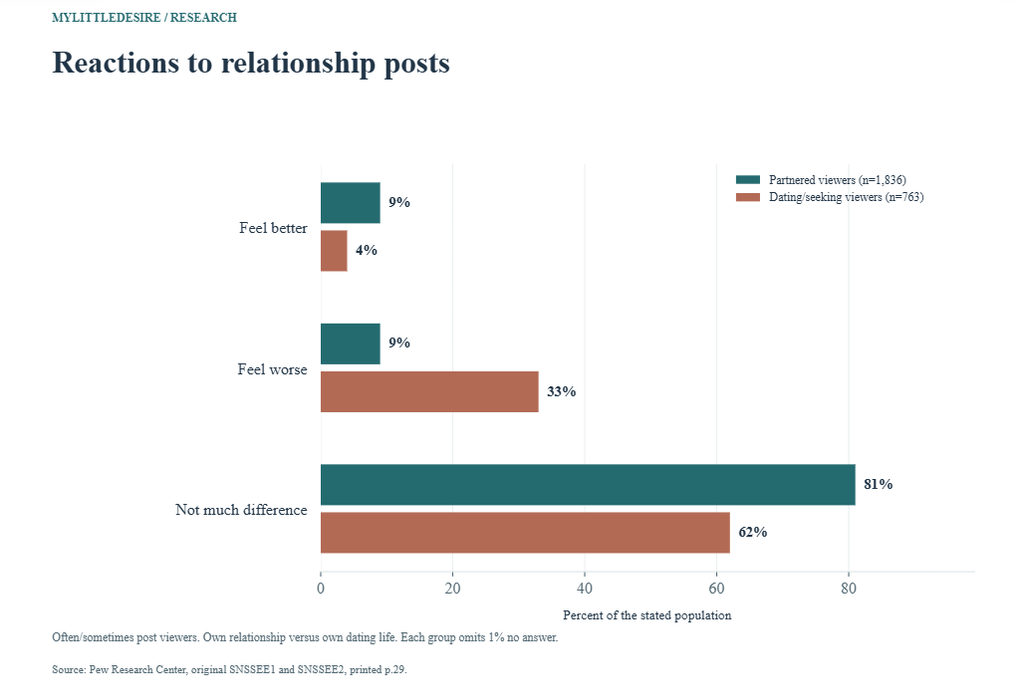
Feeling worse after seeing another couple’s posts can be relevant to social comparison, but Pew measured it separately from partner-related jealousy. Both items below concern respondents who often or sometimes saw relationship posts. The original dating-life question includes people casually dating and/or seeking dates or a relationship. Pew Research Center [S01].
F07 SNSSEE1 asks how relationship posts affect feelings about one’s own relationship. Not jealousy prevalence. Eligible n=1,836 often/sometimes viewers; 1% no answer omitted from display, so the three shown responses total 99%.
| Measure / group | Published result | Population and actual period | Original source |
|---|---|---|---|
| Feel better about own relationship | 9% | US partnered adults who often or sometimes see others’ romantic-relationship posts on social media Eligible n=1,836. 2019-10-16 to 2019-10-28 | Original source [S01] Original report printed p.15; SNSSEE1 questionnaire printed p.29 |
| Feel worse about own relationship | 9% | US partnered adults who often or sometimes see others’ romantic-relationship posts on social media Eligible n=1,836. 2019-10-16 to 2019-10-28 | Original source [S01] Original report printed p.15; SNSSEE1 questionnaire printed p.29 |
| Does not make much difference | 81% | US partnered adults who often or sometimes see others’ romantic-relationship posts on social media Eligible n=1,836. 2019-10-16 to 2019-10-28 | Original source [S01] Original report printed p.15; SNSSEE1 questionnaire printed p.29 |
F08 SNSSEE2 asks how relationship posts affect feelings about one’s own dating life. Not jealousy prevalence. Use the original questionnaire eligibility, which includes casual dating and/or seeking dates/relationships; do not narrow n=763 to only a single-and-looking subgroup. Shown categories total 99%, excluding 1% no answer.
| Measure / group | Published result | Population and actual period | Original source |
|---|---|---|---|
| Feel better about own dating life | 4% | US respondents casually dating and/or seeking dates or a relationship, who often or sometimes see romantic-relationship posts Eligible n=763. 2019-10-16 to 2019-10-28 | Original source [S01] Original SNSSEE2 questionnaire printed p.29; report printed p.16 |
| Feel worse about own dating life | 33% | US respondents casually dating and/or seeking dates or a relationship, who often or sometimes see romantic-relationship posts Eligible n=763. 2019-10-16 to 2019-10-28 | Original source [S01] Original SNSSEE2 questionnaire printed p.29; report printed p.16 |
| Does not make much difference | 62% | US respondents casually dating and/or seeking dates or a relationship, who often or sometimes see romantic-relationship posts Eligible n=763. 2019-10-16 to 2019-10-28 | Original source [S01] Original SNSSEE2 questionnaire printed p.29; report printed p.16 |
For broader connection measures, see our loneliness and social connection statistics. Feeling worse about dating life is not a loneliness diagnosis.
How common is checking an ex on social media?
The ex-checking question applies to adult social-media users, including people outside current committed relationships. It asks about ever-experience, without establishing the reason, intensity or consequences of a particular check. Pew Research Center [S01].
F09 SNSCHECKa asks whether the respondent has ever used social media to check up on someone they used to date or be in a relationship with. Not a jealousy diagnosis, unwanted contact or proof of obsessive monitoring. Social-media-user subgroup n unavailable; no assumption that each respondent currently has a partner.
| Measure / group | Published result | Population and actual period | Original source |
|---|---|---|---|
| Men | 51% | US adult social-media users, by respondent gender Exact eligible item/subgroup or pairwise n unavailable. 2019-10-16 to 2019-10-28 | Original source [S01] Original report printed p.18, gender rows; SNSCHECKa printed p.29 |
| Women | 54% | US adult social-media users, by respondent gender Exact eligible item/subgroup or pairwise n unavailable. 2019-10-16 to 2019-10-28 | Original source [S01] Original report printed p.18, gender rows; SNSCHECKa printed p.29 |
F10 The same ever-experience item across selected groups. Overall social-media-user n=3,660; subgroup n unavailable. These are overlapping summaries, not shares of a single distribution. Checking an ex is not itself a measure of jealousy.
| Measure / group | Published result | Population and actual period | Original source |
|---|---|---|---|
| All adult social-media users | 53% | US adult social-media users, with selected age/status subgroups Eligible n=3,660. 2019-10-16 to 2019-10-28 | Original source [S01] Original report printed p.18, overall/age/status rows; SNSCHECKa printed p.29 |
| Ages 18–29 | 70% | US adult social-media users, with selected age/status subgroups Exact eligible item/subgroup or pairwise n unavailable. 2019-10-16 to 2019-10-28 | Original source [S01] Original report printed p.18, overall/age/status rows; SNSCHECKa printed p.29 |
| Ages 30–49 | 61% | US adult social-media users, with selected age/status subgroups Exact eligible item/subgroup or pairwise n unavailable. 2019-10-16 to 2019-10-28 | Original source [S01] Original report printed p.18, overall/age/status rows; SNSCHECKa printed p.29 |
| Ages 50–64 | 41% | US adult social-media users, with selected age/status subgroups Exact eligible item/subgroup or pairwise n unavailable. 2019-10-16 to 2019-10-28 | Original source [S01] Original report printed p.18, overall/age/status rows; SNSCHECKa printed p.29 |
| Ages 65+ | 24% | US adult social-media users, with selected age/status subgroups Exact eligible item/subgroup or pairwise n unavailable. 2019-10-16 to 2019-10-28 | Original source [S01] Original report printed p.18, overall/age/status rows; SNSCHECKa printed p.29 |
| Married | 45% | US adult social-media users, with selected age/status subgroups Exact eligible item/subgroup or pairwise n unavailable. 2019-10-16 to 2019-10-28 | Original source [S01] Original report printed p.18, overall/age/status rows; SNSCHECKa printed p.29 |
| Living with a partner | 67% | US adult social-media users, with selected age/status subgroups Exact eligible item/subgroup or pairwise n unavailable. 2019-10-16 to 2019-10-28 | Original source [S01] Original report printed p.18, overall/age/status rows; SNSCHECKa printed p.29 |
| Committed relationship, not cohabiting | 66% | US adult social-media users, with selected age/status subgroups Exact eligible item/subgroup or pairwise n unavailable. 2019-10-16 to 2019-10-28 | Original source [S01] Original report printed p.18, overall/age/status rows; SNSCHECKa printed p.29 |
A first-party McMaster University research summary [R01] describes associations between observing an ex and more difficult breakup experiences. That adds qualitative context; it does not turn the survey’s ever-checked percentage into a rate of harmful monitoring or establish a success rate for muting an ex.
What does the historical teen survey show?
The historical teen findings concern social-media users aged 13–17 with any dating experience. They do not describe all teenagers or only current relationships. The source’s positive-connection items are shown alongside the jealousy responses to retain the wider context of the same survey. Pew Research Center [S02].
F11 How social media makes teen social-media users with dating experience feel about their relationship. Eligible n=317, not all 1,060 teens. The NET repeats a little/a lot, and unshown responses remain in the original denominator; do not sum the NET with its components or normalize the selected display.
| Measure / group | Published result | Population and actual period | Original source |
|---|---|---|---|
| Jealous or unsure — a little or a lot NET | 27% | US teens aged 13–17 who use social media and have any dating experience Eligible n=317. 2014-09-25 to 2014-10-09 and 2015-02-10 to 2015-03-16 | Original source [S02] Original report printed p.42 (physical p.43), figure; p.43 narrative |
| Jealous or unsure — a little | 20% | US teens aged 13–17 who use social media and have any dating experience Eligible n=317. 2014-09-25 to 2014-10-09 and 2015-02-10 to 2015-03-16 | Original source [S02] Original report printed p.42 (physical p.43), figure; p.43 narrative |
| Jealous or unsure — a lot | 7% | US teens aged 13–17 who use social media and have any dating experience Eligible n=317. 2014-09-25 to 2014-10-09 and 2015-02-10 to 2015-03-16 | Original source [S02] Original report printed p.42 (physical p.43), figure; p.43 narrative |
| Does not make them feel jealous or unsure | 68% | US teens aged 13–17 who use social media and have any dating experience Eligible n=317. 2014-09-25 to 2014-10-09 and 2015-02-10 to 2015-03-16 | Original source [S02] Original report printed p.42 (physical p.43), figure; p.43 narrative |
F12 A little or a lot responses to three distinct positive-connection items. Eligible n=317; overlapping perceptions, not mutually exclusive responses, observed outcomes or jealousy prevalence. Original official NETs retained.
| Measure / group | Published result | Population and actual period | Original source |
|---|---|---|---|
| More connected to what is happening in partner’s life | 59% | US teens aged 13–17 who use social media and have any dating experience Eligible n=317. 2014-09-25 to 2014-10-09 and 2015-02-10 to 2015-03-16 | Original source [S02] Original report printed pp.42–43, figure and narrative |
| A place to show care for partner | 47% | US teens aged 13–17 who use social media and have any dating experience Eligible n=317. 2014-09-25 to 2014-10-09 and 2015-02-10 to 2015-03-16 | Original source [S02] Original report printed pp.42–43, figure and narrative |
| Emotionally closer to partner | 44% | US teens aged 13–17 who use social media and have any dating experience Eligible n=317. 2014-09-25 to 2014-10-09 and 2015-02-10 to 2015-03-16 | Original source [S02] Original report printed pp.42–43, figure and narrative |
What does longitudinal research add?
The study published in 2025 followed selected young adults who remained in an exclusive relationship with the same partner across three annual waves. T2 occurred one year after T1, and T3 two years after T1. Recruitment ran from January 2019 through December 2021; the checked article does not give the final calendar endpoints. The cohort is not a national prevalence survey. Métellus, Vaillancourt-Morel, Brassard and Daspe [S03].
Reading the coefficients: a positive correlation means the scores tended to rise together; a negative one means higher scores on one measure tended to go with lower scores on the other. A coefficient of −0.26 does not mean a 26% decline in satisfaction, and 0.71 does not mean 71% of people remained jealous.
F13 Table 2 correlations between T1 attachment anxiety and jealousy at T1 or T2. Selected same-partner continuing relationships, overall n=322; exact pairwise n unavailable. These are bivariate coefficients, not the adjusted model. One-year-later association does not establish causality.
| Measure / group | Published result | Population and actual period | Original source |
|---|---|---|---|
| T1 attachment anxiety with T1 jealousy | correlation = +0.44 | Selected volunteers aged 18–29 at T1, in an exclusive relationship with the same partner at all three waves Exact eligible item/subgroup or pairwise n unavailable. Recruitment January 2019–December 2021; T2 and T3 follow-ups one and two years after T1; final calendar endpoints not stated | Original source [S03] Original article Table 2, variables 1–3, physical p.6 |
| T1 attachment anxiety with T2 jealousy | correlation = +0.36 | Selected volunteers aged 18–29 at T1, in an exclusive relationship with the same partner at all three waves Exact eligible item/subgroup or pairwise n unavailable. Recruitment January 2019–December 2021; T2 and T3 follow-ups one and two years after T1; final calendar endpoints not stated | Original source [S03] Original article Table 2, variables 1–3, physical p.6 |
F14 Correlation between jealousy scores at T1 and T2. Selected same-partner cohort, overall n=322; exact pairwise n unavailable. A score correlation is not the proportion whose jealousy persisted.
| Measure / group | Published result | Population and actual period | Original source |
|---|---|---|---|
| T1 jealousy with T2 jealousy | correlation = +0.71 | Selected volunteers aged 18–29 at T1, in an exclusive relationship with the same partner at all three waves Exact eligible item/subgroup or pairwise n unavailable. Recruitment January 2019–December 2021; T2 and T3 follow-ups one and two years after T1; final calendar endpoints not stated | Original source [S03] Original article Table 2, variable 3 with variable 2, physical p.6 |
F15 Selected same-wave and later-wave jealousy/surveillance correlations. Overall selected n=322; exact pairwise n unavailable. Coefficients do not measure how many people were monitored or prove that jealousy caused surveillance.
| Measure / group | Published result | Population and actual period | Original source |
|---|---|---|---|
| T1 jealousy with T1 surveillance | correlation = +0.44 | Selected volunteers aged 18–29 at T1, in an exclusive relationship with the same partner at all three waves Exact eligible item/subgroup or pairwise n unavailable. Recruitment January 2019–December 2021; T2 and T3 follow-ups one and two years after T1; final calendar endpoints not stated | Original source [S03] Original article Table 2, variables 2–5, physical p.6 |
| T1 jealousy with T2 surveillance | correlation = +0.33 | Selected volunteers aged 18–29 at T1, in an exclusive relationship with the same partner at all three waves Exact eligible item/subgroup or pairwise n unavailable. Recruitment January 2019–December 2021; T2 and T3 follow-ups one and two years after T1; final calendar endpoints not stated | Original source [S03] Original article Table 2, variables 2–5, physical p.6 |
| T2 jealousy with T2 surveillance | correlation = +0.39 | Selected volunteers aged 18–29 at T1, in an exclusive relationship with the same partner at all three waves Exact eligible item/subgroup or pairwise n unavailable. Recruitment January 2019–December 2021; T2 and T3 follow-ups one and two years after T1; final calendar endpoints not stated | Original source [S03] Original article Table 2, variables 2–5, physical p.6 |
F16 Selected same-wave and later-wave jealousy/satisfaction correlations. Overall selected n=322; exact pairwise n unavailable. Negative means higher scores were associated with lower satisfaction, not a percentage decline or breakup probability. Adjusted paths are separately described in section 3.2.
| Measure / group | Published result | Population and actual period | Original source |
|---|---|---|---|
| T1 jealousy with T1 satisfaction | correlation = -0.19 | Selected volunteers aged 18–29 at T1, in an exclusive relationship with the same partner at all three waves Exact eligible item/subgroup or pairwise n unavailable. Recruitment January 2019–December 2021; T2 and T3 follow-ups one and two years after T1; final calendar endpoints not stated | Original source [S03] Original article Table 2, variables 2–3 and 6–8, physical p.6 |
| T1 jealousy with T3 satisfaction | correlation = -0.26 | Selected volunteers aged 18–29 at T1, in an exclusive relationship with the same partner at all three waves Exact eligible item/subgroup or pairwise n unavailable. Recruitment January 2019–December 2021; T2 and T3 follow-ups one and two years after T1; final calendar endpoints not stated | Original source [S03] Original article Table 2, variables 2–3 and 6–8, physical p.6 |
| T2 jealousy with T2 satisfaction | correlation = -0.17 | Selected volunteers aged 18–29 at T1, in an exclusive relationship with the same partner at all three waves Exact eligible item/subgroup or pairwise n unavailable. Recruitment January 2019–December 2021; T2 and T3 follow-ups one and two years after T1; final calendar endpoints not stated | Original source [S03] Original article Table 2, variables 2–3 and 6–8, physical p.6 |
| T2 jealousy with T3 satisfaction | correlation = -0.26 | Selected volunteers aged 18–29 at T1, in an exclusive relationship with the same partner at all three waves Exact eligible item/subgroup or pairwise n unavailable. Recruitment January 2019–December 2021; T2 and T3 follow-ups one and two years after T1; final calendar endpoints not stated | Original source [S03] Original article Table 2, variables 2–3 and 6–8, physical p.6 |

The paper’s adjusted analyses add an important qualification. Jealousy at T2 was associated with lower satisfaction at T3, while the tested later-satisfaction path from surveillance was not significant. The full proposed mediation from attachment anxiety through jealousy and surveillance was not supported. Bivariate correlations and adjusted models answer different questions, and neither establishes an individual breakup risk. Original Results and Discussion [S03].
How did earlier Facebook studies measure jealousy?
Earlier Facebook research used a questionnaire score rather than an ever-experience percentage. The two published means below are included as historical measurement context. The sample was not restricted to people currently dating, and the score cannot be directly compared with the later study’s adapted summed scale. Muise, Christofides and Desmarais [S04].
F17 Published gender means from an undergraduate convenience sample. Historical seven-point response scale; means are not percentages or diagnostic thresholds. Overall n=308; exact answering n for each mean not stated. Scale version/scoring differs from the later 16-item adaptation; no cross-study score change is calculated.
| Measure / group | Published result | Population and actual period | Original source |
|---|---|---|---|
| Women: published Facebook-jealousy mean | 3.29 (published scale mean) | Undergraduate Facebook-user sample aged 17–24; not restricted to people currently in a relationship Exact eligible item/subgroup or pairwise n unavailable. Calendar fieldwork not stated in checked article; published 2009 | Original source [S04] Original article journal p.442 (physical p.2), descriptive results |
| Men: published Facebook-jealousy mean | 2.81 (published scale mean) | Undergraduate Facebook-user sample aged 17–24; not restricted to people currently in a relationship Exact eligible item/subgroup or pairwise n unavailable. Calendar fieldwork not stated in checked article; published 2009 | Original source [S04] Original article journal p.442 (physical p.2), descriptive results |
What can people discuss about digital boundaries?
Relationships Australia NSW recommends discussing how technology affects connection and agreeing on focused time together. Respect’s jealousy guidance recommends questioning anxious assumptions and avoiding controlling checking. These are attributed practical suggestions, separate from the observations; no treatment success rate is assigned.
- Name the specific online interaction that concerned you and separate what you saw from what you inferred.
- Discuss expectations about public posts, contact with former partners and privacy.
- Agree on time to talk with attention on each other.
- Avoid using jealousy as a reason to demand account access or control another person’s contacts.
Sources: Relationships Australia NSW [G01] and Respect UK [G02]. Jealous feelings do not justify coercive control or invasions of privacy.
Which differences can readers reproduce?
The following arithmetic subtracts published percentages within the same source and measure. These are descriptive percentage-point differences, not relative changes, new significance tests or causal effects. The final comparison concerns ex-checking behavior, rather than jealousy prevalence.
| Comparison | First value | Second value | Difference | Qualification |
|---|---|---|---|---|
| Adult jealousy response: women minus men | 29% | 17% | +12 percentage points | US October 2019, current partner uses social media; respondent gender, not matched partners. |
| Adult jealousy response: ages 18–29 minus 65+ | 34% | 4% | +30 percentage points | Descriptive age groups; exact subgroup n unavailable; not an age effect. |
| Adult jealousy response: cohabiting minus married | 38% | 17% | +21 percentage points | Different respondent relationship-status groups; not an effect of marriage. |
| Adult jealousy response: non-cohabiting committed minus married | 36% | 17% | +19 percentage points | Different relationship circumstances; descriptive, not causal. |
| Adult jealousy response: high school or less minus college+ | 27% | 16% | +11 percentage points | Descriptive education comparison, exact subgroup n unavailable. |
| Adult jealousy response: nonwhite minus white | 31% | 19% | +12 percentage points | Broad original group labels; no assumption of uniform experience or causal interpretation. |
| Adult jealousy response: LGB minus straight | 35% | 22% | +13 percentage points | Original respondent orientation groups; conditional on partner social-media use; subgroup n unavailable. |
| Ever checked an ex: ages 18–29 minus 65+ | 70% | 24% | +46 percentage points | Related behavior among social-media users, not jealousy prevalence or a trend. |
Common questions
What percentage of people feel jealous because of social media?
One clearly defined estimate is Pew’s 23% among US partnered adults whose current partner used social media, based on October 2019 fieldwork. The question combined jealous or unsure and asked about ever-experience with the current partner. It is not a global or 2027 estimate.
Does the 23% figure apply to all couples?
It applies only to the source’s partnered adults whose current spouse or partner used social media. The respondent did not have to use social media personally. The eligible base was 2,187.
Which age group reported the highest jealousy-or-uncertainty response?
Among the displayed adult groups, ages 18–29 had the highest percentage in the 2019 survey. This is a descriptive age comparison with unknown subgroup n, not evidence that age causes jealousy.
Does checking an ex prove someone is jealous?
No. The survey asked about a behavior and did not establish the motive or intensity of each instance. The ex-checking and partner-jealousy items also use different populations.
Does social media cause relationship dissatisfaction?
The selected longitudinal research strengthens the timing evidence for an association, but remains observational and uses a selected continuing-relationship sample. Its authors do not establish a causal effect or individual breakup prediction.
Can the teen and adult percentages be compared as a trend?
Their ages, eligibility, questions and collection periods differ. They are shown as separate findings rather than a measured increase or decrease.
Which social platform causes the most jealousy?
The evidence selected here does not establish a representative current platform ranking. An old Facebook score and a later all-platform adaptation cannot supply that ranking.
Does this resource provide comparable UK, Canadian and Australian prevalence?
No. The representative percentages here concern historical US samples. Other included work uses selected samples; a research team’s location or an Australian guidance organization does not establish national prevalence.
Research method and limitations
MyLittleDesire compiled selected published aggregates from original research reports, questionnaires and peer-reviewed articles. AI assisted retrieval, organization and drafting. No new survey, respondent-level reanalysis, hypothesis test or clinical assessment was conducted. This is a source-based compilation, not an exhaustive systematic review.
The 54 observations form 17 grouped findings from four research records: 42 percentages, ten published correlation coefficients and two scale means. Twenty-three observations describe direct jealousy/uncertainty responses, 19 describe related reactions/behaviors/benefits and 12 report research associations or means. A first-party university summary and two guidance records add context only. Response categories, NETs, subgroups and coefficients from one study are not independent studies. Four charts and eight differences reuse selected inputs.
- Concentration: 35 observations come from one 2019 adult Pew survey, and seven from one historical teen survey. This collection does not produce balanced country coverage, a worldwide jealousy rate or a current platform ranking.
- Eligibility: adult jealousy requires a social-media-using partner; relationship-post reactions require often/sometimes exposure; checking an ex uses all adult social-media users. These bases are not interchangeable.
- Dating-life filter: SNSSEE2 includes casual dating and/or seeking dates or a relationship. Its original n=763 is not silently narrowed to only a single-and-looking subgroup.
- Recall: ever-experience, general post reactions and past-six-month research scales differ. Adolescent and adult questions are not combined into a trend.
- Selection: the longitudinal study includes young adults with the same partner at all three waves and removes one partner from participating dyads. Its results do not estimate breakup risk or represent all relationships.
- Geography: the two academic papers have Canadian research teams, but participant residence is not explicitly specified in the checked methods. Team location is not substituted for national sampling.
- Units and precision: percentages, correlations and scale means remain distinct. Official NETs and original rounded values are retained; no counts or missing bases are reconstructed.
- Limits: feelings do not establish infidelity or a diagnosis. The cohort’s adjusted model and its null mediation result are distinguished from bivariate correlations. Unknown pairwise n and inconsistent sex coding are retained as limitations.
Original sources and research notes
- S01. Pew Research Center. Dating and Relationships in the Digital Age. Publication: 2020-05-08. Actual period: 2019-10-16 to 2019-10-28. Overall study n=4,860. Eligible base: SNSFEEL n=2,187 partnered adults whose current partner uses social media. SNSSEE1 n=1,836 partnered adults often/sometimes seeing relationship posts. SNSSEE2 n=763 casually dating and/or seeking dates/relationships, often/sometimes seeing such posts. SNSCHECK n=3,660 social-media users. Subgroup n unavailable. Method: Weighted probability-recruited American Trends Panel with an Ipsos KnowledgePanel LGB oversample. Original report printed pp.15–18 and 21–22; original questionnaire printed pp.28–30. Jealousy item asks ever-experience with the current partner; the respondent need not personally use social media to qualify for SNSFEEL. Jealous OR unsure is one combined self-report item, not diagnosed jealousy, frequency or proof of infidelity. Adult subgroup values describe respondent characteristics, not matched couples. Post reactions and checking an ex are related context, not jealousy prevalence. SNSSEE2 questionnaire eligibility includes casual dating; its n=763 must not silently be narrowed to only single-and-looking respondents. Supporting records: record 1, record 2, record 3.
- S02. Pew Research Center. Teens, Technology and Romantic Relationships: Social Media and Romantic Relationships. Publication: 2015-10-01. Actual period: 2014-09-25 to 2014-10-09 and 2015-02-10 to 2015-03-16. Overall study n=1,060. Eligible base: Selected social-media/relationship feeling items n=317. All teens n=1,060 and all teen daters n=361 are different bases. Method: English/Spanish probability-based GfK KnowledgePanel parent/teen survey, weighted. Second field period increased Black teen representation. Selected Figure on printed p.42 supplies n=317; narrative pp.42–43 supplies non-jealousy response and positive-connection context. Historical adolescent evidence, not current adults or all teens. Dating experience may be past or current. Jealous OR unsure is combined. A-little/a-lot responses and their NET overlap; selected display does not include every response. Positive feeling items overlap and are not outcomes of a treatment. Supporting records: record 1, record 2.
- S03. Métellus, Vaillancourt-Morel, Brassard and Daspe. Attachment Anxiety and Relationship Satisfaction in the Digital Era: The Contribution of Social Media Jealousy and Electronic Partner Surveillance. Publication: 2025-09-18 (first online). Actual period: Recruitment January 2019–December 2021; T2 and T3 follow-ups one and two years after T1; final calendar endpoints not stated. Overall study n=322. Eligible base: Selected analysis sample n=322. Exact complete-case/pairwise n for each Table 2 correlation is not stated; missing-data models use full-information maximum likelihood. Method: Online self-report longitudinal cohort recruited through advertisement websites, social media and mailing lists. One member of each participating couple randomly removed; people changing partners excluded. Table 2 reports bivariate correlations; section 3.2 separately reports adjusted longitudinal models. Adapted jealousy measure has 16 items, past-six-month framing. Nonprobability selected continuing relationships, not national prevalence or breakup risk. No paired-partner outcome reconciliation. Correlations are not percentages, adjusted coefficients or causal effects. Exact correlation estimator type is not named in the checked text, so records say published correlation coefficient rather than asserting Pearson. Sex coding conflicts between Methods and the Table 2 note; sex correlations withheld. Supporting records: record 1, record 2.
- S04. Muise, Christofides and Desmarais. More Information than You Ever Wanted: Does Facebook Bring Out the Green-Eyed Monster of Jealousy?. Publication: 2009-04-15 (first online); August 2009 issue. Actual period: Calendar fieldwork not stated in checked article; published 2009. Overall study n=308. Eligible base: Overall analysis sample n=308 (231 female, 77 male); exact answering n for each published gender mean not supplied. Method: Anonymous online undergraduate survey. Selected descriptive results on journal p.442 report women/men Facebook-jealousy score means. Methods describes 27 items with seven-point responses. These published means are retained without converting them to a percentage or comparing their levels with a later adapted scale. Historical single-platform convenience sample, with some respondents not currently dating; not national or current prevalence. Means are scale scores, not percentages of jealous people. The article contains ambiguous scale endpoint/variance wording; those details and regression coefficients are not reproduced. Supporting records: record 1, record 2.
Context and practical guidance
- R01. McMaster University, Social Psychology: Does seeing an ex on social media make it harder to move on?. Qualitative ex-partner-observation context only; contributes no numeric observation.
- G01. Relationships Australia NSW: How to Set Healthy Boundaries Around Technology and Relationships. Practical agreed-boundary and focused-time guidance; no numeric observations.
- G02. Respect UK / Respect Phoneline: Managing jealousy. Practical guidance on jealous thoughts, privacy and controlling checking; no numeric observations.
How to cite this resource
MyLittleDesire. Social Media Jealousy Statistics 2027. https://mylittledesire.com/social-media-jealousy-statistics/.