
Men’s friendships differ in number, composition, contact and emotional support. In Pew’s September 2024 U.S. survey, 38% of men and 54% of women said they would be extremely or very likely to turn to a friend for emotional support. A separate July 2023 survey found that 40% of men and 36% of women had at least five close friends outside family. Counting friends and using them for support answer different questions. Pew Research Center [S01]; Pew Research Center [S02].
This resource contains 76 published observations in 18 groups from four surveys and three publishers, including 41 male-group observations and 35 female comparators. Four charts and ten descriptive comparisons reuse those inputs. The included evidence is U.S.-based; it does not establish a global male-friendship rate.
14%
38%
of male U.S. adult citizens reported no close friends in YouGov’s June 2026 survey.Original source [S04]
of U.S. adult men said they would be extremely or very likely to turn to a friend for support in September 2024.Original source [S01]
31%
15%
of male friendship holders saw a close friend in person daily or a few times a week in that 2024 survey.Original source [S01]
of male friendship holders discussed mental health extremely often or often in Pew’s July 2023 survey.Original source [S02]
What do male friendship statistics measure?
A friend count describes network size. Same-gender composition describes who is in that network. Contact frequency concerns interaction, while support questions can ask about hypothetical help or an actual recent experience. Satisfaction and ideal preferences add further dimensions. A low figure on one measure does not determine every other aspect of a man’s friendships. For broader context, see our friendship statistics.
Also Read:-
Parent Teen Communication Statistics 2027
Multigenerational Household Statistics 2027
Family Time Togetherness Statistics 2027
Parenthood Relationship Satisfaction Statistics 2027
How many close friends do men have?
Pew’s 2023 estimates show modest differences between men and women in selected friend-count categories. YouGov’s 2026 question uses a citizen target and does not explicitly exclude family. The May 2021 figures come from a pandemic-period survey. These results belong in separate tables rather than a single trend line.
F03 Number of close friends, excluding family, among all adults. Selected bins are not the full distribution. Do not calculate the no-friend share from a rounded remainder.
| Measure / group | Published result | Population, fieldwork and base | Original source |
|---|---|---|---|
| One to four close friends — men | 50% | U.S. adults age 18+; men July 17–23, 2023 · Exact valid subgroup/item n unavailable | Original source [S02] MANYFRI; article Number of close friends |
| One to four close friends — women | 55% | U.S. adults age 18+; women July 17–23, 2023 · Exact valid subgroup/item n unavailable | Original source [S02] MANYFRI; article Number of close friends |
| Five or more close friends — men | 40% | U.S. adults age 18+; men July 17–23, 2023 · Exact valid subgroup/item n unavailable | Original source [S02] MANYFRI; article Number of close friends |
| Five or more close friends — women | 36% | U.S. adults age 18+; women July 17–23, 2023 · Exact valid subgroup/item n unavailable | Original source [S02] MANYFRI; article Number of close friends |

F17 Selected answers to the number of close friends question. Question does not explicitly exclude family. Male/female distributions each sum to 98% after rounding; do not renormalize or reconstruct counts. Item bases male 499, female 564.
| Measure / group | Published result | Population, fieldwork and base | Original source |
|---|---|---|---|
| No close friends — men | 14% | U.S. adult citizens age 18+; men June 5–9, 2026 · Published unweighted item n=499 | Original source [S04] Q6 gender table, printed cross-tab page 7 (PDF page 10) |
| No close friends — women | 18% | U.S. adult citizens age 18+; women June 5–9, 2026 · Published unweighted item n=564 | Original source [S04] Q6 gender table, printed cross-tab page 7 (PDF page 10) |
| Exactly one close friend — men | 13% | U.S. adult citizens age 18+; men June 5–9, 2026 · Published unweighted item n=499 | Original source [S04] Q6 gender table, printed cross-tab page 7 (PDF page 10) |
| Exactly one close friend — women | 13% | U.S. adult citizens age 18+; women June 5–9, 2026 · Published unweighted item n=564 | Original source [S04] Q6 gender table, printed cross-tab page 7 (PDF page 10) |
F08 Selected gender count results in the original researcher’s June 29 follow-up to the May survey. Pandemic-period estimates. Different methods and questions prevent a simple trend against Pew or YouGov. No historical 1990 data selected.
| Measure / group | Published result | Population, fieldwork and base | Original source |
|---|---|---|---|
| No close friends — men | 15% | U.S. adults age 18+; men May 14–23, 2021 · Exact valid subgroup/item n unavailable | Original source [S03] Original author follow-up, June 29, 2021, paragraphs 2–3 |
| No close friends — women | 10% | U.S. adults age 18+; women May 14–23, 2021 · Exact valid subgroup/item n unavailable | Original source [S03] Original author follow-up, June 29, 2021, paragraphs 2–3 |
| Six or more close friends — men | 27% | U.S. adults age 18+; men May 14–23, 2021 · Exact valid subgroup/item n unavailable | Original source [S03] Original author follow-up, June 29, 2021, paragraphs 2–3 |
| Six or more close friends — women | 24% | U.S. adults age 18+; women May 14–23, 2021 · Exact valid subgroup/item n unavailable | Original source [S03] Original author follow-up, June 29, 2021, paragraphs 2–3 |
Are men’s friendships mainly with other men?
In Pew’s 2023 survey, 61% of male friendship holders said all or most of their close friends were men. That does not mean they had only male friends. The Survey Center on American Life asked a different question about having at least one different-gender close friend.
F04 All or most close friends are the same gender as the respondent. Among friendship holders only. A majority same gender is not an all-male network.
| Measure / group | Published result | Population, fieldwork and base | Original source |
|---|---|---|---|
| All or most same-gender friends — men | 61% | U.S. adults age 18+ with at least one close friend outside family; men July 17–23, 2023 · Exact valid subgroup/item n unavailable | Original source [S02] GENFRI; article Gender of friends |
| All or most same-gender friends — women | 71% | U.S. adults age 18+ with at least one close friend outside family; women July 17–23, 2023 · Exact valid subgroup/item n unavailable | Original source [S02] GENFRI; article Gender of friends |
F05 All or most close friends share the respondent’s gender, within each age band. Cross-sectional groups, not changes as the same men age. Selected subgroup n unknown.
| Measure / group | Published result | Population, fieldwork and base | Original source |
|---|---|---|---|
| All or most same gender, under 50 — men | 63% | U.S. adults age 18–49 with at least one close friend outside family; men July 17–23, 2023 · Exact valid subgroup/item n unavailable | Original source [S02] GENFRI; article Gender of friends, age-by-gender paragraph |
| All or most same gender, under 50 — women | 67% | U.S. adults age 18–49 with at least one close friend outside family; women July 17–23, 2023 · Exact valid subgroup/item n unavailable | Original source [S02] GENFRI; article Gender of friends, age-by-gender paragraph |
| All or most same gender, age 50+ — men | 59% | U.S. adults age 50+ with at least one close friend outside family; men July 17–23, 2023 · Exact valid subgroup/item n unavailable | Original source [S02] GENFRI; article Gender of friends, age-by-gender paragraph |
| All or most same gender, age 50+ — women | 74% | U.S. adults age 50+ with at least one close friend outside family; women July 17–23, 2023 · Exact valid subgroup/item n unavailable | Original source [S02] GENFRI; article Gender of friends, age-by-gender paragraph |
F10 Reporting at least one close friend of a different gender. Original report uses binary gender language. This does not establish the size or quality of a network, and married and overall bases differ.
| Measure / group | Published result | Population, fieldwork and base | Original source |
|---|---|---|---|
| Has a close friend of a different gender — men | 63% | U.S. adults age 18+ with a close friend; men May 14–23, 2021 · Exact valid subgroup/item n unavailable | Original source [S03] Report Friendship Types, different-gender friendship paragraphs |
| Has a close friend of a different gender — women | 53% | U.S. adults age 18+ with a close friend; women May 14–23, 2021 · Exact valid subgroup/item n unavailable | Original source [S03] Report Friendship Types, different-gender friendship paragraphs |
| Married, has a different-gender close friend — men | 54% | U.S. married adults age 18+ with a close friend; men May 14–23, 2021 · Exact valid subgroup/item n unavailable | Original source [S03] Report Friendship Types, different-gender friendship paragraphs |
| Married, has a different-gender close friend — women | 43% | U.S. married adults age 18+ with a close friend; women May 14–23, 2021 · Exact valid subgroup/item n unavailable | Original source [S03] Report Friendship Types, different-gender friendship paragraphs |
Would men turn to friends for emotional support?
The 38% male figure concerns what people believe they would do if they needed emotional support. It applies to all adult men in that question, including those who did not report a close friend, and does not measure the support they actually received.
F01 Extremely or very likely to turn to a friend if emotional support were needed. Hypothetical likelihood among all adults, not actual support received or a male-friend-only relationship.
| Measure / group | Published result | Population, fieldwork and base | Original source |
|---|---|---|---|
| Would turn to a friend — men | 38% | U.S. adults age 18+; men September 3–15, 2024 · Exact valid subgroup/item n unavailable | Original source [S01] EMOSUPPOTH a; report printed page 5 and chapter 2 |
| Would turn to a friend — women | 54% | U.S. adults age 18+; women September 3–15, 2024 · Exact valid subgroup/item n unavailable | Original source [S01] EMOSUPPOTH a; report printed page 5 and chapter 2 |
How often do men communicate with close friends?
Pew’s 2024 friend-contact questions apply to adults with at least one close friend outside family. Men reported frequent in-person contact slightly more often than women, while women reported frequent texting, social-media contact and phone/video conversation more often. Frequent includes a few times a week.
F02 At least once a day or a few times a week, with one or more close friends. Modes overlap. Does not measure daily contact only, time spent or contact with every friend. Retain published male texting NET 56, not rounded 21+34=55.
| Measure / group | Published result | Population, fieldwork and base | Original source |
|---|---|---|---|
| Text a close friend — men | 56% | U.S. adults age 18+ with at least one close friend outside family; men September 3–15, 2024 · Exact valid subgroup/item n unavailable | Original source [S01] COMMFRI a–d; report printed page 12, gender chart |
| Text a close friend — women | 66% | U.S. adults age 18+ with at least one close friend outside family; women September 3–15, 2024 · Exact valid subgroup/item n unavailable | Original source [S01] COMMFRI a–d; report printed page 12, gender chart |
| Interact on social media — men | 33% | U.S. adults age 18+ with at least one close friend outside family; men September 3–15, 2024 · Exact valid subgroup/item n unavailable | Original source [S01] COMMFRI a–d; report printed page 12, gender chart |
| Interact on social media — women | 45% | U.S. adults age 18+ with at least one close friend outside family; women September 3–15, 2024 · Exact valid subgroup/item n unavailable | Original source [S01] COMMFRI a–d; report printed page 12, gender chart |
| Phone or video chat — men | 32% | U.S. adults age 18+ with at least one close friend outside family; men September 3–15, 2024 · Exact valid subgroup/item n unavailable | Original source [S01] COMMFRI a–d; report printed page 12, gender chart |
| Phone or video chat — women | 38% | U.S. adults age 18+ with at least one close friend outside family; women September 3–15, 2024 · Exact valid subgroup/item n unavailable | Original source [S01] COMMFRI a–d; report printed page 12, gender chart |
| See a close friend in person — men | 31% | U.S. adults age 18+ with at least one close friend outside family; men September 3–15, 2024 · Exact valid subgroup/item n unavailable | Original source [S01] COMMFRI a–d; report printed page 12, gender chart |
| See a close friend in person — women | 28% | U.S. adults age 18+ with at least one close friend outside family; women September 3–15, 2024 · Exact valid subgroup/item n unavailable | Original source [S01] COMMFRI a–d; report printed page 12, gender chart |

What do men talk about with their friends?
The 2023 topic questions show different conversation patterns. Topics can overlap, and the work question applies only to employed adults with a close friend. The under-50 mental-health comparison covers ages 18–49, not only young adults.
F06 Topics coming up extremely often or often in conversations with any close friend. Topics overlap. Work is restricted to employed friendship holders; other topics use all friendship holders. Frequency is not topic importance or friendship quality.
| Measure / group | Published result | Population, fieldwork and base | Original source |
|---|---|---|---|
| Family life — men | 47% | U.S. adults age 18+ with at least one close friend outside family; men July 17–23, 2023 · Exact valid subgroup/item n unavailable | Original source [S02] TOPICTALK a–g; article Topics of conversation / Differences by gender |
| Family life — women | 67% | U.S. adults age 18+ with at least one close friend outside family; women July 17–23, 2023 · Exact valid subgroup/item n unavailable | Original source [S02] TOPICTALK a–g; article Topics of conversation / Differences by gender |
| Physical health — men | 31% | U.S. adults age 18+ with at least one close friend outside family; men July 17–23, 2023 · Exact valid subgroup/item n unavailable | Original source [S02] TOPICTALK a–g; article Topics of conversation / Differences by gender |
| Physical health — women | 41% | U.S. adults age 18+ with at least one close friend outside family; women July 17–23, 2023 · Exact valid subgroup/item n unavailable | Original source [S02] TOPICTALK a–g; article Topics of conversation / Differences by gender |
| Mental health — men | 15% | U.S. adults age 18+ with at least one close friend outside family; men July 17–23, 2023 · Exact valid subgroup/item n unavailable | Original source [S02] TOPICTALK a–g; article Topics of conversation / Differences by gender |
| Mental health — women | 31% | U.S. adults age 18+ with at least one close friend outside family; women July 17–23, 2023 · Exact valid subgroup/item n unavailable | Original source [S02] TOPICTALK a–g; article Topics of conversation / Differences by gender |
| Work — men | 54% | U.S. employed adults age 18+ with at least one close friend outside family; men July 17–23, 2023 · Exact valid subgroup/item n unavailable | Original source [S02] TOPICTALK a–g; article Topics of conversation / Differences by gender |
| Work — women | 61% | U.S. employed adults age 18+ with at least one close friend outside family; women July 17–23, 2023 · Exact valid subgroup/item n unavailable | Original source [S02] TOPICTALK a–g; article Topics of conversation / Differences by gender |
| Pop culture — men | 32% | U.S. adults age 18+ with at least one close friend outside family; men July 17–23, 2023 · Exact valid subgroup/item n unavailable | Original source [S02] TOPICTALK a–g; article Topics of conversation / Differences by gender |
| Pop culture — women | 37% | U.S. adults age 18+ with at least one close friend outside family; women July 17–23, 2023 · Exact valid subgroup/item n unavailable | Original source [S02] TOPICTALK a–g; article Topics of conversation / Differences by gender |
| Sports — men | 37% | U.S. adults age 18+ with at least one close friend outside family; men July 17–23, 2023 · Exact valid subgroup/item n unavailable | Original source [S02] TOPICTALK a–g; article Topics of conversation / Differences by gender |
| Sports — women | 13% | U.S. adults age 18+ with at least one close friend outside family; women July 17–23, 2023 · Exact valid subgroup/item n unavailable | Original source [S02] TOPICTALK a–g; article Topics of conversation / Differences by gender |
| Current events — men | 53% | U.S. adults age 18+ with at least one close friend outside family; men July 17–23, 2023 · Exact valid subgroup/item n unavailable | Original source [S02] TOPICTALK a–g; article Topics of conversation / Differences by gender |
| Current events — women | 44% | U.S. adults age 18+ with at least one close friend outside family; women July 17–23, 2023 · Exact valid subgroup/item n unavailable | Original source [S02] TOPICTALK a–g; article Topics of conversation / Differences by gender |
F07 Extremely often or often among adults younger than 50 who have a close friend. Under 50 means ages 18–49, not only young adults or Gen Z. No causal interpretation.
| Measure / group | Published result | Population, fieldwork and base | Original source |
|---|---|---|---|
| Mental-health discussion, under 50 — men | 20% | U.S. adults age 18–49 with at least one close friend outside family; men July 17–23, 2023 · Exact valid subgroup/item n unavailable | Original source [S02] TOPICTALK f; article Differences by gender |
| Mental-health discussion, under 50 — women | 43% | U.S. adults age 18–49 with at least one close friend outside family; women July 17–23, 2023 · Exact valid subgroup/item n unavailable | Original source [S02] TOPICTALK f; article Differences by gender |
How do men share feelings and receive support?
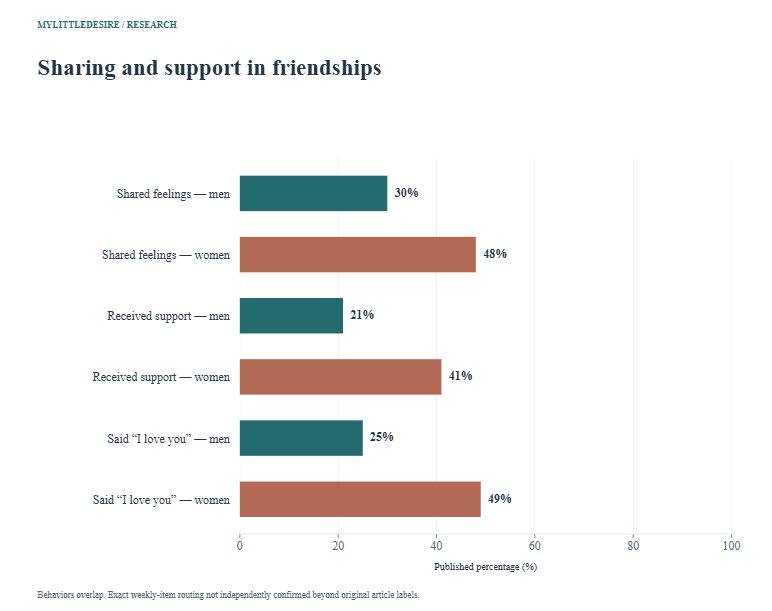
The May 2021 survey reported lower male rates of private emotional sharing, receiving support and telling a friend they loved them. Among men, those with female friends reported these behaviors more often than men without female friends. The survey does not establish that network composition caused the difference.
F11 Reported each behavior within the past week. Different behaviors can overlap. Article’s reported male/female groups retained; exact weekly-item routing not independently confirmed. These are self-reports, not observation or clinical outcomes.
| Measure / group | Published result | Population, fieldwork and base | Original source |
|---|---|---|---|
| Shared personal feelings privately — men | 30% | U.S. adults age 18+; men May 14–23, 2021 · Exact valid subgroup/item n unavailable | Original source [S03] Report Emotional Support section |
| Shared personal feelings privately — women | 48% | U.S. adults age 18+; women May 14–23, 2021 · Exact valid subgroup/item n unavailable | Original source [S03] Report Emotional Support section |
| Received emotional support — men | 21% | U.S. adults age 18+; men May 14–23, 2021 · Exact valid subgroup/item n unavailable | Original source [S03] Report Emotional Support section |
| Received emotional support — women | 41% | U.S. adults age 18+; women May 14–23, 2021 · Exact valid subgroup/item n unavailable | Original source [S03] Report Emotional Support section |
| Told a friend they loved them — men | 25% | U.S. adults age 18+; men May 14–23, 2021 · Exact valid subgroup/item n unavailable | Original source [S03] Report Emotional Support section |
| Told a friend they loved them — women | 49% | U.S. adults age 18+; women May 14–23, 2021 · Exact valid subgroup/item n unavailable | Original source [S03] Report Emotional Support section |
F12 Past-week behavior among men, compared by female-friend status. Different, self-selected groups. The report does not establish that adding female friends causes support, sharing or affection. Valid subgroup bases unknown.
| Measure / group | Published result | Population, fieldwork and base | Original source |
|---|---|---|---|
| Received emotional support — men with female friends | 28% | U.S. adult men with female friends May 14–23, 2021 · Exact valid subgroup/item n unavailable | Original source [S03] Report Emotional Support, final two paragraphs |
| Received emotional support — men without female friends | 16% | U.S. adult men without female friends; report describes only male friends for sharing/love contrasts May 14–23, 2021 · Exact valid subgroup/item n unavailable | Original source [S03] Report Emotional Support, final two paragraphs |
| Shared personal feelings privately — men with female friends | 38% | U.S. adult men with female friends May 14–23, 2021 · Exact valid subgroup/item n unavailable | Original source [S03] Report Emotional Support, final two paragraphs |
| Shared personal feelings privately — men without female friends | 25% | U.S. adult men without female friends; report describes only male friends for sharing/love contrasts May 14–23, 2021 · Exact valid subgroup/item n unavailable | Original source [S03] Report Emotional Support, final two paragraphs |
| Told a friend they loved them — men with female friends | 35% | U.S. adult men with female friends May 14–23, 2021 · Exact valid subgroup/item n unavailable | Original source [S03] Report Emotional Support, final two paragraphs |
| Told a friend they loved them — men without female friends | 15% | U.S. adult men without female friends; report describes only male friends for sharing/love contrasts May 14–23, 2021 · Exact valid subgroup/item n unavailable | Original source [S03] Report Emotional Support, final two paragraphs |
How satisfied are men, and are they making new friends?
Friendship satisfaction is its own measure: being satisfied with the number of friends does not automatically mean being satisfied with their quality. The young-adult new-friend question refers to the previous 12 months as measured in May 2021.
F09 Completely or very satisfied with the number of friends. Satisfaction with number differs from satisfaction with quality. Selected gender item bases unavailable.
| Measure / group | Published result | Population, fieldwork and base | Original source |
|---|---|---|---|
| Satisfied with friend count — men | 48% | U.S. adults age 18+; men May 14–23, 2021 · Exact valid subgroup/item n unavailable | Original source [S03] Report How Many Close Friends Do Americans Have? |
| Satisfied with friend count — women | 54% | U.S. adults age 18+; women May 14–23, 2021 · Exact valid subgroup/item n unavailable | Original source [S03] Report How Many Close Friends Do Americans Have? |
F13 Made a new friend within the past 12 months, among adults age 18–29. Not a current annual formation rate or a measure of friendship durability. Ages 18–29 only.
| Measure / group | Published result | Population, fieldwork and base | Original source |
|---|---|---|---|
| Made a new friend in past 12 months — men | 54% | U.S. adults age 18–29; men May 14–23, 2021 · Exact valid subgroup/item n unavailable | Original source [S03] Report Pandemic Friendship |
| Made a new friend in past 12 months — women | 58% | U.S. adults age 18–29; women May 14–23, 2021 · Exact valid subgroup/item n unavailable | Original source [S03] Report Pandemic Friendship |
How difficult is making friends in 2026?
YouGov’s June 2026 survey separates difficulty making friends from enjoyment of doing so. A person can enjoy the idea while finding it difficult. The male and female unweighted item bases vary slightly across questions and are shown in each table.
F14 Typical perceived difficulty of making new friends. Somewhat and very difficult are separate published categories. No new combined estimate or significance test. Item bases male 502, female 564.
| Measure / group | Published result | Population, fieldwork and base | Original source |
|---|---|---|---|
| Somewhat difficult — men | 23% | U.S. adult citizens age 18+; men June 5–9, 2026 · Published unweighted item n=502 | Original source [S04] Q1 gender table, printed cross-tab page 1 (PDF page 4) |
| Somewhat difficult — women | 17% | U.S. adult citizens age 18+; women June 5–9, 2026 · Published unweighted item n=564 | Original source [S04] Q1 gender table, printed cross-tab page 1 (PDF page 4) |
| Very difficult — men | 14% | U.S. adult citizens age 18+; men June 5–9, 2026 · Published unweighted item n=502 | Original source [S04] Q1 gender table, printed cross-tab page 1 (PDF page 4) |
| Very difficult — women | 15% | U.S. adult citizens age 18+; women June 5–9, 2026 · Published unweighted item n=564 | Original source [S04] Q1 gender table, printed cross-tab page 1 (PDF page 4) |

F15 Enjoyment of making new friends: a lot. Enjoyment is different from ease, actual success or the number of friends. Item bases male 501, female 562.
| Measure / group | Published result | Population, fieldwork and base | Original source |
|---|---|---|---|
| Enjoy making new friends a lot — men | 29% | U.S. adult citizens age 18+; men June 5–9, 2026 · Published unweighted item n=501 | Original source [S04] Q2 gender table, printed cross-tab page 2 (PDF page 5) |
| Enjoy making new friends a lot — women | 27% | U.S. adult citizens age 18+; women June 5–9, 2026 · Published unweighted item n=562 | Original source [S04] Q2 gender table, printed cross-tab page 2 (PDF page 5) |
What do men want from friendships?
Ideal closeness and ideal friend count concern preferences. They are not ratings of existing friendships. The desired-count question and actual-count question have different item bases; comparing their distributions does not identify how many individual men have fewer friends than they want.
F16 Ideal preferred closeness: very close. Preference is not a rating of existing friendships. Item bases male 501, female 563.
| Measure / group | Published result | Population, fieldwork and base | Original source |
|---|---|---|---|
| Prefer very close friendships — men | 25% | U.S. adult citizens age 18+; men June 5–9, 2026 · Published unweighted item n=501 | Original source [S04] Q3 gender table, printed cross-tab page 3 (PDF page 6) |
| Prefer very close friendships — women | 30% | U.S. adult citizens age 18+; women June 5–9, 2026 · Published unweighted item n=563 | Original source [S04] Q3 gender table, printed cross-tab page 3 (PDF page 6) |
F18 Desired number of close friends in an ideal world. Selected categories, not a full distribution or average. Actual and ideal counts use separate item bases, so differences do not identify unmet wishes of individual people. Item bases male 500, female 563.
| Measure / group | Published result | Population, fieldwork and base | Original source |
|---|---|---|---|
| Ideally no close friends — men | 5% | U.S. adult citizens age 18+; men June 5–9, 2026 · Published unweighted item n=500 | Original source [S04] Q7 gender table, printed cross-tab page 9 (PDF page 12) |
| Ideally no close friends — women | 6% | U.S. adult citizens age 18+; women June 5–9, 2026 · Published unweighted item n=563 | Original source [S04] Q7 gender table, printed cross-tab page 9 (PDF page 12) |
| Ideally eleven or more close friends — men | 14% | U.S. adult citizens age 18+; men June 5–9, 2026 · Published unweighted item n=500 | Original source [S04] Q7 gender table, printed cross-tab page 9 (PDF page 12) |
| Ideally eleven or more close friends — women | 8% | U.S. adult citizens age 18+; women June 5–9, 2026 · Published unweighted item n=563 | Original source [S04] Q7 gender table, printed cross-tab page 9 (PDF page 12) |
How should these findings be interpreted?
Use the statistic whose population, question and time period match the statement being made. A source about friends of any gender should not become a claim about men’s relationships with other men. A group-level difference does not describe every man, show biological causes or measure an intervention’s effect.
No-friend percentages should also remain separate from loneliness. Someone can have friends and feel lonely, or report no close friends without reporting frequent loneliness. See our loneliness statistics for the different instruments used to study that experience.
Ten reproducible descriptive comparisons
Each difference below subtracts the second published percentage from the first. Results are percentage points, using rounded published inputs. They are descriptive arithmetic, without a new confidence interval or significance test. The workbook retrieves inputs by stable observation ID and checks units and measure type.
| ID | Comparison | First | Second | Difference | Qualification |
|---|---|---|---|---|---|
| C01 | Would turn to a friend: women minus men | 54% | 38% | +16 percentage points | Hypothetical support likelihood among all adults, not actual receipt. Rounded inputs; descriptive arithmetic only. |
| C02 | Frequent texting: women minus men | 66% | 56% | +10 percentage points | Among friendship holders; retain published male NET 56, not rounded component sum. Rounded inputs; descriptive arithmetic only. |
| C03 | Frequent in-person contact: men minus women | 31% | 28% | +3 percentage points | At least a few times a week among friendship holders, not time spent. Rounded inputs; descriptive arithmetic only. |
| C04 | Five or more close friends: men minus women | 40% | 36% | +4 percentage points | All adults, excluding family. Selected group difference, not an average count. Rounded inputs; descriptive arithmetic only. |
| C05 | Frequent mental-health discussion: women minus men | 31% | 15% | +16 percentage points | Among friendship holders, extremely often/often. Rounded inputs; descriptive arithmetic only. |
| C06 | Same-gender majority age 50+: women minus men | 74% | 59% | +15 percentage points | Age 50+ friendship holders. Composition is not quality or change with age. Rounded inputs; descriptive arithmetic only. |
| C07 | Received support in past week: women minus men | 41% | 21% | +20 percentage points | Article-reported gender groups; exact weekly routing not independently confirmed. Rounded inputs; descriptive arithmetic only. |
| C08 | Men receiving support: with minus without female friends | 28% | 16% | +12 percentage points | Association between different male network groups, not a causal effect. Rounded inputs; descriptive arithmetic only. |
| C09 | No close friends in 2026: men minus women | 14% | 18% | -4 percentage points | U.S. adult citizens; item-valid bases 499 and 564. No significance test. Rounded inputs; descriptive arithmetic only. |
| C10 | Exactly one close friend in 2026: men minus women | 13% | 13% | +0 percentage points | Equal rounded aggregate rates do not mean individuals have equivalent friendships. Rounded inputs; descriptive arithmetic only. |
Common questions about male friendship
What percentage of men have no close friends?
In YouGov’s June 5–9, 2026 survey of U.S. adult citizens, 14% of men reported no close friends, with an unweighted male item base of 499. The May 2021 American Perspectives Survey reported 15% using a different survey and period. These estimates are not a direct trend.
Do men have fewer close friends than women?
There is no universal answer across instruments. Pew’s July 2023 survey found five or more close friends outside family among 40% of men and 36% of women. YouGov’s 2026 no-friend percentages were 14% for male adult citizens and 18% for female adult citizens. Neither comparison measures friendship quality.
How often do men talk about mental health with friends?
Pew’s 2023 survey found 15% of male friendship holders said mental health came up extremely often or often. Among male friendship holders under 50, the figure was 20%. These are different age scopes.
Do these figures only describe male friends of men?
Most do not. They concern friends of the male respondent, regardless of the friend’s gender. Same-gender composition and mixed-gender network findings are labelled separately.
Do men with female friends receive more support?
In the May 2021 survey, 28% of men with female friends reported emotional support in the past week, compared with 16% of men without female friends. This association does not show that adding female friends causes support.
Does a 16-point support difference mean 16% of men lack support?
No. The 16-point comparison subtracts men’s 38% from women’s 54% on hypothetical likelihood of turning to a friend. It is not a percentage of unsupported individuals or a matched-person outcome.
Can these surveys tell men how many friends they should have?
No. The selected descriptive findings do not establish an ideal personal friend count, contact schedule or clinical treatment.
Research method and limitations
Selection and concentration. We selected original publisher reports, survey tables and methods directly addressing friend counts, network composition, communication, emotional sharing, satisfaction, formation and preferences. There are 76 observations in 18 groups: Pew 2024 contributes 10, Pew 2023 contributes 26, American Perspectives Survey 2021 contributes 24, and YouGov 2026 contributes 16. This is four studies from three publisher labels, including 41 male-group results and 35 female comparators. Subgroup cells are not independent studies, and MyLittleDesire conducted no survey.
Verification and access limits. Original Pew articles, report graphics, toplines and methods were checked. The Survey Center’s original report, methods, footnotes and same-survey gender-count follow-up were checked. Its topline PDF was located but not independently readable/accessible, so exact weekly-item routing is not claimed as verified. YouGov’s original gender cross-tabs and methods were checked. Published aggregates were reviewed, without auditing confidential respondent data.
Sample bases and uncertainty. Sixteen selected YouGov observations preserve published unweighted gender-by-item bases. Sixty selected bases remain unknown; full study and route totals are kept separate. Weighted item bases and selected estimate intervals were not supplied. No subgroup margin is borrowed from an overall sample, and no respondent counts, new intervals or significance tests are reconstructed. YouGov’s weighted opt-in design is distinguished from the probability-based Pew and Ipsos panel designs.
Definitions and dates. Pew counts and friend-contact routes explicitly exclude family. YouGov’s close-friend question does not. The 2026 target is adult citizens, while the other studies target U.S. adults. Work-topic results require employment; friendship-holder and age restrictions remain visible. Hypothetical support, received support, contact, frequency, number, satisfaction and preferences stay separate. Published NETs are retained when rounded component sums differ.
Interpretation. These repeated, cross-sectional descriptive findings do not establish causal gender effects, individual change with age, an effect of adding a friend, a global average or a health intervention benefit. Different survey instruments are not combined into a time trend. Original gender categories are retained; binary columns should not be read as describing everyone’s identity. The 2027 title is an edition label, not a claim of future fieldwork.
Maintenance. Recheck original questions, subgroup definitions, item bases and fieldwork before replacing a result. Add genuinely comparable future waves before describing a trend. Update the review date after substantive research and keep the evergreen URL.
Original sources and supporting records
- Pew Research Center. Men, Women and Social Connections: support and friend contact [S01]
Published: January 16, 2025. Actual fieldwork: September 3–15, 2024.
Population: U.S. adults age 18+; communication questions only for those with at least one close friend outside family.
Full study sample: 6,204. 6,204 adults in the full study; COMMFRI route n=5,107 across all genders, not the selected male/female valid bases..
Bases: Exact selected gender-by-item n not established. Friend-support likelihood asks all adults; communication is restricted to friendship holders.
Method: Probability-based American Trends Panel plus Black/Hispanic oversample from SSRS Opinion Panel. Web or live telephone interviews; weighted to the U.S. adult population. Original article, report, topline and methods checked.
Limits: Hypothetical support likelihood differs from receiving support. Frequent contact means daily or a few times a week, not every day. Modes overlap and contact with any close friend does not imply a male friend or contact with every friend. Published texting NET for men is 56, despite rounded component sum 21+34=55. Selected subgroup n unknown; 5,107 is not the male base.
Supporting record 1 · Supporting record 2 · Supporting record 3 - Pew Research Center. What does friendship look like in America? [S02]
Published: October 12, 2023. Actual fieldwork: July 17–23, 2023.
Population: U.S. adults age 18+; counts exclude family; composition/topics among those with at least one close friend; work topic also requires employment.
Full study sample: 5,057. 5,057 adults; full-study men n=2,807, women n=2,191. Friendship-holder route n=4,618; employed friendship-holder work route n=2,880. These are not every selected valid subgroup/item base..
Bases: Selected gender-by-item and gender-by-age n unknown. Full gender samples are eligibility context, not item-complete bases.
Method: American Trends Panel probability sample recruited through residential addresses; weighted for gender, race/ethnicity, party, education and other factors. Original article and three-page topline checked; linked Wave 131 methods checked despite its women-in-politics page title.
Limits: Friend counts, same-gender composition and topic frequency are different constructs. Topic NET is extremely often/often; work applies to employed friendship holders only. Same-gender majority does not mean all friends are men. All/most published combined figures retained instead of recomputing rounded components. Age comparisons are cross-sectional.
Supporting record 1 · Supporting record 2 - Survey Center on American Life. The State of American Friendship: Change, Challenges, and Loss [S03]
Published: June 8, 2021; gender count follow-up June 29, 2021. Actual fieldwork: May 14–23, 2021.
Population: U.S. adults age 18+; selected friendship-holder, married, young-adult and network-composition groups explicitly identified.
Full study sample: 2,019. 2,019 adults overall; exact selected gender, age, marital-status and item bases not supplied beside results..
Bases: Unweighted and weighted selected bases unknown. Gender-count estimates are from the original author’s same-survey follow-up, not a second study.
Method: Ipsos probability-based KnowledgePanel survey, all 50 states and District of Columbia, conducted online. Original researcher report, methods, footnotes and follow-up checked. Topline link located, but its PDF was not text-readable through browsing and direct retrieval was denied; no independent routing verification claimed.
Limits: Pandemic-period self-report, not current 2027 prevalence. Weekly sharing, support and love express different behaviors. Exact routing for weekly behaviors not independently confirmed beyond article labels. Having female friends is an association, not a causal benefit of mixed-gender networks. Close-friend count is subjective. No historical 1990 estimates selected or trend calculated.
Supporting record 1 - YouGov. Friendship and Loneliness: gender cross-tabulations [S04]
Published: 2026; exact release day not stated in the retrieved tables. Actual fieldwork: June 5–9, 2026.
Population: U.S. adult citizens age 18+; male and female columns of the published cross-tabulations.
Full study sample: 1,066. 1,066 adult citizens overall. Item-valid male/female bases vary by question and are preserved per observation..
Bases: Q1 male/female n=502/564; Q2 n=501/562; Q3 n=501/563; Q6 n=499/564; Q7 n=500/563. Weighted item bases not published.
Method: Web interviews from YouGov’s opt-in panel, weighted by demographics, region, political variables and registration. Original gender tables and methods checked. Publisher reports overall weighting-adjusted margin of error ±4.3 points; not assigned to gender cells or interpreted as proof of probability sampling.
Limits: Citizen population differs from Pew/APS all-adult targets. Responses and totals are rounded; the full Q6 gender distributions sum to 98%. No renormalization, reconstructed counts, new intervals or significance tests. Actual versus desired counts are separate item distributions with different bases, not the percentage of individuals whose wishes are unmet.
How to cite this resource
MyLittleDesire. Male Friendship Statistics 2027. https://mylittledesire.com/male-friendship-statistics/.