Intergenerational friendships cross a meaningful age gap. The selected studies generally use at least 15 years older or younger, but they ask different questions: some measure any friend, others a close friend, and others only people who already have a close friend. AARP’s research summary reports that 54% of U.S. adults had friends from another generation in its 2025 survey. This is its any-friend finding, not a closest-friend estimate. AARP Research [S04].
This resource contains 86 published observations in 13 groups from four studies and three publishers, with four charts and ten descriptive comparisons. The international tables are historical 2018 evidence. Seventy observations were checked against original reports/tables and methods; 16 AARP observations are explicitly labelled publisher-summary-only because full tables and questionnaires were not retrieved.
54%
47%
reported any intergenerational friend in AARP’s October–November 2025 survey. Research-summary verification only.Original publisher [S04]
of covered U.S. online respondents age 18–64 reported a friend 15+ years older in Ipsos’s 2018 survey.Original publisher [S01]
26%
46%
met a close intergenerational friend at work in AARP’s 2019 reporting. Summary-only; exact item base unknown.Original publisher [S02]
of Michigan’s older friendship holders had a close friend 15+ years older or younger in August 2024.Original publisher [S03]
What counts as an intergenerational friendship?
An age-gap definition is different from assigning people to named birth cohorts. Two people 15 years apart may or may not fall into different named generations. The figures below preserve each study’s age-gap threshold and friendship scope. For broader definitions and measures, see our friendship statistics.
| Source | Friendship scope | Eligible population | Actual fieldwork |
|---|---|---|---|
| Ipsos [S01] | The Future of Ageing / The Perennials — variation in age of friends | Online panel respondents age 16–64 in 28 countries and 18–64 in the United States and Canada | August 24–September 7, 2018 |
| AARP Research [S02] | The Positive Impact of Intergenerational Friendships — 2019 publisher summaries | U.S. adults age 18+, with close intergenerational-friendship holders or younger/older sides specified for follow-up findings | March 21–April 2, 2019 |
| University of Michigan National Poll on Healthy Aging [S03] | The Value of Friendships as We Age — intergenerational findings | U.S. adults surveyed at ages 50–94, published as 50+, with at least one close friend; further intergenerational-holder route for directions | August 5–27, 2024 |
| AARP Research [S04] | The Friendship Study — 2025 any-friend finding from research summary | U.S. adults age 18+, any intergenerational friend, not restricted to closest friends | October 23–November 10, 2025 |
What does the newer AARP research summary report?
The explicit any-friend finding in AARP’s research summary is 54%. Its methods describe 1,488 U.S. adult participants, with an online survey weighted by generation. The separate interactive data story discusses closest friends and uses a different presence-chart base. The exact question and base mapping could not be verified from the full report, so those closer-friend percentages are not selected here. We do not substitute one definition for another or infer a decline from 2019.
F13 At least one friend from another generation, defined as at least 15 years older or younger. Publisher summary only. This is any intergenerational friend, not the separate closest-friend measure. Exact valid item n unknown; no cross-survey trend.
| Measure / group | Published result | Population, fieldwork and base | Publisher and verification |
|---|---|---|---|
| Has a friend at least 15 years older or younger | 54% | U.S. adults age 18+, any intergenerational friend October 23–November 10, 2025 · Exact selected valid item n unavailable | Original publisher [S04] Original research summary, A Closer Look: Intergenerational Friendships · Publisher summary only |
Also Read:-
Friendship After 50 Statistics 2027
Women Friendship Statistics 2027
Male Friendship Statistics 2027
Parent Teen Communication Statistics 2027
Multigenerational Household Statistics 2027
How did age-gap friendships vary across surveyed countries?
Ipsos’s August–September 2018 survey asked about friends who were 15 years older or younger. The U.S. figures were 47% for older friends and 33% for younger friends; Great Britain 48% and 31%; Canada 44% and 31%; Australia 41% and 32%. These are directional responses and can overlap. The two rates cannot be added to estimate anyone with an age-gap friend.

F01 Published percentage reporting friends with a 15-year-or-greater age gap in the older direction. 2018 online survey. Country coverage and representativeness differ. Directional rates can overlap; do not add or interpret as current world rates.
| Measure / group | Published result | Population, fieldwork and base | Publisher and verification |
|---|---|---|---|
| Published 30-country Total — friend 15+ years older | 45% | Covered online respondents across the 30-country survey August 24–September 7, 2018 · Exact selected valid item n unavailable | Original publisher [S01] Original tables printed page 4 · Original report/table and methods |
| Brazil — friend 15+ years older | 57% | Brazil online panel respondents age 16–64 August 24–September 7, 2018 · Exact selected valid item n unavailable | Original publisher [S01] Original tables printed page 4 · Original report/table and methods |
| South Africa — friend 15+ years older | 56% | South Africa online panel respondents age 16–64 August 24–September 7, 2018 · Exact selected valid item n unavailable | Original publisher [S01] Original tables printed page 4 · Original report/table and methods |
| Colombia — friend 15+ years older | 55% | Colombia online panel respondents age 16–64 August 24–September 7, 2018 · Exact selected valid item n unavailable | Original publisher [S01] Original tables printed page 4 · Original report/table and methods |
| Malaysia — friend 15+ years older | 55% | Malaysia online panel respondents age 16–64 August 24–September 7, 2018 · Exact selected valid item n unavailable | Original publisher [S01] Original tables printed page 4 · Original report/table and methods |
| Peru — friend 15+ years older | 53% | Peru online panel respondents age 16–64 August 24–September 7, 2018 · Exact selected valid item n unavailable | Original publisher [S01] Original tables printed page 4 · Original report/table and methods |
| Turkey — friend 15+ years older | 53% | Turkey online panel respondents age 16–64 August 24–September 7, 2018 · Exact selected valid item n unavailable | Original publisher [S01] Original tables printed page 4 · Original report/table and methods |
| Romania — friend 15+ years older | 52% | Romania online panel respondents age 16–64 August 24–September 7, 2018 · Exact selected valid item n unavailable | Original publisher [S01] Original tables printed page 4 · Original report/table and methods |
| Serbia — friend 15+ years older | 51% | Serbia online panel respondents age 16–64 August 24–September 7, 2018 · Exact selected valid item n unavailable | Original publisher [S01] Original tables printed page 4 · Original report/table and methods |
| Sweden — friend 15+ years older | 51% | Sweden online panel respondents age 16–64 August 24–September 7, 2018 · Exact selected valid item n unavailable | Original publisher [S01] Original tables printed page 4 · Original report/table and methods |
| India — friend 15+ years older | 50% | India online panel respondents age 16–64 August 24–September 7, 2018 · Exact selected valid item n unavailable | Original publisher [S01] Original tables printed page 4 · Original report/table and methods |
| Hungary — friend 15+ years older | 49% | Hungary online panel respondents age 16–64 August 24–September 7, 2018 · Exact selected valid item n unavailable | Original publisher [S01] Original tables printed page 4 · Original report/table and methods |
| Czech Republic — friend 15+ years older | 49% | Czech Republic online panel respondents age 16–64 August 24–September 7, 2018 · Exact selected valid item n unavailable | Original publisher [S01] Original tables printed page 4 · Original report/table and methods |
| Great Britain — friend 15+ years older | 48% | Great Britain online panel respondents age 16–64 August 24–September 7, 2018 · Exact selected valid item n unavailable | Original publisher [S01] Original tables printed page 4 · Original report/table and methods |
| Mexico — friend 15+ years older | 48% | Mexico online panel respondents age 16–64 August 24–September 7, 2018 · Exact selected valid item n unavailable | Original publisher [S01] Original tables printed page 4 · Original report/table and methods |
| France — friend 15+ years older | 47% | France online panel respondents age 16–64 August 24–September 7, 2018 · Exact selected valid item n unavailable | Original publisher [S01] Original tables printed page 4 · Original report/table and methods |
| United States — friend 15+ years older | 47% | United States online panel respondents age 18–64 August 24–September 7, 2018 · Exact selected valid item n unavailable | Original publisher [S01] Original tables printed page 4 · Original report/table and methods |
| Italy — friend 15+ years older | 46% | Italy online panel respondents age 16–64 August 24–September 7, 2018 · Exact selected valid item n unavailable | Original publisher [S01] Original tables printed page 4 · Original report/table and methods |
| Belgium — friend 15+ years older | 45% | Belgium online panel respondents age 16–64 August 24–September 7, 2018 · Exact selected valid item n unavailable | Original publisher [S01] Original tables printed page 4 · Original report/table and methods |
| Canada — friend 15+ years older | 44% | Canada online panel respondents age 18–64 August 24–September 7, 2018 · Exact selected valid item n unavailable | Original publisher [S01] Original tables printed page 4 · Original report/table and methods |
| Argentina — friend 15+ years older | 42% | Argentina online panel respondents age 16–64 August 24–September 7, 2018 · Exact selected valid item n unavailable | Original publisher [S01] Original tables printed page 4 · Original report/table and methods |
| Chile — friend 15+ years older | 42% | Chile online panel respondents age 16–64 August 24–September 7, 2018 · Exact selected valid item n unavailable | Original publisher [S01] Original tables printed page 4 · Original report/table and methods |
| Australia — friend 15+ years older | 41% | Australia online panel respondents age 16–64 August 24–September 7, 2018 · Exact selected valid item n unavailable | Original publisher [S01] Original tables printed page 4 · Original report/table and methods |
| Spain — friend 15+ years older | 40% | Spain online panel respondents age 16–64 August 24–September 7, 2018 · Exact selected valid item n unavailable | Original publisher [S01] Original tables printed page 4 · Original report/table and methods |
| China — friend 15+ years older | 39% | China online panel respondents age 16–64 August 24–September 7, 2018 · Exact selected valid item n unavailable | Original publisher [S01] Original tables printed page 4 · Original report/table and methods |
| Germany — friend 15+ years older | 38% | Germany online panel respondents age 16–64 August 24–September 7, 2018 · Exact selected valid item n unavailable | Original publisher [S01] Original tables printed page 4 · Original report/table and methods |
| Russia — friend 15+ years older | 37% | Russia online panel respondents age 16–64 August 24–September 7, 2018 · Exact selected valid item n unavailable | Original publisher [S01] Original tables printed page 4 · Original report/table and methods |
| Saudi Arabia — friend 15+ years older | 37% | Saudi Arabia online panel respondents age 16–64 August 24–September 7, 2018 · Exact selected valid item n unavailable | Original publisher [S01] Original tables printed page 4 · Original report/table and methods |
| Poland — friend 15+ years older | 35% | Poland online panel respondents age 16–64 August 24–September 7, 2018 · Exact selected valid item n unavailable | Original publisher [S01] Original tables printed page 4 · Original report/table and methods |
| Japan — friend 15+ years older | 24% | Japan online panel respondents age 16–64 August 24–September 7, 2018 · Exact selected valid item n unavailable | Original publisher [S01] Original tables printed page 4 · Original report/table and methods |
| South Korea — friend 15+ years older | 12% | South Korea online panel respondents age 16–64 August 24–September 7, 2018 · Exact selected valid item n unavailable | Original publisher [S01] Original tables printed page 4 · Original report/table and methods |
F02 Published percentage reporting friends with a 15-year-or-greater age gap in the younger direction. 2018 online survey. Country coverage and representativeness differ. Directional rates can overlap; do not add or interpret as current world rates.
| Measure / group | Published result | Population, fieldwork and base | Publisher and verification |
|---|---|---|---|
| Published 30-country Total — friend 15+ years younger | 33% | Covered online respondents across the 30-country survey August 24–September 7, 2018 · Exact selected valid item n unavailable | Original publisher [S01] Original tables printed page 5 · Original report/table and methods |
| Malaysia — friend 15+ years younger | 49% | Malaysia online panel respondents age 16–64 August 24–September 7, 2018 · Exact selected valid item n unavailable | Original publisher [S01] Original tables printed page 5 · Original report/table and methods |
| Romania — friend 15+ years younger | 49% | Romania online panel respondents age 16–64 August 24–September 7, 2018 · Exact selected valid item n unavailable | Original publisher [S01] Original tables printed page 5 · Original report/table and methods |
| Serbia — friend 15+ years younger | 46% | Serbia online panel respondents age 16–64 August 24–September 7, 2018 · Exact selected valid item n unavailable | Original publisher [S01] Original tables printed page 5 · Original report/table and methods |
| Sweden — friend 15+ years younger | 44% | Sweden online panel respondents age 16–64 August 24–September 7, 2018 · Exact selected valid item n unavailable | Original publisher [S01] Original tables printed page 5 · Original report/table and methods |
| Turkey — friend 15+ years younger | 41% | Turkey online panel respondents age 16–64 August 24–September 7, 2018 · Exact selected valid item n unavailable | Original publisher [S01] Original tables printed page 5 · Original report/table and methods |
| Brazil — friend 15+ years younger | 40% | Brazil online panel respondents age 16–64 August 24–September 7, 2018 · Exact selected valid item n unavailable | Original publisher [S01] Original tables printed page 5 · Original report/table and methods |
| India — friend 15+ years younger | 40% | India online panel respondents age 16–64 August 24–September 7, 2018 · Exact selected valid item n unavailable | Original publisher [S01] Original tables printed page 5 · Original report/table and methods |
| Italy — friend 15+ years younger | 37% | Italy online panel respondents age 16–64 August 24–September 7, 2018 · Exact selected valid item n unavailable | Original publisher [S01] Original tables printed page 5 · Original report/table and methods |
| Czech Republic — friend 15+ years younger | 37% | Czech Republic online panel respondents age 16–64 August 24–September 7, 2018 · Exact selected valid item n unavailable | Original publisher [S01] Original tables printed page 5 · Original report/table and methods |
| China — friend 15+ years younger | 36% | China online panel respondents age 16–64 August 24–September 7, 2018 · Exact selected valid item n unavailable | Original publisher [S01] Original tables printed page 5 · Original report/table and methods |
| Peru — friend 15+ years younger | 35% | Peru online panel respondents age 16–64 August 24–September 7, 2018 · Exact selected valid item n unavailable | Original publisher [S01] Original tables printed page 5 · Original report/table and methods |
| France — friend 15+ years younger | 34% | France online panel respondents age 16–64 August 24–September 7, 2018 · Exact selected valid item n unavailable | Original publisher [S01] Original tables printed page 5 · Original report/table and methods |
| Argentina — friend 15+ years younger | 33% | Argentina online panel respondents age 16–64 August 24–September 7, 2018 · Exact selected valid item n unavailable | Original publisher [S01] Original tables printed page 5 · Original report/table and methods |
| Belgium — friend 15+ years younger | 33% | Belgium online panel respondents age 16–64 August 24–September 7, 2018 · Exact selected valid item n unavailable | Original publisher [S01] Original tables printed page 5 · Original report/table and methods |
| Colombia — friend 15+ years younger | 33% | Colombia online panel respondents age 16–64 August 24–September 7, 2018 · Exact selected valid item n unavailable | Original publisher [S01] Original tables printed page 5 · Original report/table and methods |
| United States — friend 15+ years younger | 33% | United States online panel respondents age 18–64 August 24–September 7, 2018 · Exact selected valid item n unavailable | Original publisher [S01] Original tables printed page 5 · Original report/table and methods |
| Australia — friend 15+ years younger | 32% | Australia online panel respondents age 16–64 August 24–September 7, 2018 · Exact selected valid item n unavailable | Original publisher [S01] Original tables printed page 5 · Original report/table and methods |
| Chile — friend 15+ years younger | 32% | Chile online panel respondents age 16–64 August 24–September 7, 2018 · Exact selected valid item n unavailable | Original publisher [S01] Original tables printed page 5 · Original report/table and methods |
| Mexico — friend 15+ years younger | 32% | Mexico online panel respondents age 16–64 August 24–September 7, 2018 · Exact selected valid item n unavailable | Original publisher [S01] Original tables printed page 5 · Original report/table and methods |
| Saudi Arabia — friend 15+ years younger | 32% | Saudi Arabia online panel respondents age 16–64 August 24–September 7, 2018 · Exact selected valid item n unavailable | Original publisher [S01] Original tables printed page 5 · Original report/table and methods |
| Canada — friend 15+ years younger | 31% | Canada online panel respondents age 18–64 August 24–September 7, 2018 · Exact selected valid item n unavailable | Original publisher [S01] Original tables printed page 5 · Original report/table and methods |
| Great Britain — friend 15+ years younger | 31% | Great Britain online panel respondents age 16–64 August 24–September 7, 2018 · Exact selected valid item n unavailable | Original publisher [S01] Original tables printed page 5 · Original report/table and methods |
| Hungary — friend 15+ years younger | 31% | Hungary online panel respondents age 16–64 August 24–September 7, 2018 · Exact selected valid item n unavailable | Original publisher [S01] Original tables printed page 5 · Original report/table and methods |
| Spain — friend 15+ years younger | 31% | Spain online panel respondents age 16–64 August 24–September 7, 2018 · Exact selected valid item n unavailable | Original publisher [S01] Original tables printed page 5 · Original report/table and methods |
| South Africa — friend 15+ years younger | 30% | South Africa online panel respondents age 16–64 August 24–September 7, 2018 · Exact selected valid item n unavailable | Original publisher [S01] Original tables printed page 5 · Original report/table and methods |
| Poland — friend 15+ years younger | 27% | Poland online panel respondents age 16–64 August 24–September 7, 2018 · Exact selected valid item n unavailable | Original publisher [S01] Original tables printed page 5 · Original report/table and methods |
| Russia — friend 15+ years younger | 27% | Russia online panel respondents age 16–64 August 24–September 7, 2018 · Exact selected valid item n unavailable | Original publisher [S01] Original tables printed page 5 · Original report/table and methods |
| Germany — friend 15+ years younger | 24% | Germany online panel respondents age 16–64 August 24–September 7, 2018 · Exact selected valid item n unavailable | Original publisher [S01] Original tables printed page 5 · Original report/table and methods |
| South Korea — friend 15+ years younger | 15% | South Korea online panel respondents age 16–64 August 24–September 7, 2018 · Exact selected valid item n unavailable | Original publisher [S01] Original tables printed page 5 · Original report/table and methods |
| Japan — friend 15+ years younger | 13% | Japan online panel respondents age 16–64 August 24–September 7, 2018 · Exact selected valid item n unavailable | Original publisher [S01] Original tables printed page 5 · Original report/table and methods |
How did younger- and older-friend reports vary by age?
The original Ipsos monograph reports that 39% of covered respondents age 55–64 had an older friend. Reports of a younger friend were 38% at ages 35–44, 46% at 45–54 and 50% at 55–64. These are separate age groups in one survey, not the change a particular person experiences while aging.
F03 Having a friend at least 15 years older, in the age-55–64 group. Covered age group in the 30-country online study. Not all adults and not a within-person aging effect.
| Measure / group | Published result | Population, fieldwork and base | Publisher and verification |
|---|---|---|---|
| Age 55–64 — older friend | 39% | Covered online respondents age 55–64 across the 30-country survey August 24–September 7, 2018 · Exact selected valid item n unavailable | Original publisher [S01] Original monograph printed page 74 · Original report/table and methods |
F04 Having a friend at least 15 years younger in each selected respondent age band. Separate cross-sectional groups, not individuals followed as they age. Covered online respondents only.
| Measure / group | Published result | Population, fieldwork and base | Publisher and verification |
|---|---|---|---|
| Age 35–44 — younger friend | 38% | Covered online respondents age 35–44 across the 30-country survey August 24–September 7, 2018 · Exact selected valid item n unavailable | Original publisher [S01] Original monograph printed page 74 · Original report/table and methods |
| Age 45–54 — younger friend | 46% | Covered online respondents age 45–54 across the 30-country survey August 24–September 7, 2018 · Exact selected valid item n unavailable | Original publisher [S01] Original monograph printed page 74 · Original report/table and methods |
| Age 55–64 — younger friend | 50% | Covered online respondents age 55–64 across the 30-country survey August 24–September 7, 2018 · Exact selected valid item n unavailable | Original publisher [S01] Original monograph printed page 74 · Original report/table and methods |
How common were close intergenerational friendships in 2019?
AARP’s March–April 2019 online survey found a close friend at least 15 years older or younger among 37% of surveyed adults. This uses a close-friend definition and should not be directly compared with Ipsos’s any-friend direction rates or AARP’s newer any-friend summary finding. The AARP research summary was revised in 2020, but the fieldwork remains 2019.
F05 At least one close friend at least 15 years older or younger. Publisher summary only. March–April 2019 fieldwork, not 2020 or 2027. Distinct from any-friend and friendship-holder-only measures.
| Measure / group | Published result | Population, fieldwork and base | Publisher and verification |
|---|---|---|---|
| Has a close intergenerational friend | 37% | U.S. surveyed adults age 18+ March 21–April 2, 2019 · Exact selected valid item n unavailable | Original publisher [S02] Research summary, Young and Old Connections · Publisher summary only |
Where did close intergenerational friends meet?
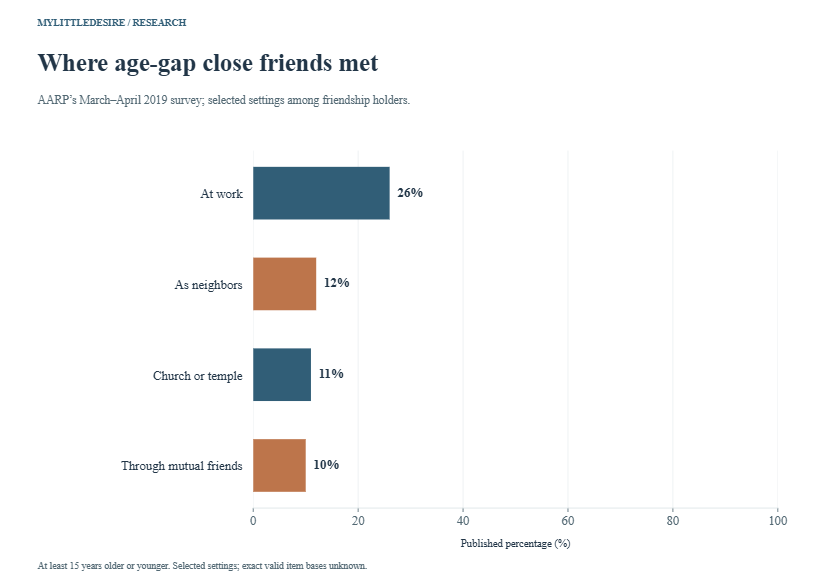
Work was the most commonly reported setting among those listed in AARP’s original 2019 reporting, followed by neighbors, church or temple, and mutual friends. These are selected meeting settings among people with a close intergenerational friendship, not percentages of all adults forming such a friendship at each location.
F06 Selected meeting settings for close intergenerational friendships. Publisher summary only; exact item-valid n and detailed routing not inspected. Selected settings are not an exhaustive distribution.
| Measure / group | Published result | Population, fieldwork and base | Publisher and verification |
|---|---|---|---|
| At work | 26% | U.S. adults with a close friend at least 15 years older or younger March 21–April 2, 2019 · Exact selected valid item n unavailable | Original publisher [S02] Original AARP companion article, meeting settings · Publisher summary only |
| As neighbors | 12% | U.S. adults with a close friend at least 15 years older or younger March 21–April 2, 2019 · Exact selected valid item n unavailable | Original publisher [S02] Original AARP companion article, meeting settings · Publisher summary only |
| At church or temple | 11% | U.S. adults with a close friend at least 15 years older or younger March 21–April 2, 2019 · Exact selected valid item n unavailable | Original publisher [S02] Original AARP companion article, meeting settings · Publisher summary only |
| Through mutual friends | 10% | U.S. adults with a close friend at least 15 years older or younger March 21–April 2, 2019 · Exact selected valid item n unavailable | Original publisher [S02] Original AARP companion article, meeting settings · Publisher summary only |
How long had intergenerational friendships lasted?
AARP’s research summary reports 45% had lasted at least ten years and 20% more than twenty years. The latter group is contained within the former. Adding those percentages would double count longer friendships.
F07 Selected reported duration categories. Publisher summary only. The more-than-20-years group is nested within at-least-10-years; do not add the two percentages. Relationship-level/holder routing not independently inspected.
| Measure / group | Published result | Population, fieldwork and base | Publisher and verification |
|---|---|---|---|
| At least 10 years | 45% | U.S. adults with a close friend at least 15 years older or younger March 21–April 2, 2019 · Exact selected valid item n unavailable | Original publisher [S02] Research summary, Young and Old Connections · Publisher summary only |
| More than 20 years | 20% | U.S. adults with a close friend at least 15 years older or younger March 21–April 2, 2019 · Exact selected valid item n unavailable | Original publisher [S02] Research summary, Young and Old Connections · Publisher summary only |
What did younger and older friends value about each other?
Younger respondents valued perspective, inspiration and role models. Older respondents described perspective, appreciation of their experiences and opportunities to share insights. These are self-reported perceptions from different eligible groups; they do not establish a medical benefit or show that an age gap caused an outcome.
F08 Younger-side perceptions of an older close friend. Publisher summary only. Self-reported benefits, not tested clinical/causal effects; multiple benefits may overlap.
| Measure / group | Published result | Population, fieldwork and base | Publisher and verification |
|---|---|---|---|
| Older friend provides another perspective | 61% | Younger side of close intergenerational friendships March 21–April 2, 2019 · Exact selected valid item n unavailable | Original publisher [S02] Original AARP companion article, younger perspective · Publisher summary only |
| Older friend inspires them | 44% | Younger side of close intergenerational friendships March 21–April 2, 2019 · Exact selected valid item n unavailable | Original publisher [S02] Original AARP companion article, younger perspective · Publisher summary only |
| Older friend serves as a role model | 40% | Younger side of close intergenerational friendships March 21–April 2, 2019 · Exact selected valid item n unavailable | Original publisher [S02] Original AARP companion article, younger perspective · Publisher summary only |
F09 Older-side perceptions of a younger close friend. Publisher summary only. Separate eligible perspective group from younger-side findings. Ratings can overlap and do not prove health benefits.
| Measure / group | Published result | Population, fieldwork and base | Publisher and verification |
|---|---|---|---|
| Younger friend provides another perspective | 54% | Older side of close intergenerational friendships March 21–April 2, 2019 · Exact selected valid item n unavailable | Original publisher [S02] Original AARP companion article, older perspective · Publisher summary only |
| Greater appreciation of own experiences | 37% | Older side of close intergenerational friendships March 21–April 2, 2019 · Exact selected valid item n unavailable | Original publisher [S02] Original AARP companion article, older perspective · Publisher summary only |
| Can share opinions and insights | 37% | Older side of close intergenerational friendships March 21–April 2, 2019 · Exact selected valid item n unavailable | Original publisher [S02] Original AARP companion article, older perspective · Publisher summary only |

How open were friends from different generations?
In AARP’s 2019 reporting, 39% said they hid nothing from a close intergenerational friend, while 47% were fairly open without sharing everything. The second response is not equivalent to full disclosure.
F10 Selected self-disclosure responses about a close intergenerational friend. Publisher summary only. Fairly open does not mean sharing everything; responses not assumed exhaustive.
| Measure / group | Published result | Population, fieldwork and base | Publisher and verification |
|---|---|---|---|
| Hide nothing | 39% | U.S. adults with a close friend at least 15 years older or younger March 21–April 2, 2019 · Exact selected valid item n unavailable | Original publisher [S02] Original AARP companion article, openness · Publisher summary only |
| Fairly open without sharing everything | 47% | U.S. adults with a close friend at least 15 years older or younger March 21–April 2, 2019 · Exact selected valid item n unavailable | Original publisher [S02] Original AARP companion article, openness · Publisher summary only |
What does the 2024 older-adult poll show?
The University of Michigan’s August 2024 national poll surveyed adults at ages 50–94, published as 50+. Among those with at least one close friend, 46% had a close friend at least 15 years older or younger. Among that intergenerational-friend group, 52% had both older and younger friends, 35% younger only and 13% older only. Each question has its own eligibility condition.
F11 A close friend at least 15 years older or younger. Q11 requires a close friend. 46% is not an estimate for every older adult or all U.S. adults.
| Measure / group | Published result | Population, fieldwork and base | Publisher and verification |
|---|---|---|---|
| Has an intergenerational close friend | 46% | U.S. respondents surveyed at ages 50–94 (published as 50+) with at least one close friend August 5–27, 2024 · Exact selected valid item n unavailable | Original publisher [S03] Q11; original report Close intergenerational friendships · Original report/table and methods |
F12 Direction among people who already have a close intergenerational friend. Q12 requires an intergenerational friend. The 52/35/13 split is conditional, not based on all older adults or all friendship holders.
| Measure / group | Published result | Population, fieldwork and base | Publisher and verification |
|---|---|---|---|
| Both older and younger generations | 52% | U.S. respondents surveyed at ages 50–94 (published as 50+) with at least one close friend who also have an intergenerational close friend August 5–27, 2024 · Exact selected valid item n unavailable | Original publisher [S03] Q12, conditioned on Q11 Yes · Original report/table and methods |
| Younger generation only | 35% | U.S. respondents surveyed at ages 50–94 (published as 50+) with at least one close friend who also have an intergenerational close friend August 5–27, 2024 · Exact selected valid item n unavailable | Original publisher [S03] Q12, conditioned on Q11 Yes · Original report/table and methods |
| Older generation only | 13% | U.S. respondents surveyed at ages 50–94 (published as 50+) with at least one close friend who also have an intergenerational close friend August 5–27, 2024 · Exact selected valid item n unavailable | Original publisher [S03] Q12, conditioned on Q11 Yes · Original report/table and methods |

How should these statistics be interpreted?
Match a statistic to the claim’s geography, age, friendship scope and denominator. Any-friend, close-friend and conditional friendship-holder estimates are different measures. Friend count or age diversity also differs from loneliness; see our loneliness statistics for those definitions and survey periods.
A perceived benefit is not proof that a friendship improves health. A cross-sectional age difference is not an individual aging trajectory. These studies do not establish an ideal age gap, a required number of friends or a quantified treatment benefit.
Ten reproducible descriptive comparisons
Each result subtracts the second published percentage from the first and uses percentage points. Rounded inputs are retained. These are descriptive differences, with no new confidence interval, significance test or causal interpretation. The workbook retrieves stable observation IDs and guards units and measure types.
| ID | Comparison | First | Second | Difference | Qualification |
|---|---|---|---|---|---|
| C01 | U.S.: older-friend minus younger-friend rate | 47% | 33% | +14 percentage points | Same 2018 country population; overlapping directional responses. Rounded inputs; no new significance test. |
| C02 | Great Britain: older-friend minus younger-friend rate | 48% | 31% | +17 percentage points | Same covered country population and 2018 fieldwork. Rounded inputs; no new significance test. |
| C03 | Canada: older-friend minus younger-friend rate | 44% | 31% | +13 percentage points | Age 18–64 covered population; not all-age adults. Rounded inputs; no new significance test. |
| C04 | Australia: older-friend minus younger-friend rate | 41% | 32% | +9 percentage points | Age 16–64 covered online population. Rounded inputs; no new significance test. |
| C05 | Published Total: older-friend minus younger-friend rate | 45% | 33% | +12 percentage points | Publisher Total across surveyed countries; not a world-population rate. Rounded inputs; no new significance test. |
| C06 | Met at work minus as neighbors | 26% | 12% | +14 percentage points | Selected meeting settings, publisher-summary verification only. Rounded inputs; no new significance test. |
| C07 | Perspective benefit: younger-side minus older-side | 61% | 54% | +7 percentage points | Different younger-side/older-side eligible groups; not paired change. Rounded inputs; no new significance test. |
| C08 | Fairly open minus hide-nothing response | 47% | 39% | +8 percentage points | Separate disclosure responses, not an all-openness NET. Rounded inputs; no new significance test. |
| C09 | Conditional both-generations minus younger-only share | 52% | 35% | +17 percentage points | Only among older respondents with an intergenerational friend. Rounded inputs; no new significance test. |
| C10 | South Korea: older-friend minus younger-friend rate | 12% | 15% | -3 percentage points | Same covered 2018 country population. Negative descriptive result is valid. Rounded inputs; no new significance test. |
Common questions about intergenerational friendship
What age gap defines these intergenerational friendships?
The selected studies generally use at least 15 years older or younger. An age-gap definition is not the same as membership in different named birth generations.
What does AARP’s newer 54% figure measure?
Its research summary says adults with friends from another generation, at least 15 years older or younger. It is an any-friend figure from the 2025 survey, not a closest-friend rate. Full tables were not retrieved.
Can the older- and younger-friend rates be added?
No. A person can have both older and younger friends, so the responses can overlap.
Are the country percentages current?
No. The country comparisons use August–September 2018 fieldwork and retain that date. They exclude respondents age 65+.
Does Michigan’s 46% apply to every older adult?
No. Q11 requires at least one close friend. Its subsequent direction split also requires an intergenerational friend.
Do the studies show a rise or fall over time?
No comparable trend is calculated here. Definitions, age coverage, survey instruments and eligibility differ.
Were all original tables available?
No. Ipsos original tables/monograph and Michigan report/questions were checked. Sixteen AARP rows use original publisher summaries or companion reporting; exact valid item bases and full questionnaires were not independently inspected.
Research method and limitations
Selection and concentration. There are 86 observations in 13 groups from four studies and three publishers: Ipsos 66, AARP 2019 fifteen, Michigan four and AARP 2025 one. Sixty-two observations are country/Total directional cells from a single survey. Ipsos contributes about 77% of selected observations. Related cells and nested categories are not independent studies. Charts and comparisons reuse inputs. MyLittleDesire conducted no survey.
Verification levels. Seventy observations were checked against original reports/tables, methods and relevant questions. All 62 Ipsos country/Total cells were independently matched to original PDF pages 4–5, which were also visually inspected. Four further age values appear in the original monograph. Michigan’s original full HTML and questionnaire establish Q11/Q12 routes. Sixteen AARP observations were verified only against original publisher summaries/companion text retrieved through indexed publisher content. Full AARP reports/questionnaires were not retrieved; direct PDF/DOI access returned 403.
Newer AARP selection. Only the explicit any-friend figure in the 2025 research summary is selected. The separate data story’s closer-friend percentages and chart bases are excluded until their exact question and record-unit mapping can be checked. This is not a correction of the publisher or evidence of a trend. Qualitative friend-pair interviews are not another prevalence survey.
Coverage and uncertainty. All 86 selected item-valid bases, weighted item bases and selected estimate confidence intervals remain unknown. Full survey totals stay separate. Ipsos’s country sample-size descriptions are approximate; full 20,788 is not every country or subgroup n. Fifteen samples are described as representative within covered ages and fifteen are not nationally representative. No respondent counts, pooled global rate, new intervals or significance tests are reconstructed.
Interpretation and maintenance. Preserve any versus close friendship, the 15-year age gap, age coverage, directional overlap, conditional routes and nested duration categories. Keep historical dates visible; add a new wave only after checking instrument comparability. Update review dates after substantive source review. No causal health or longitudinal aging effect is inferred.
Original sources and supporting records
- Ipsos. The Future of Ageing / The Perennials — variation in age of friends [S01]
Published: February 2019 tables; March 2019 monograph. Actual fieldwork: August 24–September 7, 2018.
Population: Online panel respondents age 16–64 in 28 countries and 18–64 in the United States and Canada.
Full study sample: 20,788. 20,788 online respondents across 30 countries. Printed chart base is the full study total, not an exact country or age-subgroup valid n.
Bases: Country samples approximately 500+ or 1,000+ as described in original methods. Exact selected country/age-by-item valid n and weighted bases unavailable; not replaced with 20,788.
Method: Original 20-page tables, pages 4–5; original monograph pages 74–75; and U.S. publisher methods checked. Ipsos Global Advisor online panel. Weighted to country demographics. Fifteen country samples described as representative within covered ages; fifteen described as more urban, educated and affluent rather than nationally representative.
Limits: Historical 2018 survey, not 2027 prevalence. Excludes adults 65+. Friends are not restricted to close friends. Older and younger ties can overlap and must not be added to estimate any age-gap friendship. Published Total is not labelled a world-population rate here; no new pooled estimate or country weighting inferred. Country results are not equally representative or a rank of friendship quality. Monograph age groups are cross-sectional, not within-person aging. No overall margin assigned to selected cells.
Supporting record 1 · Supporting record 2 - AARP Research. The Positive Impact of Intergenerational Friendships — 2019 publisher summaries [S02]
Published: May 2019; research summary revised February 14, 2020; companion article May 29, 2019. Actual fieldwork: March 21–April 2, 2019.
Population: U.S. adults age 18+, with close intergenerational-friendship holders or younger/older sides specified for follow-up findings.
Full study sample: 1,500. 1,500 adults surveyed online. Selected follow-up valid bases, friendship-level counts and weighted bases not independently verified.
Bases: Prevalence concerns surveyed adults. Meeting, duration and disclosure concern close intergenerational friendships/holders. Benefits distinguish younger and older perspectives. Exact item-valid n unknown.
Method: Original AARP Research summary and original AARP companion reporting retrieved through indexed publisher text. Online survey with a 15-year-or-greater age-gap definition. Full original PDF located through DOI metadata but direct access returned 403. Full questionnaire, weights and item-level tables not independently inspected.
Limits: Fifteen selected observations are publisher-summary verification only. 2020 revision is not 2020 fieldwork. No use of a secondary report to supply missing item bases. Benefit ratings are self-reported perceptions, not clinical or causal effects. Duration categories are nested: 20+ years is contained within 10+ years. Meeting places need not exhaust all possibilities. Different older/younger perspectives are separate eligible groups, not paired-person change.
Supporting record 1 · Supporting record 2 · Supporting record 3 - University of Michigan National Poll on Healthy Aging. The Value of Friendships as We Age — intergenerational findings [S03]
Published: December 12, 2024. Actual fieldwork: August 5–27, 2024.
Population: U.S. adults surveyed at ages 50–94, published as 50+, with at least one close friend; further intergenerational-holder route for directions.
Full study sample: 3,486. 3,486 national respondents age 50–94; selected valid routed bases not supplied. Separate Michigan state sample excluded.
Bases: Q11 requires at least one close friend. Q12 requires a close friend at least 15 years older/younger. Exact valid unweighted/weighted bases unknown.
Method: Original full HTML report/methods and three-page questionnaire checked. NORC randomly selected stratified national household panel, online/phone, with racial/ethnic oversamples. National data weighted to the U.S. population. Full completion rate 36%; overall margins not assigned to these routed cells.
Limits: 46% uses friendship holders, not all older adults. The 52/35/13 direction split is conditional on having an intergenerational friend. Ages 50–94 are not all adults. No explicit family exclusion in Q1. Full-report PDF denied and linked Tableau returned an error during review; full HTML and original questions accessible. No national/state pooling or causal health claim.
Supporting record 1 · Supporting record 2 - AARP Research. The Friendship Study — 2025 any-friend finding from research summary [S04]
Published: March 6, 2026; research summary updated June 19, 2026. Actual fieldwork: October 23–November 10, 2025.
Population: U.S. adults age 18+, any intergenerational friend, not restricted to closest friends.
Full study sample: 1,488. 1,488 U.S. adult participants according to original research-summary methods. Exact selected valid item base unknown.
Bases: Research summary explicitly reports adults with friends at least 15 years older or younger. Exact valid unweighted/weighted item bases not retrieved.
Method: Original indexed AARP Research summary checked. Publisher describes a nationally representative online survey, weighted by generation. Qualitative interviews with friend pairs are a separate component, not an additional prevalence sample. Full report and questionnaire not retrieved.
Limits: One selected observation is publisher-summary verification only. Do not substitute the data story’s 22% close-friend figure or presence-chart n=4,095 for the any-friend estimate or participant count. The question/base mapping for those closer-friend charts is unresolved. No subtraction from 2019 as a trend; different friendship scope. No new CI or respondent count.
Supporting record 1 · Supporting record 2
Additional reviewed context: AARP’s Intergenerational Friendships: The Hidden Gems. Its numerical charts are not selected here; the base-mapping limit is described above.
How to cite this resource
MyLittleDesire. Intergenerational Friendship Statistics 2027. https://mylittledesire.com/intergenerational-friendship-statistics/.