
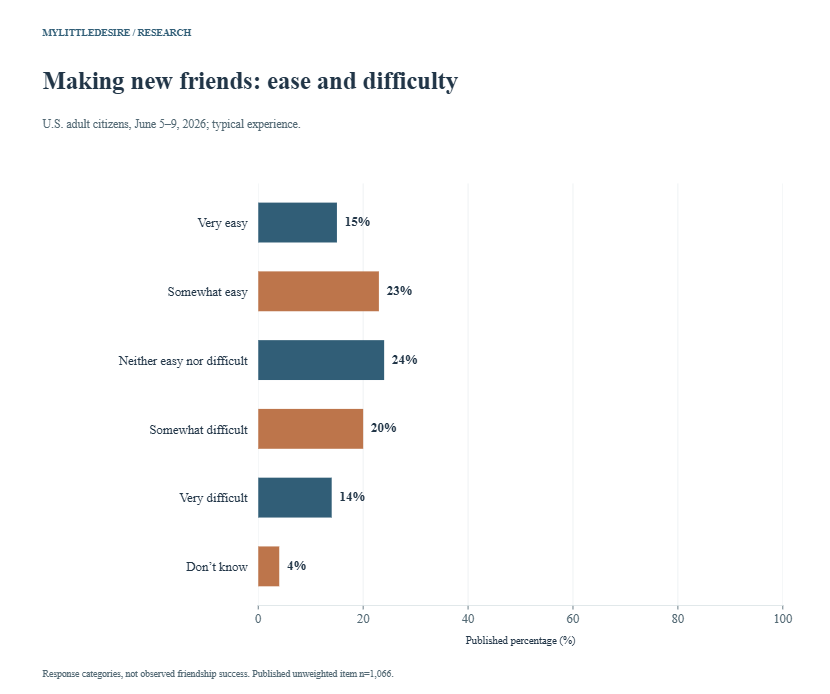
Making friends as an adult can mean wanting new connections, finding the process easy or difficult, or actually forming a friendship. Those measures answer different questions. In YouGov’s June 2026 U.S. adult-citizen survey, 20% found making new friends somewhat difficult and 14% very difficult. These are separate response categories, not an observed failure rate. YouGov [S01].
This resource contains 75 published observations in 16 groups from five studies and four publisher labels, with four charts and ten descriptive comparisons. Original reports, tables, methods and relevant questions were checked. Evidence covers U.S. adults, Australian adults and selected adult age groups in a historical UK survey; it does not establish a global rate or comparable country ranking.
20%
75%
found new-friend formation somewhat difficult in YouGov’s June 2026 U.S. adult-citizen survey; 14% selected very difficult.Original source [S01]
were very or somewhat interested in new friendships in Michigan’s August 2024 poll of surveyed ages 50–94.Original source [S02]
51.9%
50%
reported a new friend within the last 12 months in the 2023 adult quota sample. This is not a nationally representative rate.Original source [S03]
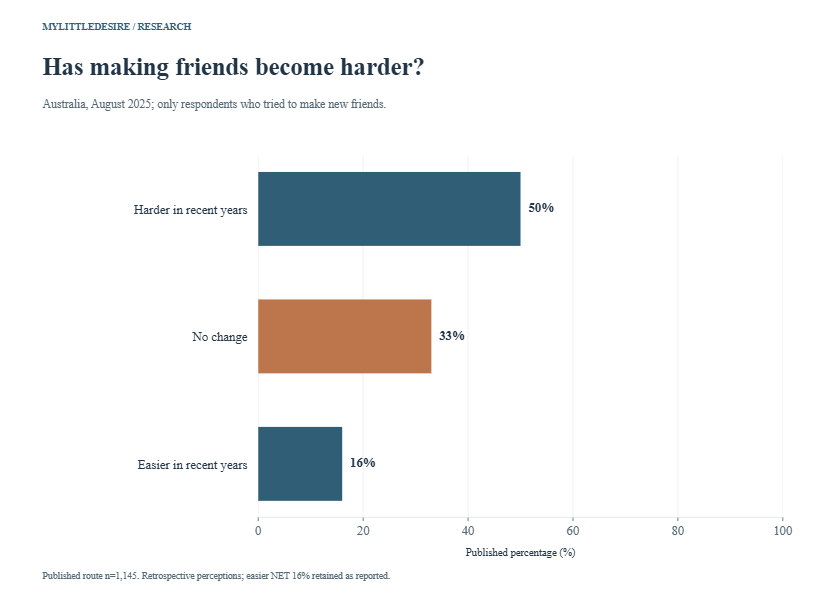
of Australian respondents who tried making friends said it had become harder in recent years, in August 2025.Original source [S04]
What do adult friendship-formation statistics measure?
Difficulty describes an assessment of the process. Enjoyment describes how it feels. Interest describes desire, and a last-new-friend question describes reported formation during a period. Where an existing friend was first met is another question again: adults may have met those friends in childhood. For broader context, see our friendship statistics.
| Source | Measure | Population | Fieldwork |
|---|---|---|---|
| YouGov [S01] | Friendship and Loneliness — making new friends, U.S. 2026 | U.S. adult citizens age 18+, with selected gender and adult age groups | June 5–9, 2026 |
| University of Michigan National Poll on Healthy Aging [S02] | The Value of Friendships as We Age — formation and interest | U.S. respondents surveyed at ages 50–94, published as 50+, with selected self-rated-health subgroups | August 5–27, 2024 |
| American Friendship Project [S03] | The American Friendship Project — 2023 adult quota sample | 2023 U.S. adult quota sample, ages 18–95; attitude items restricted to participants with at least one friend | June 9–24, 2023 |
| Real Insurance / MYMAVINS [S04] | Real Relationships Report 2025 — making friends | Australian adults; difficulty question among people who tried making friends; meeting settings among people with friends | August 13–18, 2025 |
| YouGov [S05] | The Big Friendship Survey — selected adult age groups, UK 2021 | Selected published question respondents age 25–39, 40–59 and 60+; full survey included age 16+ | June 16–22, 2021 |
How easy or difficult is making friends for U.S. adults?
YouGov’s 2026 question asks how easy or difficult respondents typically find making new friends. It includes a neutral option and “don’t know,” so it differs from agreement statements about difficulty and retrospective comparisons with younger years. The target is U.S. adult citizens in a weighted opt-in web survey.
F01 Typical ease/difficulty of making new friends. Not actual new-friend success. Original response categories retained; no derived easy/difficult NET.
| Measure / group | Published result | Population, fieldwork and reported base | Original source |
|---|---|---|---|
| Very easy | 15% | U.S. adult citizens age 18+ June 5–9, 2026 · Published unweighted item n=1,066 | Original source [S01] Q1, first age/gender cross-tab, printed page 1 (PDF page 4) |
| Somewhat easy | 23% | U.S. adult citizens age 18+ June 5–9, 2026 · Published unweighted item n=1,066 | Original source [S01] Q1, first age/gender cross-tab, printed page 1 (PDF page 4) |
| Neither easy nor difficult | 24% | U.S. adult citizens age 18+ June 5–9, 2026 · Published unweighted item n=1,066 | Original source [S01] Q1, first age/gender cross-tab, printed page 1 (PDF page 4) |
| Somewhat difficult | 20% | U.S. adult citizens age 18+ June 5–9, 2026 · Published unweighted item n=1,066 | Original source [S01] Q1, first age/gender cross-tab, printed page 1 (PDF page 4) |
| Very difficult | 14% | U.S. adult citizens age 18+ June 5–9, 2026 · Published unweighted item n=1,066 | Original source [S01] Q1, first age/gender cross-tab, printed page 1 (PDF page 4) |
| Don’t know | 4% | U.S. adult citizens age 18+ June 5–9, 2026 · Published unweighted item n=1,066 | Original source [S01] Q1, first age/gender cross-tab, printed page 1 (PDF page 4) |
F02 Selected somewhat/very difficult responses within each gender. Separate adult-citizen groups; no causal gender effect. Exact published unweighted question bases retained.
| Measure / group | Published result | Population, fieldwork and reported base | Original source |
|---|---|---|---|
| Men — somewhat difficult | 23% | U.S. adult citizens, men June 5–9, 2026 · Published unweighted item n=502 | Original source [S01] Q1 gender columns, printed page 1 |
| Women — somewhat difficult | 17% | U.S. adult citizens, women June 5–9, 2026 · Published unweighted item n=564 | Original source [S01] Q1 gender columns, printed page 1 |
| Men — very difficult | 14% | U.S. adult citizens, men June 5–9, 2026 · Published unweighted item n=502 | Original source [S01] Q1 gender columns, printed page 1 |
| Women — very difficult | 15% | U.S. adult citizens, women June 5–9, 2026 · Published unweighted item n=564 | Original source [S01] Q1 gender columns, printed page 1 |
F03 Selected difficulty responses in four adult age groups. Separate cross-sectional groups, not individual aging trajectories. Responses/age groups not pooled.
| Measure / group | Published result | Population, fieldwork and reported base | Original source |
|---|---|---|---|
| Age 18–29 — somewhat difficult | 20% | U.S. adult citizens age 18–29 June 5–9, 2026 · Published unweighted item n=250 | Original source [S01] Q1 age columns, printed page 1 |
| Age 30–44 — somewhat difficult | 17% | U.S. adult citizens age 30–44 June 5–9, 2026 · Published unweighted item n=245 | Original source [S01] Q1 age columns, printed page 1 |
| Age 45–64 — somewhat difficult | 19% | U.S. adult citizens age 45–64 June 5–9, 2026 · Published unweighted item n=340 | Original source [S01] Q1 age columns, printed page 1 |
| Age 65+ — somewhat difficult | 23% | U.S. adult citizens age 65+ June 5–9, 2026 · Published unweighted item n=231 | Original source [S01] Q1 age columns, printed page 1 |
| Age 18–29 — very difficult | 12% | U.S. adult citizens age 18–29 June 5–9, 2026 · Published unweighted item n=250 | Original source [S01] Q1 age columns, printed page 1 |
| Age 30–44 — very difficult | 21% | U.S. adult citizens age 30–44 June 5–9, 2026 · Published unweighted item n=245 | Original source [S01] Q1 age columns, printed page 1 |
| Age 45–64 — very difficult | 16% | U.S. adult citizens age 45–64 June 5–9, 2026 · Published unweighted item n=340 | Original source [S01] Q1 age columns, printed page 1 |
| Age 65+ — very difficult | 6% | U.S. adult citizens age 65+ June 5–9, 2026 · Published unweighted item n=231 | Original source [S01] Q1 age columns, printed page 1 |
The gender and age tables describe different groups. They do not establish that gender or aging caused an outcome. A 65+ result should keep that age label rather than becoming an estimate for every adult.
Also Read:-
Intergenerational Friendship Statistics 2027
Friendship After 50 Statistics 2027
Women Friendship Statistics 2027
Male Friendship Statistics 2027
Parent Teen Communication Statistics 2027
Do adults enjoy making new friends?
In the separate enjoyment question, 28% said they enjoyed making friends a lot and 52% a little, while 11% said not at all and 9% were not sure. Enjoying the process does not mean finding it easy or having made a friend during a particular month or year.
F04 Reported enjoyment of making new friends. Enjoyment is distinct from ease, attempts and actual success. Q2 valid unweighted total differs from full n=1,066.
| Measure / group | Published result | Population, fieldwork and reported base | Original source |
|---|---|---|---|
| A lot | 28% | U.S. adult citizens age 18+ June 5–9, 2026 · Published unweighted item n=1,063 | Original source [S01] Q2 total, printed page 2 (PDF page 5) |
| A little | 52% | U.S. adult citizens age 18+ June 5–9, 2026 · Published unweighted item n=1,063 | Original source [S01] Q2 total, printed page 2 (PDF page 5) |
| Not at all | 11% | U.S. adult citizens age 18+ June 5–9, 2026 · Published unweighted item n=1,063 | Original source [S01] Q2 total, printed page 2 (PDF page 5) |
| Not sure | 9% | U.S. adult citizens age 18+ June 5–9, 2026 · Published unweighted item n=1,063 | Original source [S01] Q2 total, printed page 2 (PDF page 5) |
F05 Selected a-lot/not-at-all enjoyment responses by age. Cross-sectional adult-citizen groups, not causal aging effects. Rounded category sums not normalized.
| Measure / group | Published result | Population, fieldwork and reported base | Original source |
|---|---|---|---|
| Age 18–29 — a lot | 36% | U.S. adult citizens age 18–29 June 5–9, 2026 · Published unweighted item n=250 | Original source [S01] Q2 age columns, printed page 2 |
| Age 30–44 — a lot | 24% | U.S. adult citizens age 30–44 June 5–9, 2026 · Published unweighted item n=245 | Original source [S01] Q2 age columns, printed page 2 |
| Age 45–64 — a lot | 22% | U.S. adult citizens age 45–64 June 5–9, 2026 · Published unweighted item n=338 | Original source [S01] Q2 age columns, printed page 2 |
| Age 65+ — a lot | 33% | U.S. adult citizens age 65+ June 5–9, 2026 · Published unweighted item n=230 | Original source [S01] Q2 age columns, printed page 2 |
| Age 18–29 — not at all | 11% | U.S. adult citizens age 18–29 June 5–9, 2026 · Published unweighted item n=250 | Original source [S01] Q2 age columns, printed page 2 |
| Age 30–44 — not at all | 12% | U.S. adult citizens age 30–44 June 5–9, 2026 · Published unweighted item n=245 | Original source [S01] Q2 age columns, printed page 2 |
| Age 45–64 — not at all | 14% | U.S. adult citizens age 45–64 June 5–9, 2026 · Published unweighted item n=338 | Original source [S01] Q2 age columns, printed page 2 |
| Age 65+ — not at all | 6% | U.S. adult citizens age 65+ June 5–9, 2026 · Published unweighted item n=230 | Original source [S01] Q2 age columns, printed page 2 |
Do adults after 50 want new friends?
Michigan’s national poll surveyed adults at ages 50–94, publishing findings as 50+. Forty-two percent said making friends was harder than when they were younger, while 10% said easier and 48% about the same. At the same time, 75% were interested in new friendships, including 14% very and 61% somewhat interested. Those interest categories are components of the 75% NET.
F06 Own retrospective comparison with when younger. Q10 asks all. Perception, not longitudinal aging. Health subgroups may overlap; no causal health effect.
| Measure / group | Published result | Population, fieldwork and reported base | Original source |
|---|---|---|---|
| Harder now | 42% | U.S. respondents surveyed at ages 50–94 (published as 50+) August 5–27, 2024 · Exact selected item/subgroup n unavailable | Original source [S02] Q10 making-friends item; original report Making new friends |
| Easier now | 10% | U.S. respondents surveyed at ages 50–94 (published as 50+) August 5–27, 2024 · Exact selected item/subgroup n unavailable | Original source [S02] Q10 making-friends item; original report Making new friends |
| About the same | 48% | U.S. respondents surveyed at ages 50–94 (published as 50+) August 5–27, 2024 · Exact selected item/subgroup n unavailable | Original source [S02] Q10 making-friends item; original report Making new friends |
| Harder, fair/poor mental health | 65% | U.S. respondents surveyed at ages 50–94 (published as 50+) reporting fair/poor mental health August 5–27, 2024 · Exact selected item/subgroup n unavailable | Original source [S02] Q10 making-friends item; original report Making new friends |
| Harder, fair/poor physical health | 55% | U.S. respondents surveyed at ages 50–94 (published as 50+) reporting fair/poor physical health August 5–27, 2024 · Exact selected item/subgroup n unavailable | Original source [S02] Q10 making-friends item; original report Making new friends |
F07 Interest in developing new friendships. Q3 asks all. Interested NET contains very and somewhat components; do not add. Interest is not observed formation.
| Measure / group | Published result | Population, fieldwork and reported base | Original source |
|---|---|---|---|
| Very/somewhat interested | 75% | U.S. respondents surveyed at ages 50–94 (published as 50+) August 5–27, 2024 · Exact selected item/subgroup n unavailable | Original source [S02] Q3; original report Making new friends |
| Very interested | 14% | U.S. respondents surveyed at ages 50–94 (published as 50+) August 5–27, 2024 · Exact selected item/subgroup n unavailable | Original source [S02] Q3; original report Making new friends |
| Somewhat interested | 61% | U.S. respondents surveyed at ages 50–94 (published as 50+) August 5–27, 2024 · Exact selected item/subgroup n unavailable | Original source [S02] Q3; original report Making new friends |
| Not interested | 25% | U.S. respondents surveyed at ages 50–94 (published as 50+) August 5–27, 2024 · Exact selected item/subgroup n unavailable | Original source [S02] Q3; original report Making new friends |
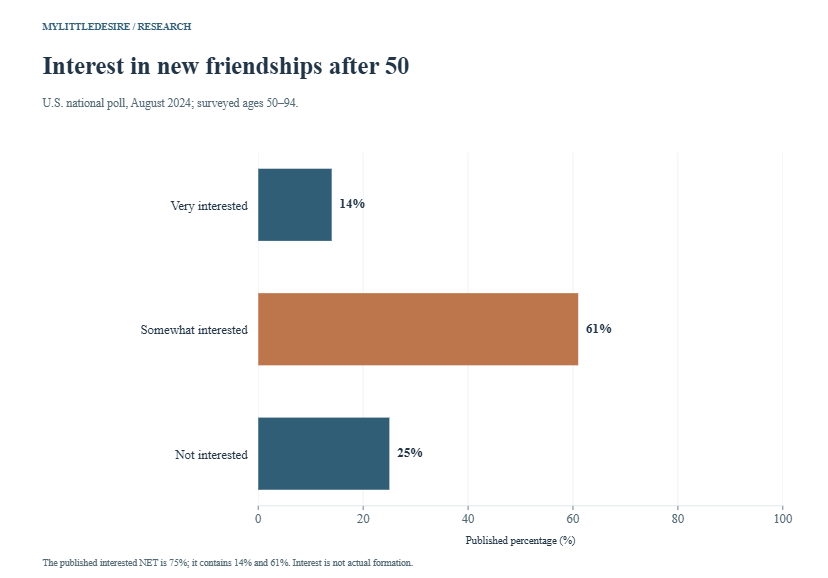
These questions ask all respondents, unlike other friendship-holder-only questions in the same poll. The health-specific percentages describe subgroups and associations. Retrospective perceptions do not follow the same individuals over decades.
What does the American Friendship Project report?
The American Friendship Project’s 2023 adult quota sample provides a different view. Among friendship holders, 48.9% agreed it was difficult to make new friends, 36.0% to maintain friendships at that time, and 65.6% said making friends was easier at another time of life. The study’s separate last-new-friend question reported 51.9% within the last 12 months. Difficulty and recent formation can coexist.
F08 Published percent agreeing with each friendship experience on a seven-point agreement scale. Among friendship holders. Published table base n=2,210, not confirmed item-complete n. Do not invent a numerical agreement threshold. Quota sample not nationally representative.
| Measure / group | Published result | Population, fieldwork and reported base | Original source |
|---|---|---|---|
| Difficult to make new friends | 48.9% | 2023 U.S. adult quota-sample friendship holders June 9–24, 2023 · Published table n=2,210 | Original source [S03] Original Table 3, 2023 SCRI % Agree column and footnote |
| Difficult to maintain friendships now | 36.0% | 2023 U.S. adult quota-sample friendship holders June 9–24, 2023 · Published table n=2,210 | Original source [S03] Original Table 3, 2023 SCRI % Agree column and footnote |
| Easier to make friends at another time of life | 65.6% | 2023 U.S. adult quota-sample friendship holders June 9–24, 2023 · Published table n=2,210 | Original source [S03] Original Table 3, 2023 SCRI % Agree column and footnote |
| Not as close to friends as desired | 47.3% | 2023 U.S. adult quota-sample friendship holders June 9–24, 2023 · Published table n=2,210 | Original source [S03] Original Table 3, 2023 SCRI % Agree column and footnote |
F09 Most recent new friendship in the last 12 months. Original Table 9 reported base n=2,243. Separate from difficulty. Name-generation procedures changed across 2022/2023, so no wave-to-wave trend inferred.
| Measure / group | Published result | Population, fieldwork and reported base | Original source |
|---|---|---|---|
| Made a new friend in the last 12 months | 51.9% | 2023 U.S. adult quota-sample respondents June 9–24, 2023 · Published table n=2,243 | Original source [S03] Original Table 9, 2023 Last 12 months row |
These are adult quota-sample findings, not a probability-based nationally representative estimate. The 2022 college-student and adult samples are not included in the selected figures. Name-generation prompts changed between waves, so the 2023 new-friend percentage is not used to claim a year-to-year increase. The published percent-agree values are retained without assigning an unverified cutpoint on the seven-point scale.
Has making friends become harder for Australian attempters?
The Real Relationships Report asks whether making friends has become easier or harder in recent years, specifically among respondents who tried. Its published overall route is 1,145 people. Fifty percent reported harder, 33% no change and the report’s prose NET was 16% easier. The original 16% is retained rather than replaced by the sum of rounded pie-chart components.
F10 Perceived change in making new friends in recent years. Route n=1,145 as printed; weighting status unspecified. Published easier NET 16 retained, not replaced by rounded 6+11. No change is not a satisfaction/success rate.
| Measure / group | Published result | Population, fieldwork and reported base | Original source |
|---|---|---|---|
| Harder in recent years | 50% | Australian adult respondents who tried to make new friends August 13–18, 2025 · Published route n=1,145 | Original source [S04] Original report page 12, prose NETs and chart no-change category |
| Easier in recent years | 16% | Australian adult respondents who tried to make new friends August 13–18, 2025 · Published route n=1,145 | Original source [S04] Original report page 12, prose NETs and chart no-change category |
| No change | 33% | Australian adult respondents who tried to make new friends August 13–18, 2025 · Published route n=1,145 | Original source [S04] Original report page 12, prose NETs and chart no-change category |
F11 Harder in recent years within each gender. Retrospective comparison among attempters; exact gender-route bases unavailable, not replaced by full or overall route n.
| Measure / group | Published result | Population, fieldwork and reported base | Original source |
|---|---|---|---|
| Women | 58% | Australian adult respondents who tried to make new friends, women August 13–18, 2025 · Exact selected item/subgroup n unavailable | Original source [S04] Original report page 12, gender prose |
| Men | 42% | Australian adult respondents who tried to make new friends, men August 13–18, 2025 · Exact selected item/subgroup n unavailable | Original source [S04] Original report page 12, gender prose |
F12 Selected harder/no-change responses within named report cohorts. Exact cohort-route bases unknown. Cohorts retained as named without guessed ages. Cross-sectional perceptions, not individual aging.
| Measure / group | Published result | Population, fieldwork and reported base | Original source |
|---|---|---|---|
| Gen Y — harder | 57% | Australian adult respondents who tried to make new friends in the Gen Y cohort August 13–18, 2025 · Exact selected item/subgroup n unavailable | Original source [S04] Original report page 12, cohort prose |
| Gen Z — harder | 55% | Australian adult respondents who tried to make new friends in the Gen Z cohort August 13–18, 2025 · Exact selected item/subgroup n unavailable | Original source [S04] Original report page 12, cohort prose |
| Baby Boomers — harder | 42% | Australian adult respondents who tried to make new friends in the Baby Boomer cohort August 13–18, 2025 · Exact selected item/subgroup n unavailable | Original source [S04] Original report page 12, cohort prose |
| Baby Boomers — no change | 46% | Australian adult respondents who tried to make new friends in the Baby Boomer cohort August 13–18, 2025 · Exact selected item/subgroup n unavailable | Original source [S04] Original report page 12, cohort prose |
The gender and cohort results use smaller subgroup populations whose exact route bases are not supplied. “Harder” is a retrospective perception among attempters, not the percentage of every Australian adult unable to make friends.
Where had Australian adults met existing close friends?
Among respondents with friends, the report lists work, school, family, community settings, partners and sports or health activities as ways existing close friends had been met. Multiple answers were allowed. School may refer to childhood friendships; these results do not identify where a new friendship was formed during adulthood or prove that a particular setting will work for an individual.
F13 Selected reported meeting settings for current close friends. Published route n=1,055; multiple responses, selected settings. Friends may have met in childhood; not an adult-only formation setting or a success rate. Mutual-friend figure excluded because chart/prose conflict.
| Measure / group | Published result | Population, fieldwork and reported base | Original source |
|---|---|---|---|
| Work | 44% | Australian adult respondents with friends August 13–18, 2025 · Published route n=1,055 | Original source [S04] Original report page 11 chart and route footnote |
| Primary or secondary school | 29% | Australian adult respondents with friends August 13–18, 2025 · Published route n=1,055 | Original source [S04] Original report page 11 chart and route footnote |
| Through family members | 22% | Australian adult respondents with friends August 13–18, 2025 · Published route n=1,055 | Original source [S04] Original report page 11 chart and route footnote |
| Neighbors or local community events | 21% | Australian adult respondents with friends August 13–18, 2025 · Published route n=1,055 | Original source [S04] Original report page 11 chart and route footnote |
| Through a partner | 18% | Australian adult respondents with friends August 13–18, 2025 · Published route n=1,055 | Original source [S04] Original report page 11 chart and route footnote |
| Sports, clubs, gym or health activities | 18% | Australian adult respondents with friends August 13–18, 2025 · Published route n=1,055 | Original source [S04] Original report page 11 chart and route footnote |
One conflicting result withheld. The original Australian page gives different mutual-friend percentages in its chart and prose. That measure is excluded here. The other selected settings agree with the original chart and relevant prose.
What do selected UK adult age groups report?
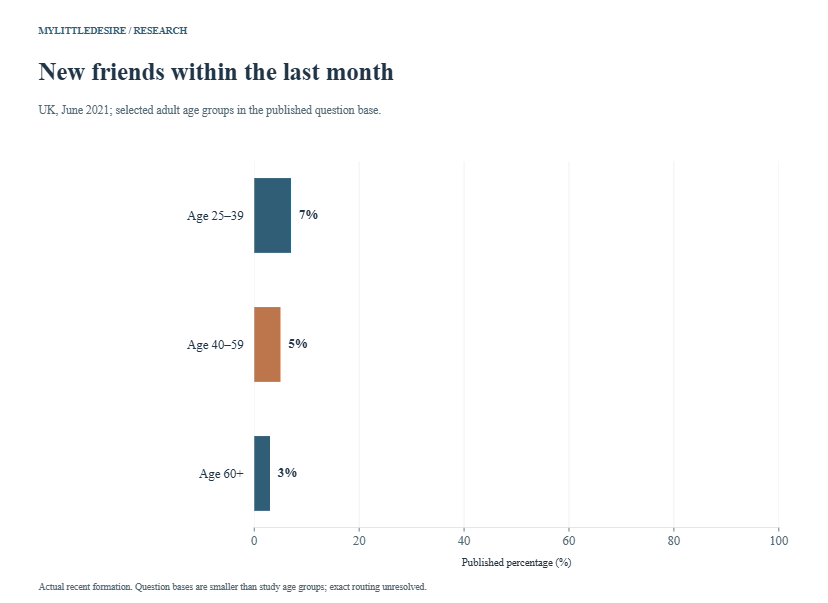
YouGov’s June 2021 UK tables provide historical responses for ages 25–39, 40–59 and 60+. These are selected published question populations, with bases smaller than the study’s full age groups. Exact routing was not independently confirmed, so the findings should not be generalized to every UK adult. No age-16–24 or full-age-16+ estimate is included.
F14 Very/fairly easy/difficult categories in selected adult age groups. Published question bases are smaller than full age-group samples; exact route unresolved. Do not generalize to all UK adults. Historical pandemic-period estimates; no 16–24 observations selected.
| Measure / group | Published result | Population, fieldwork and reported base | Original source |
|---|---|---|---|
| Age 25–39 — very easy | 7% | UK published-question respondents age 25–39 June 16–22, 2021 · Published unweighted question n=529; weighted Base=526 | Original source [S05] Original PDF page 6, ease question age columns |
| Age 40–59 — very easy | 9% | UK published-question respondents age 40–59 June 16–22, 2021 · Published unweighted question n=645; weighted Base=638 | Original source [S05] Original PDF page 6, ease question age columns |
| Age 60+ — very easy | 9% | UK published-question respondents age 60+ June 16–22, 2021 · Published unweighted question n=743; weighted Base=677 | Original source [S05] Original PDF page 6, ease question age columns |
| Age 25–39 — fairly easy | 36% | UK published-question respondents age 25–39 June 16–22, 2021 · Published unweighted question n=529; weighted Base=526 | Original source [S05] Original PDF page 6, ease question age columns |
| Age 40–59 — fairly easy | 36% | UK published-question respondents age 40–59 June 16–22, 2021 · Published unweighted question n=645; weighted Base=638 | Original source [S05] Original PDF page 6, ease question age columns |
| Age 60+ — fairly easy | 38% | UK published-question respondents age 60+ June 16–22, 2021 · Published unweighted question n=743; weighted Base=677 | Original source [S05] Original PDF page 6, ease question age columns |
| Age 25–39 — fairly difficult | 33% | UK published-question respondents age 25–39 June 16–22, 2021 · Published unweighted question n=529; weighted Base=526 | Original source [S05] Original PDF page 6, ease question age columns |
| Age 40–59 — fairly difficult | 34% | UK published-question respondents age 40–59 June 16–22, 2021 · Published unweighted question n=645; weighted Base=638 | Original source [S05] Original PDF page 6, ease question age columns |
| Age 60+ — fairly difficult | 36% | UK published-question respondents age 60+ June 16–22, 2021 · Published unweighted question n=743; weighted Base=677 | Original source [S05] Original PDF page 6, ease question age columns |
| Age 25–39 — very difficult | 18% | UK published-question respondents age 25–39 June 16–22, 2021 · Published unweighted question n=529; weighted Base=526 | Original source [S05] Original PDF page 6, ease question age columns |
| Age 40–59 — very difficult | 16% | UK published-question respondents age 40–59 June 16–22, 2021 · Published unweighted question n=645; weighted Base=638 | Original source [S05] Original PDF page 6, ease question age columns |
| Age 60+ — very difficult | 13% | UK published-question respondents age 60+ June 16–22, 2021 · Published unweighted question n=743; weighted Base=677 | Original source [S05] Original PDF page 6, ease question age columns |
F15 Most recent new friendship within the last month. Published question route unresolved; only the printed age-question population is represented. Actual recent formation, not ease or intention.
| Measure / group | Published result | Population, fieldwork and reported base | Original source |
|---|---|---|---|
| Age 25–39 — last month | 7% | UK published-question respondents age 25–39 June 16–22, 2021 · Published unweighted question n=529; weighted Base=526 | Original source [S05] Original PDF page 6, last-new-friend Last month row |
| Age 40–59 — last month | 5% | UK published-question respondents age 40–59 June 16–22, 2021 · Published unweighted question n=645; weighted Base=638 | Original source [S05] Original PDF page 6, last-new-friend Last month row |
| Age 60+ — last month | 3% | UK published-question respondents age 60+ June 16–22, 2021 · Published unweighted question n=743; weighted Base=677 | Original source [S05] Original PDF page 6, last-new-friend Last month row |
F16 Publisher-reported within-past-year NET. 21% is the published article NET, not the table’s separate 10% Last year response option. Retain printed age-question bases and unresolved route, not all age-60+ adults.
| Measure / group | Published result | Population, fieldwork and reported base | Original source |
|---|---|---|---|
| Age 60+ — made a friend in the past year | 21% | UK published-question respondents age 60+ June 16–22, 2021 · Published unweighted question n=743; weighted Base=677 | Original source [S05] Original article 60+ past-year NET; PDF page 6 age-question bases |
For age 60+, the original article’s within-past-year figure is 21%. The table’s separate “last year” response is 10%, alongside earlier month and six-month options. The 10% option is not itself the within-year NET. These pandemic-period results are not a current country comparison.
How should these findings be interpreted?
Match the time window, population and question to the claim. Wanting new friendships, enjoying the process, reporting difficulty and having formed a friendship are not interchangeable. Friendship formation also differs from loneliness; see our loneliness statistics for those measures and periods.
The studies do not provide one universal friendship-failure rate, ideal friend count or guaranteed way to make friends. No clinical benefit, causal effect, world average or new significance test is inferred here.
Ten reproducible descriptive comparisons
Each result subtracts the second published percentage from the first and uses percentage points. Rounded inputs remain visible. The workbook retrieves stable IDs and guards units and measure types. Negative differences and genuine zeros are valid results.
| ID | Comparison | First | Second | Difference | Qualification |
|---|---|---|---|---|---|
| C01 | Somewhat minus very difficult in U.S. 2026 | 20% | 14% | +6 percentage points | Two response categories, not a combined difficulty NET. Rounded inputs; no new significance test. |
| C02 | Somewhat difficult: men minus women | 23% | 17% | +6 percentage points | Different adult-citizen gender groups. Rounded inputs; no new significance test. |
| C03 | UK last-month formation: 60+ minus 25–39 | 3% | 7% | -4 percentage points | Historical selected question populations; exact routing unresolved. Rounded inputs; no new significance test. |
| C04 | Enjoy making friends a lot minus not at all | 28% | 11% | +17 percentage points | Enjoyment responses, not observed success. Rounded inputs; no new significance test. |
| C05 | Older-adult interested NET minus not interested | 75% | 25% | +50 percentage points | Two interest response groups; NET overlaps its own very/somewhat components. Rounded inputs; no new significance test. |
| C06 | Adult quota sample: making minus maintaining difficulty | 48.9% | 36.0% | +12.9 percentage points | Different task items among friendship holders. Rounded inputs; no new significance test. |
| C07 | Adult quota sample: easier at another time minus current making difficulty | 65.6% | 48.9% | +16.7 percentage points | Different agreement items, not measured change over time. Rounded inputs; no new significance test. |
| C08 | Australia existing friends: work minus school | 44% | 29% | +15 percentage points | Overlapping settings; friends may have met in childhood. Rounded inputs; no new significance test. |
| C09 | Older adults: harder minus easier versus younger | 42% | 10% | +32 percentage points | Retrospective categories, not longitudinal aging. Rounded inputs; no new significance test. |
| C10 | Australia increased difficulty: women minus men | 58% | 42% | +16 percentage points | Among attempters; exact gender-route bases unknown. Rounded inputs; no new significance test. |
Common questions about making friends as an adult
How many adults find making new friends difficult?
It depends on the question and population. In YouGov’s June 2026 U.S. adult-citizen survey, 20% selected somewhat difficult and 14% very difficult. AFP’s separate 2023 adult quota-sample agreement item was 48.9% among friendship holders. These are different measures.
Does finding it difficult mean someone made no friends?
No. Difficulty is a perception. A separate formation question asks when a person most recently made a new friend.
Do older adults want new friends?
In Michigan’s August 2024 national poll of surveyed ages 50–94, 75% were very or somewhat interested. The survey does not equate interest with actual formation.
Is adult friendship harder because of age?
The selected retrospective comparisons and cross-sectional age groups do not establish that aging caused difficulty or follow individuals across their lives.
Are Australian meeting-place figures about friends made as adults?
Not necessarily. Adults reported where existing close friends were met, including primary and secondary school. Those ties may have begun in childhood.
Why is one Australian setting missing?
Its chart and prose give conflicting mutual-friend percentages. The measure is withheld pending clarification.
Do the UK figures describe every UK adult?
No. Only adult age groups are selected, and their published question bases are smaller than full age-group study samples. Exact routing was not independently confirmed.
Are these 2027 survey results?
No. 2027 is the edition label. Source review occurred November 4, 2026; actual fieldwork in 2021, 2023, 2024, 2025 and 2026 remains visible.
Research method and limitations
Selection and concentration. Seventy-five observations in 16 groups come from five studies and four publisher labels: YouGov U.S. 30, Michigan nine, AFP five, Real Insurance/MYMAVINS fifteen and YouGov UK sixteen. Related categories and subgroups are not independent studies. YouGov contributes 46 observations across two different surveys. Charts and comparisons reuse inputs. MyLittleDesire conducted no survey.
Original-source verification. Original YouGov U.S./UK tables, questions and relevant methods were checked. AFP’s original article, manuscript XML, table cells and footnotes were checked. The Australian full report was downloaded and pages 11–12 visually inspected. Michigan’s original full HTML and questionnaire copies were retrieved earlier on the same review date; fresh access attempts returned 403. No interactive-table or respondent-record audit is claimed.
Bases. Sixty observations retain a published unweighted item, table or route base; fifteen exact subgroup/item bases remain unknown. Table and route counts are labelled as such and are not automatically every item-complete base. Sixteen UK observations preserve the separate printed weighted Base; 59 weighted bases are unavailable. No selected estimate confidence intervals are supplied. Full study totals stay separate. UK question bases are smaller than full age-group samples, and exact routing remains unresolved.
Definitions and source conflicts. Typical ease, enjoyment, interest, perceived change, actual formation and retrospective meeting settings remain separate. Interested NETs contain components; multiple meeting settings can overlap. Australia’s original easier NET is retained despite rounded component sums. Its contradictory mutual-friend setting is withheld. AFP’s original 2023 earlier-ease value is 65.6%, and only the adult quota sample is selected. Published agreement is not assigned an invented numerical cutpoint.
Interpretation and maintenance. Do not pool dates, countries or instruments into a global rate or trend. Preserve citizenship, ages, health groups and routes. No new respondent counts, intervals, significance tests, clinical effects or longitudinal aging claim. Recheck original questions, bases and instruments before replacing figures; update review dates only after substantive source review.
Original sources and supporting records
- YouGov. Friendship and Loneliness — making new friends, U.S. 2026 [S01]
Published: 2026; exact release day not stated in tables. Actual fieldwork: June 5–9, 2026.
Population: U.S. adult citizens age 18+, with selected gender and adult age groups.
Full sample: 1,066. 1,066 adult citizens overall. Q1 total unweighted n=1,066; Q2 total n=1,063. Age/gender question bases preserved.
Bases: Thirty selected observations have exact published unweighted question bases. Weighted bases unavailable.
Method: Original PDF questions, cross-tabs and methods checked. Weighted opt-in web panel of U.S. adult citizens. Demographic, regional and political weighting. Overall adjusted margin ±4.3 points not assigned to selected subgroups.
Limits: Citizen-only target differs from all resident adults. Q1 typical ease is distinct from Q2 enjoyment. Responses are categories, not observed success. Rounded distributions may sum to 99/101; no normalization, new NETs, reconstructed counts or new CIs. Age/gender differences are descriptive, not causal or individual aging effects. - University of Michigan National Poll on Healthy Aging. The Value of Friendships as We Age — formation and interest [S02]
Published: December 12, 2024. Actual fieldwork: August 5–27, 2024.
Population: U.S. respondents surveyed at ages 50–94, published as 50+, with selected self-rated-health subgroups.
Full sample: 3,486. 3,486 national respondents age 50–94. Exact selected valid item/subgroup bases unknown; separate Michigan sample excluded.
Bases: Q3 interest and Q10 making-friends comparison ask all respondents. Exact selected valid n unavailable.
Method: Original full HTML report/methods and three-page questionnaire checked, using copies retrieved earlier on the same review date when fresh access returned 403. NORC randomly selected stratified national household panel, online/phone; racial/ethnic oversamples and national weighting. Full completion rate 36%.
Limits: Retrospective easier/harder versus younger is not longitudinal aging. Health associations are not causal; health groups can overlap. Interested NET contains very/somewhat components; do not add. Interest is not attempted or successful friendship formation. Full study n is not every item base. Full-report PDF denied/Tableau error; no interactive-table audit.
Supporting record 1 · Supporting record 2 - American Friendship Project. The American Friendship Project — 2023 adult quota sample [S03]
Published: July 30, 2024. Actual fieldwork: June 9–24, 2023.
Population: 2023 U.S. adult quota sample, ages 18–95; attitude items restricted to participants with at least one friend.
Full sample: 2,243. 2,243 retained 2023 adult participants. Table 3 friendship-holder base n=2,210; Table 9 2023 base n=2,243. Published table bases retained, not asserted as every item-complete base.
Bases: Table 3 attitudes among friendship holders, reported table n=2,210. Table 9 last-new-friend question reported 2023 table n=2,243. Individual item missingness not separately reported.
Method: Original peer-reviewed PLOS ONE article, manuscript XML, table rows/footnotes and methods checked. Siena College Research Institute/Lucid quota sample with attention, speed and response-quality screening. Not a probability-based nationally representative sample. 2022 adult and student samples not selected.
Limits: Published percent-agree values on a seven-point agreement scale retained without inventing a cutpoint. 51.9% is past-12-month formation, distinct from 48.9% difficulty. Survey/name-generation procedures changed between 2022 and 2023, so no growth trend inferred. Friends can include relatives/partners. Table bases not automatically every item-valid n. No clinical or causal effects.
Supporting record 1 · Supporting record 2 · Supporting record 3 - Real Insurance / MYMAVINS. Real Relationships Report 2025 — making friends [S04]
Published: 2025; exact release day not stated in report. Actual fieldwork: August 13–18, 2025.
Population: Australian adults; difficulty question among people who tried making friends; meeting settings among people with friends.
Full sample: 1,204. 1,204 adults overall. Difficulty route n=1,145; meeting-place route n=1,055. Route bases published without separate weighting-status details. Gender/cohort route bases unknown.
Bases: Overall difficulty/ease/no-change: published route n=1,145. Selected meeting places: published route n=1,055. Gender/cohort subgroup bases unknown. Weighted bases unavailable.
Method: Original 18 MB report downloaded/extracted; pages 3, 11 and 12 checked, charts 11–12 rendered and visually reviewed. Commissioned by Real Insurance, conducted by MYMAVINS via online survey. Publisher calls sample broadly representative across age, gender, wealth and location; probability design/weights not independently specified.
Limits: Difficulty is perceived change in recent years among attempters, not typical ease or actual success. Published easier NET 16 retained despite rounded pie components 6+11=17; no new NET constructed. Mutual-friend setting excluded because chart 29 conflicts with prose 22. Meeting settings describe existing close friends, possibly met in childhood, not necessarily adult-age formation or a proven intervention. Multiple responses and selected settings only. Cohorts retained as named, without inferred age bands. - YouGov. The Big Friendship Survey — selected adult age groups, UK 2021 [S05]
Published: December 16, 2021 article. Actual fieldwork: June 16–22, 2021.
Population: Selected published question respondents age 25–39, 40–59 and 60+; full survey included age 16+.
Full sample: 2,195. 2,195 UK participants age 16+ overall. Selected age-question unweighted bases 529/645/743; printed weighted Base 526/638/677. Only age-25+ observations selected.
Bases: Published question bases are smaller than full age-group samples; exact routing not independently confirmed. Do not generalize to every UK adult. Unweighted and printed weighted bases retained.
Method: Original 48-page YouGov tables and original article checked. Published weighted online survey results; unweighted versus weighted base distinction checked in official YouGov documentation. Original PDF page 6 rendered and visually inspected.
Limits: Historical 2021 pandemic-period estimates. No age-16–24 or all-age-16+ observation selected for this adult-focused resource. Published question sample differs from full study sample, with routing unresolved. Very/fairly ease/difficulty options are categories, not combined NETs. Last-month response is actual recent formation; published age-60+ past-year 21 is a separate NET. No current country ranking or cross-study subtraction.
Supporting record 1 · Supporting record 2 · Supporting record 3
How to cite this resource
MyLittleDesire. Making Friends as an Adult Statistics 2027. https://mylittledesire.com/making-friends-as-an-adult-statistics/.