
International Friendship Day 2027 falls on Friday, July 30. The United Nations’ formal name is the International Day of Friendship. Its purpose includes connections across communities and cultures, alongside the friendships people maintain in daily life.
This reference contains 54 survey observations in 22 groups from four source collections, with four charts and ten descriptive comparisons. Two collections are geographic views of YouGov Profiles published around Friendship Day 2024; the others cover ordinary communication, support and making friends. Official observance facts are presented separately from survey results.
July 30
90%
is the UN observance date; in 2027 it falls on a Friday. The resolution was adopted May 3, 2011.UN resolution
of committed U.S. online adults agreed with quality over quantity in the July 2024 Profiles article; 83% of single adults did.Original source [S01]
74%
20%
of U.S. adults with a close friend reported at least one contact mode at least a few times a week in September 2024.Original source [S03]
selected somewhat difficult when asked about making new friends in the June 2026 U.S. adult-citizen survey.Original source [S04]
When is International Friendship Day in 2027?
| Fact | Verified detail |
|---|---|
| Formal UN name | International Day of Friendship |
| 2027 date | Friday, July 30, 2027 |
| Resolution | A/RES/65/275 |
| Adoption date | May 3, 2011 |
| Document distribution date | July 28, 2011 |
| Original authority | United Nations resolution |
The resolution designates July 30 and invites observance in ways appropriate to local cultures and circumstances, including education and public awareness. It connects friendship with peace, mutual understanding and respect across communities, and emphasizes involving young people. The document’s July 28 distribution date is different from its May 3 adoption date.
Also Read:-
Sympathy Card Condolence Practices Statistics 2027
Thank You Notes Appreciation Statistics 2027
Social Support During Life Changes Statistics 2027
Neighbor Relationships And Community Connection Statistics 2027
What do International Friendship Day statistics measure?
Some research is published to coincide with Friendship Day but asks about ordinary friendship attitudes. Other surveys describe routine contact and support without asking about the day. Neither type provides a count of people celebrating. This page focuses on the observance and relevant evidence; our friendship statistics page covers the broader subject.
| Collection | Target / subgroup | Actual period | Sample context |
|---|---|---|---|
| YouGov Profiles — U.S. [S01] | U.S. online adult population; single/committed relationship-status and selected gender groups | Continuously collected/rolling Profiles data published July 29, 2024; exact collection window unreported | Rolling Profiles product, not a single questionnaire. Exact full and selected item/subgroup n not given in inspected article. |
| YouGov Profiles — GB [S02] | GB online adult population; single/committed relationship-status and selected gender groups | Continuously collected/rolling Profiles data published July 29, 2024; exact collection window unreported | Rolling Profiles product, not a single questionnaire. Exact full and selected item/subgroup n not given in inspected article. |
| Pew Research Center [S03] | U.S. adults age 18+; communication items limited to people with at least one close friend outside family | September 3–15, 2024 | 6,204 full respondents: 5,202 ATP and 1,002 SSRS; full asked gender bases men 2,710 and women 3,446. Communication eligible base 5,107; exact gender counts within that subset unavailable. |
| YouGov — June 2026 survey [S04] | U.S. adult citizens age 18+, not all U.S. residents or a worldwide sample | June 5–9, 2026 | 1,066 respondents; Question 1 crosstab prints unweighted total n=1,066. |
What did U.S. Friendship Day research find about friendship values?
F01 Quality over quantity Original July 2024 Friendship Day article; rolling collection window and exact item/subgroup bases unknown. Attitudinal agreement, not day participation or causal effects. Categories follow publisher wording.
| Measure / group | Published percentage | Population, period and base | Original source |
|---|---|---|---|
| Single | 83% | U.S. online adult population; single/committed relationship-status and selected gender groups Continuously collected/rolling Profiles data published July 29, 2024; exact collection window unreported · Exact selected item/group n unavailable | Original source [S01] Original article relationship-status paragraph: Quality over quantity |
| Committed | 90% | U.S. online adult population; single/committed relationship-status and selected gender groups Continuously collected/rolling Profiles data published July 29, 2024; exact collection window unreported · Exact selected item/group n unavailable | Original source [S01] Original article relationship-status paragraph: Quality over quantity |
F02 Make friends based on common interests and values Original July 2024 Friendship Day article; rolling collection window and exact item/subgroup bases unknown. Attitudinal agreement, not day participation or causal effects. Categories follow publisher wording.
| Measure / group | Published percentage | Population, period and base | Original source |
|---|---|---|---|
| Single | 78% | U.S. online adult population; single/committed relationship-status and selected gender groups Continuously collected/rolling Profiles data published July 29, 2024; exact collection window unreported · Exact selected item/group n unavailable | Original source [S01] Original article relationship-status paragraph: Make friends based on common interests and values |
| Committed | 83% | U.S. online adult population; single/committed relationship-status and selected gender groups Continuously collected/rolling Profiles data published July 29, 2024; exact collection window unreported · Exact selected item/group n unavailable | Original source [S01] Original article relationship-status paragraph: Make friends based on common interests and values |
F03 Envy friends’ lifestyles Original July 2024 Friendship Day article; rolling collection window and exact item/subgroup bases unknown. Attitudinal agreement, not day participation or causal effects. Categories follow publisher wording.
| Measure / group | Published percentage | Population, period and base | Original source |
|---|---|---|---|
| Single | 24% | U.S. online adult population; single/committed relationship-status and selected gender groups Continuously collected/rolling Profiles data published July 29, 2024; exact collection window unreported · Exact selected item/group n unavailable | Original source [S01] Original article relationship-status paragraph: Envy friends’ lifestyles |
| Committed | 34% | U.S. online adult population; single/committed relationship-status and selected gender groups Continuously collected/rolling Profiles data published July 29, 2024; exact collection window unreported · Exact selected item/group n unavailable | Original source [S01] Original article relationship-status paragraph: Envy friends’ lifestyles |
F04 Friendship groups are an important part of life Original July 2024 Friendship Day article; rolling collection window and exact item/subgroup bases unknown. Attitudinal agreement, not day participation or causal effects. Categories follow publisher wording.
| Measure / group | Published percentage | Population, period and base | Original source |
|---|---|---|---|
| Single | 64% | U.S. online adult population; single/committed relationship-status and selected gender groups Continuously collected/rolling Profiles data published July 29, 2024; exact collection window unreported · Exact selected item/group n unavailable | Original source [S01] Original article relationship-status paragraph: Friendship groups are an important part of life |
| Committed | 64% | U.S. online adult population; single/committed relationship-status and selected gender groups Continuously collected/rolling Profiles data published July 29, 2024; exact collection window unreported · Exact selected item/group n unavailable | Original source [S01] Original article relationship-status paragraph: Friendship groups are an important part of life |
F05 Friends are more important than family Original July 2024 Friendship Day article; rolling collection window and exact item/subgroup bases unknown. Attitudinal agreement, not day participation or causal effects. Categories follow publisher wording.
| Measure / group | Published percentage | Population, period and base | Original source |
|---|---|---|---|
| Single | 26% | U.S. online adult population; single/committed relationship-status and selected gender groups Continuously collected/rolling Profiles data published July 29, 2024; exact collection window unreported · Exact selected item/group n unavailable | Original source [S01] Original article relationship-status paragraph: Friends are more important than family |
| Committed | 19% | U.S. online adult population; single/committed relationship-status and selected gender groups Continuously collected/rolling Profiles data published July 29, 2024; exact collection window unreported · Exact selected item/group n unavailable | Original source [S01] Original article relationship-status paragraph: Friends are more important than family |
F06 Agreement that friends are more important than family. Original July 2024 Friendship Day article; rolling collection window and exact item/subgroup bases unknown. Attitudinal agreement, not day participation or causal effects. Categories follow publisher wording.
| Measure / group | Published percentage | Population, period and base | Original source |
|---|---|---|---|
| Men | 25% | U.S. online adult population; single/committed relationship-status and selected gender groups Continuously collected/rolling Profiles data published July 29, 2024; exact collection window unreported · Exact selected item/group n unavailable | Original source [S01] Original article demographic paragraph |
| Women | 19% | U.S. online adult population; single/committed relationship-status and selected gender groups Continuously collected/rolling Profiles data published July 29, 2024; exact collection window unreported · Exact selected item/group n unavailable | Original source [S01] Original article demographic paragraph |
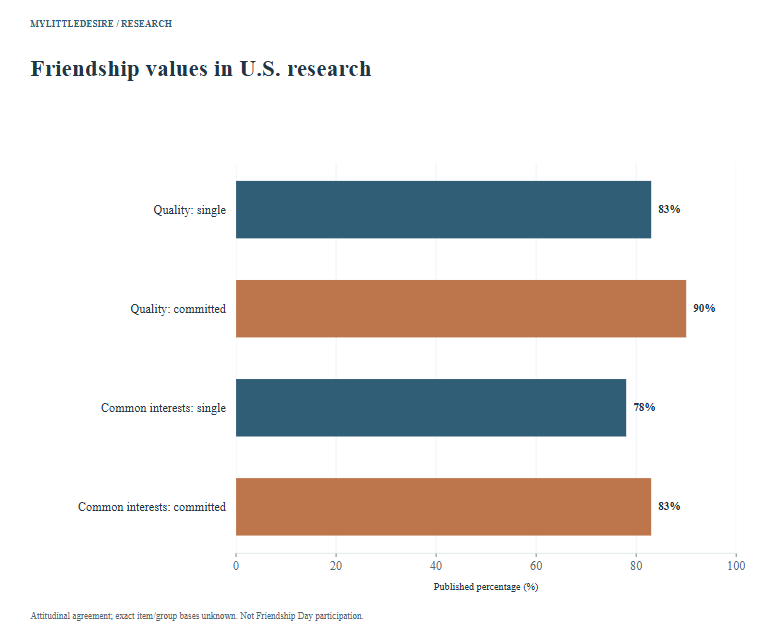
The U.S. article compares agreement among single and committed adults. Committed includes people married, in a civil partnership, in a relationship or living with a partner. Friendship-group importance was reported as 64% for both groups: one shared published figure supports those two related observations.
What did GB Friendship Day research find?
F07 Quality over quantity Original July 2024 Friendship Day article; rolling collection window and exact item/subgroup bases unknown. Attitudinal agreement, not day participation or causal effects. Categories follow publisher wording.
| Measure / group | Published percentage | Population, period and base | Original source |
|---|---|---|---|
| Single | 88% | GB online adult population; single/committed relationship-status and selected gender groups Continuously collected/rolling Profiles data published July 29, 2024; exact collection window unreported · Exact selected item/group n unavailable | Original source [S02] Original article relationship-status paragraph: Quality over quantity |
| Committed | 90% | GB online adult population; single/committed relationship-status and selected gender groups Continuously collected/rolling Profiles data published July 29, 2024; exact collection window unreported · Exact selected item/group n unavailable | Original source [S02] Original article relationship-status paragraph: Quality over quantity |
F08 Make friends based on common interests and values Original July 2024 Friendship Day article; rolling collection window and exact item/subgroup bases unknown. Attitudinal agreement, not day participation or causal effects. Categories follow publisher wording.
| Measure / group | Published percentage | Population, period and base | Original source |
|---|---|---|---|
| Single | 78% | GB online adult population; single/committed relationship-status and selected gender groups Continuously collected/rolling Profiles data published July 29, 2024; exact collection window unreported · Exact selected item/group n unavailable | Original source [S02] Original article relationship-status paragraph: Make friends based on common interests and values |
| Committed | 76% | GB online adult population; single/committed relationship-status and selected gender groups Continuously collected/rolling Profiles data published July 29, 2024; exact collection window unreported · Exact selected item/group n unavailable | Original source [S02] Original article relationship-status paragraph: Make friends based on common interests and values |
F09 Aim to be a trusted resource for friends Original July 2024 Friendship Day article; rolling collection window and exact item/subgroup bases unknown. Attitudinal agreement, not day participation or causal effects. Categories follow publisher wording.
| Measure / group | Published percentage | Population, period and base | Original source |
|---|---|---|---|
| Single | 68% | GB online adult population; single/committed relationship-status and selected gender groups Continuously collected/rolling Profiles data published July 29, 2024; exact collection window unreported · Exact selected item/group n unavailable | Original source [S02] Original article relationship-status paragraph: Aim to be a trusted resource for friends |
| Committed | 64% | GB online adult population; single/committed relationship-status and selected gender groups Continuously collected/rolling Profiles data published July 29, 2024; exact collection window unreported · Exact selected item/group n unavailable | Original source [S02] Original article relationship-status paragraph: Aim to be a trusted resource for friends |
F10 Friendship groups are an important part of life Original July 2024 Friendship Day article; rolling collection window and exact item/subgroup bases unknown. Attitudinal agreement, not day participation or causal effects. Categories follow publisher wording.
| Measure / group | Published percentage | Population, period and base | Original source |
|---|---|---|---|
| Single | 68% | GB online adult population; single/committed relationship-status and selected gender groups Continuously collected/rolling Profiles data published July 29, 2024; exact collection window unreported · Exact selected item/group n unavailable | Original source [S02] Original article relationship-status paragraph: Friendship groups are an important part of life |
| Committed | 65% | GB online adult population; single/committed relationship-status and selected gender groups Continuously collected/rolling Profiles data published July 29, 2024; exact collection window unreported · Exact selected item/group n unavailable | Original source [S02] Original article relationship-status paragraph: Friendship groups are an important part of life |
F11 Envy friends’ lifestyles Original July 2024 Friendship Day article; rolling collection window and exact item/subgroup bases unknown. Attitudinal agreement, not day participation or causal effects. Categories follow publisher wording.
| Measure / group | Published percentage | Population, period and base | Original source |
|---|---|---|---|
| Single | 36% | GB online adult population; single/committed relationship-status and selected gender groups Continuously collected/rolling Profiles data published July 29, 2024; exact collection window unreported · Exact selected item/group n unavailable | Original source [S02] Original article relationship-status paragraph: Envy friends’ lifestyles |
| Committed | 23% | GB online adult population; single/committed relationship-status and selected gender groups Continuously collected/rolling Profiles data published July 29, 2024; exact collection window unreported · Exact selected item/group n unavailable | Original source [S02] Original article relationship-status paragraph: Envy friends’ lifestyles |
F12 Friends are more important than family Original July 2024 Friendship Day article; rolling collection window and exact item/subgroup bases unknown. Attitudinal agreement, not day participation or causal effects. Categories follow publisher wording.
| Measure / group | Published percentage | Population, period and base | Original source |
|---|---|---|---|
| Single | 24% | GB online adult population; single/committed relationship-status and selected gender groups Continuously collected/rolling Profiles data published July 29, 2024; exact collection window unreported · Exact selected item/group n unavailable | Original source [S02] Original article relationship-status paragraph: Friends are more important than family |
| Committed | 16% | GB online adult population; single/committed relationship-status and selected gender groups Continuously collected/rolling Profiles data published July 29, 2024; exact collection window unreported · Exact selected item/group n unavailable | Original source [S02] Original article relationship-status paragraph: Friends are more important than family |
F13 Aim to be a trusted resource for friends Original July 2024 Friendship Day article; rolling collection window and exact item/subgroup bases unknown. Attitudinal agreement, not day participation or causal effects. Categories follow publisher wording.
| Measure / group | Published percentage | Population, period and base | Original source |
|---|---|---|---|
| Women | 69% | GB online adult population; single/committed relationship-status and selected gender groups Continuously collected/rolling Profiles data published July 29, 2024; exact collection window unreported · Exact selected item/group n unavailable | Original source [S02] Original article gender bullet/paragraph: Aim to be a trusted resource for friends |
| Men | 62% | GB online adult population; single/committed relationship-status and selected gender groups Continuously collected/rolling Profiles data published July 29, 2024; exact collection window unreported · Exact selected item/group n unavailable | Original source [S02] Original article gender bullet/paragraph: Aim to be a trusted resource for friends |
F14 Quality over quantity Original July 2024 Friendship Day article; rolling collection window and exact item/subgroup bases unknown. Attitudinal agreement, not day participation or causal effects. Categories follow publisher wording.
| Measure / group | Published percentage | Population, period and base | Original source |
|---|---|---|---|
| Women | 91% | GB online adult population; single/committed relationship-status and selected gender groups Continuously collected/rolling Profiles data published July 29, 2024; exact collection window unreported · Exact selected item/group n unavailable | Original source [S02] Original article gender bullet/paragraph: Quality over quantity |
| Men | 87% | GB online adult population; single/committed relationship-status and selected gender groups Continuously collected/rolling Profiles data published July 29, 2024; exact collection window unreported · Exact selected item/group n unavailable | Original source [S02] Original article gender bullet/paragraph: Quality over quantity |
F15 Friends are more important than family Original July 2024 Friendship Day article; rolling collection window and exact item/subgroup bases unknown. Attitudinal agreement, not day participation or causal effects. Categories follow publisher wording.
| Measure / group | Published percentage | Population, period and base | Original source |
|---|---|---|---|
| Women | 16% | GB online adult population; single/committed relationship-status and selected gender groups Continuously collected/rolling Profiles data published July 29, 2024; exact collection window unreported · Exact selected item/group n unavailable | Original source [S02] Original article gender bullet/paragraph: Friends are more important than family |
| Men | 20% | GB online adult population; single/committed relationship-status and selected gender groups Continuously collected/rolling Profiles data published July 29, 2024; exact collection window unreported · Exact selected item/group n unavailable | Original source [S02] Original article gender bullet/paragraph: Friends are more important than family |
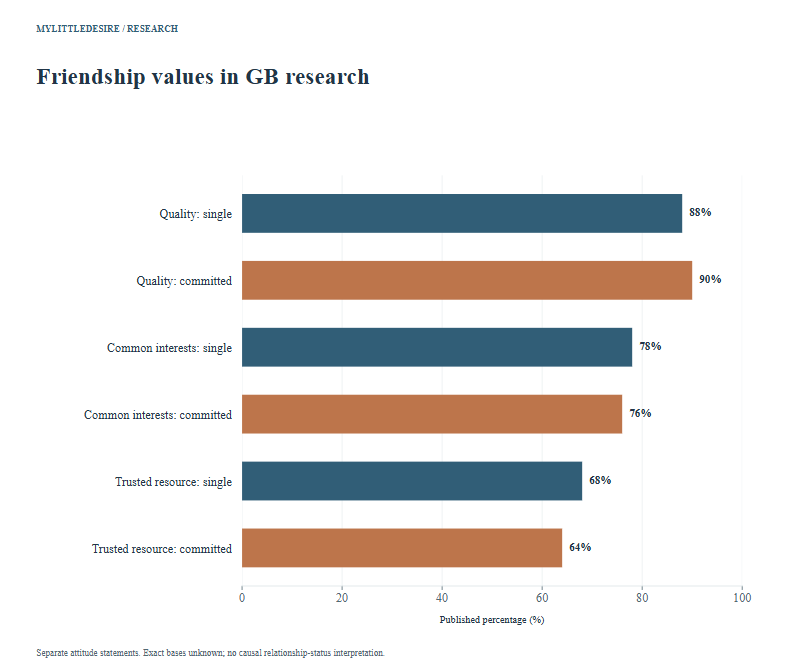
The GB article also reports relationship-status and gender differences. Its percentages describe attitudes, not causes or personal rules. Exact rolling windows and selected bases are unavailable. The U.S. and GB publications use the same Profiles product and should not be treated as two independent methods or a harmonized ranking of countries.
How did adults stay in touch with close friends?
F16 At least once a day or a few times a week, among adults with a close friend outside family. Published NET, not sum of rounded components. Mode categories overlap; any-mode NET is not summed. Overall eligible asked n=5,107; exact gender subset bases unknown. Not a holiday participation measure.
| Measure / group | Published percentage | Population, period and base | Original source |
|---|---|---|---|
| All adults | 61% | U.S. all adults with at least one close friend outside family September 3–15, 2024 · Eligible asked base n=5,107; item-complete n unconfirmed | Original source [S03] Report printed page 12 / PDF page 13, original communication chart; COMMFRI eligibility in topline p.3 |
| Men | 56% | U.S. men with at least one close friend outside family September 3–15, 2024 · Exact selected item/group n unavailable | Original source [S03] Report printed page 12 / PDF page 13, original communication chart; COMMFRI eligibility in topline p.3 |
| Women | 66% | U.S. women with at least one close friend outside family September 3–15, 2024 · Exact selected item/group n unavailable | Original source [S03] Report printed page 12 / PDF page 13, original communication chart; COMMFRI eligibility in topline p.3 |
F17 At least once a day or a few times a week, among adults with a close friend outside family. Published NET, not sum of rounded components. Mode categories overlap; any-mode NET is not summed. Overall eligible asked n=5,107; exact gender subset bases unknown. Not a holiday participation measure.
| Measure / group | Published percentage | Population, period and base | Original source |
|---|---|---|---|
| All adults | 39% | U.S. all adults with at least one close friend outside family September 3–15, 2024 · Eligible asked base n=5,107; item-complete n unconfirmed | Original source [S03] Report printed page 12 / PDF page 13, original communication chart; COMMFRI eligibility in topline p.3 |
| Men | 33% | U.S. men with at least one close friend outside family September 3–15, 2024 · Exact selected item/group n unavailable | Original source [S03] Report printed page 12 / PDF page 13, original communication chart; COMMFRI eligibility in topline p.3 |
| Women | 45% | U.S. women with at least one close friend outside family September 3–15, 2024 · Exact selected item/group n unavailable | Original source [S03] Report printed page 12 / PDF page 13, original communication chart; COMMFRI eligibility in topline p.3 |
F18 At least once a day or a few times a week, among adults with a close friend outside family. Published NET, not sum of rounded components. Mode categories overlap; any-mode NET is not summed. Overall eligible asked n=5,107; exact gender subset bases unknown. Not a holiday participation measure.
| Measure / group | Published percentage | Population, period and base | Original source |
|---|---|---|---|
| All adults | 35% | U.S. all adults with at least one close friend outside family September 3–15, 2024 · Eligible asked base n=5,107; item-complete n unconfirmed | Original source [S03] Report printed page 12 / PDF page 13, original communication chart; COMMFRI eligibility in topline p.3 |
| Men | 32% | U.S. men with at least one close friend outside family September 3–15, 2024 · Exact selected item/group n unavailable | Original source [S03] Report printed page 12 / PDF page 13, original communication chart; COMMFRI eligibility in topline p.3 |
| Women | 38% | U.S. women with at least one close friend outside family September 3–15, 2024 · Exact selected item/group n unavailable | Original source [S03] Report printed page 12 / PDF page 13, original communication chart; COMMFRI eligibility in topline p.3 |
F19 At least once a day or a few times a week, among adults with a close friend outside family. Published NET, not sum of rounded components. Mode categories overlap; any-mode NET is not summed. Overall eligible asked n=5,107; exact gender subset bases unknown. Not a holiday participation measure.
| Measure / group | Published percentage | Population, period and base | Original source |
|---|---|---|---|
| All adults | 29% | U.S. all adults with at least one close friend outside family September 3–15, 2024 · Eligible asked base n=5,107; item-complete n unconfirmed | Original source [S03] Report printed page 12 / PDF page 13, original communication chart; COMMFRI eligibility in topline p.3 |
| Men | 31% | U.S. men with at least one close friend outside family September 3–15, 2024 · Exact selected item/group n unavailable | Original source [S03] Report printed page 12 / PDF page 13, original communication chart; COMMFRI eligibility in topline p.3 |
| Women | 28% | U.S. women with at least one close friend outside family September 3–15, 2024 · Exact selected item/group n unavailable | Original source [S03] Report printed page 12 / PDF page 13, original communication chart; COMMFRI eligibility in topline p.3 |
F20 At least once a day or a few times a week, among adults with a close friend outside family. Published NET, not sum of rounded components. Mode categories overlap; any-mode NET is not summed. Overall eligible asked n=5,107; exact gender subset bases unknown. Not a holiday participation measure.
| Measure / group | Published percentage | Population, period and base | Original source |
|---|---|---|---|
| All adults | 74% | U.S. all adults with at least one close friend outside family September 3–15, 2024 · Eligible asked base n=5,107; item-complete n unconfirmed | Original source [S03] Report printed page 12 / PDF page 13, original communication chart; COMMFRI eligibility in topline p.3 |
| Men | 70% | U.S. men with at least one close friend outside family September 3–15, 2024 · Exact selected item/group n unavailable | Original source [S03] Report printed page 12 / PDF page 13, original communication chart; COMMFRI eligibility in topline p.3 |
| Women | 77% | U.S. women with at least one close friend outside family September 3–15, 2024 · Exact selected item/group n unavailable | Original source [S03] Report printed page 12 / PDF page 13, original communication chart; COMMFRI eligibility in topline p.3 |
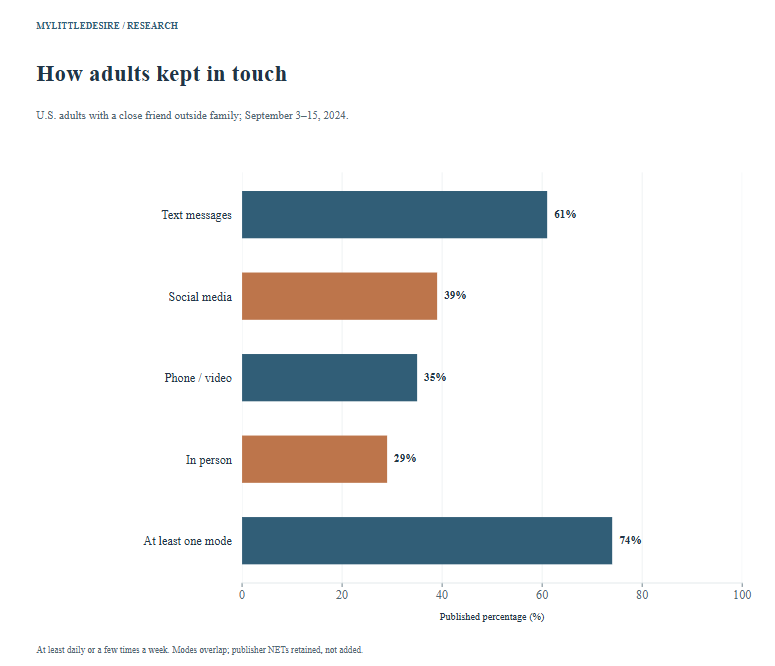
Pew’s communication questions were asked only of adults with a close friend outside their family. The 74% any-mode figure is the publisher’s combined result, not the sum of text, social, phone and in-person percentages. A person can use several modes. These describe regular behavior during the survey period, not activity on July 30.
Preserve the published NETs. The report gives texting at 61% overall, while its separately rounded topline categories are 25% daily and 35% a few times a week. For men, the published NET is 56%, while rounded components are 21% and 34%. We retain the original NETs rather than substituting sums of rounded values.
How likely were adults to seek support from a friend?
F21 Extremely or very likely to turn to a friend if emotional support were needed. Hypothetical willingness, not actual help received or treatment efficacy. Full asked all/gender bases retained; exact item-complete n unconfirmed. Not a holiday outcome.
| Measure / group | Published percentage | Population, period and base | Original source |
|---|---|---|---|
| All adults | 46% | U.S. all adults September 3–15, 2024 · Full asked base n=6,204; item-complete n unconfirmed | Original source [S03] Report printed page 10 / PDF page 11, friend-support chart; EMOSUPPOTH.a topline p.6 |
| Men | 38% | U.S. men September 3–15, 2024 · Full asked base n=2,710; item-complete n unconfirmed | Original source [S03] Report printed page 10 / PDF page 11, friend-support chart; EMOSUPPOTH.a topline p.6 |
| Women | 54% | U.S. women September 3–15, 2024 · Full asked base n=3,446; item-complete n unconfirmed | Original source [S03] Report printed page 10 / PDF page 11, friend-support chart; EMOSUPPOTH.a topline p.6 |
Saying someone would turn to a friend is different from reporting help actually received. The selected support measure does not test the effect of celebrating Friendship Day, and a gender comparison cannot establish why individuals choose particular sources of support.
How easy did adults find making new friends?
F22 Original six-category response to Question 1. June 2026 adult-citizen opt-in survey. Printed unweighted n=1,066; percentages weighted. No new combined easy/difficult NET. Not a day-participation or success measure.
| Measure / group | Published percentage | Population, period and base | Original source |
|---|---|---|---|
| Very easy | 15% | U.S. adult citizens age 18+, not all U.S. residents or a worldwide sample June 5–9, 2026 · Printed unweighted Question 1 base n=1,066 | Original source [S04] Original PDF topline p.1; Question 1 crosstab printed p.1 / PDF p.4 |
| Somewhat easy | 23% | U.S. adult citizens age 18+, not all U.S. residents or a worldwide sample June 5–9, 2026 · Printed unweighted Question 1 base n=1,066 | Original source [S04] Original PDF topline p.1; Question 1 crosstab printed p.1 / PDF p.4 |
| Neither easy nor difficult | 24% | U.S. adult citizens age 18+, not all U.S. residents or a worldwide sample June 5–9, 2026 · Printed unweighted Question 1 base n=1,066 | Original source [S04] Original PDF topline p.1; Question 1 crosstab printed p.1 / PDF p.4 |
| Somewhat difficult | 20% | U.S. adult citizens age 18+, not all U.S. residents or a worldwide sample June 5–9, 2026 · Printed unweighted Question 1 base n=1,066 | Original source [S04] Original PDF topline p.1; Question 1 crosstab printed p.1 / PDF p.4 |
| Very difficult | 14% | U.S. adult citizens age 18+, not all U.S. residents or a worldwide sample June 5–9, 2026 · Printed unweighted Question 1 base n=1,066 | Original source [S04] Original PDF topline p.1; Question 1 crosstab printed p.1 / PDF p.4 |
| Don’t know | 4% | U.S. adult citizens age 18+, not all U.S. residents or a worldwide sample June 5–9, 2026 · Printed unweighted Question 1 base n=1,066 | Original source [S04] Original PDF topline p.1; Question 1 crosstab printed p.1 / PDF p.4 |
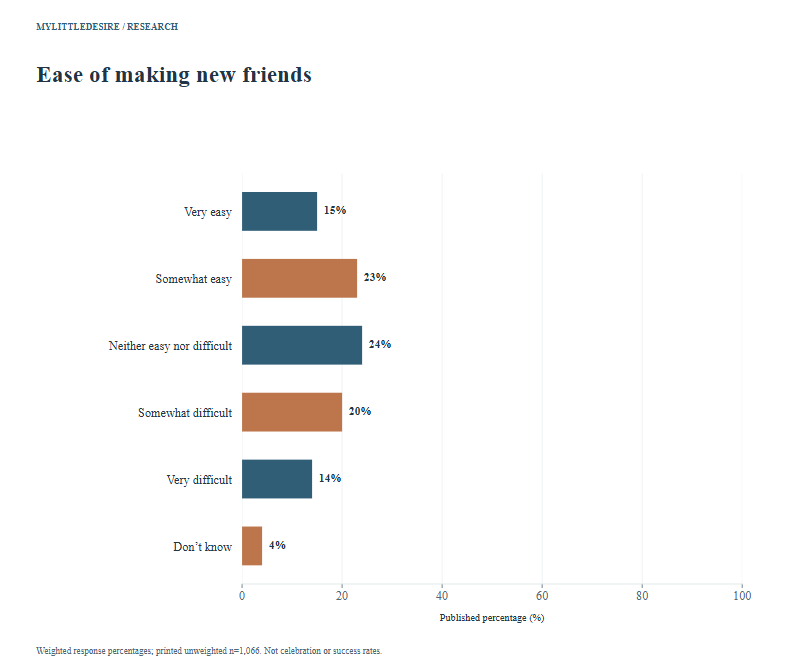
The June 2026 YouGov question asks perceived ease, with six response categories retained. It is not a measure of how many friendships were successfully formed. Its target is adult U.S. citizens, which differs from Pew’s U.S. adult population and the Profiles online populations. No trend is constructed across those designs.
How can the research inform an observance?
The UN resolution supports education and public awareness across communities. A school, group or individual can use the date as a reminder to make room for friendship, with attention to different cultures and circumstances. The following are editorial ideas, not activities tested by these surveys:
- Choose a way to contact a friend that fits the relationship, such as a message, call or planned meeting.
- Make space for someone new through a shared interest or an inclusive group activity.
- Use a discussion or educational activity to learn about friendship across communities.
The studies describe attitudes and habits; they do not establish a best celebration, required gift, spending target or health outcome. There is no need to turn the day into a comparison of how many friends someone has.
Ten reproducible descriptive comparisons
Each comparison subtracts published percentages within a compatible source/construct and reports percentage points. No new significance test, causal effect or cross-country ranking is calculated.
| ID | Comparison | First | Second | Difference | Qualification |
|---|---|---|---|---|---|
| C01 | U.S. quality preference: committed minus single | 90% | 83% | +7 percentage points | Relationship-status association, not an effect of partnering. Descriptive arithmetic on published inputs. |
| C02 | U.S. common-interest agreement: committed minus single | 83% | 78% | +5 percentage points | Different status groups; bases unknown. Descriptive arithmetic on published inputs. |
| C03 | U.S. lifestyle envy: committed minus single | 34% | 24% | +10 percentage points | Agreement, not observed envy frequency. Descriptive arithmetic on published inputs. |
| C04 | GB quality preference: committed minus single | 90% | 88% | +2 percentage points | Rolling Profiles data; no significance test. Descriptive arithmetic on published inputs. |
| C05 | GB trusted-resource agreement: women minus men | 69% | 62% | +7 percentage points | Attitudinal gender comparison; exact bases unknown. Descriptive arithmetic on published inputs. |
| C06 | GB lifestyle envy: single minus committed | 36% | 23% | +13 percentage points | No causal relationship-status inference. Descriptive arithmetic on published inputs. |
| C07 | Frequent texting: women minus men | 66% | 56% | +10 percentage points | Published NETs, not sums of rounded components; subset bases unknown. Descriptive arithmetic on published inputs. |
| C08 | Friend-support likelihood: women minus men | 54% | 38% | +16 percentage points | Extremely/very likely, not actual help received. Descriptive arithmetic on published inputs. |
| C09 | Frequent in-person contact: men minus women | 31% | 28% | +3 percentage points | Among people with a close friend; no clinical effect. Descriptive arithmetic on published inputs. |
| C10 | Making-friend difficulty: somewhat minus very | 20% | 14% | +6 percentage points | Separate original response categories; no new NET. Descriptive arithmetic on published inputs. |
Common questions
When did the UN establish the day?
The General Assembly adopted resolution A/RES/65/275 on May 3, 2011. The document was distributed July 28, 2011.
Are these global celebration statistics?
No. They describe specified friendship attitudes and habits, alongside official observance facts.
Do the Profiles articles have July 2024 fieldwork dates?
They were published in July 2024, but use rolling data with an unreported exact collection window.
Can the U.S. and GB figures rank countries?
No. Exact windows/bases and coverage do not support a harmonized ranking here.
Can contact-mode percentages be added?
No. Modes overlap; use the publisher’s any-mode NET.
Does celebrating the day improve health or reduce loneliness?
The selected surveys do not test a Friendship Day intervention or establish that effect.
Research method and limitations
Selection and concentration. There are 54 observations: U.S. Profiles 12, GB Profiles 18, Pew 18 and June 2026 YouGov six. Four source collections come from two research publishers; 36 observations are from YouGov products and 18 from Pew. The two Profiles market views share a product. Related categories, groups and NETs are not independent studies. MyLittleDesire conducted no survey.
Verification. Thirty Profiles observations were checked against 29 distinct published numeric labels, including the shared U.S. 64% statement. Fifteen Pew communication chart labels and three friend-support NETs were checked, with original charts reviewed visually. Six original YouGov crosstab cells and their base were checked. The UN date/adoption facts were verified against the resolution; the 2027 weekday was checked by calendar calculation.
Bases and uncertainty. Fourteen rows retain reported asked/eligible/unweighted bases: five Pew overall communication rows, three Pew support asked-base rows and six YouGov Question 1 rows. Forty selected bases remain unknown. All selected weighted counts and estimate-specific CIs are unavailable and left blank. No intervals are constructed from study-level margins.
Interpretation. Keep agreement separate from behavior, ordinary friendship research separate from celebration metrics, publication separate from collection, and citizens/online populations separate from all adults. Observance facts are not counted toward the 54 survey observations. There is no verified global spending/participation estimate or invented official 2027 theme in this resource.
Original sources
Official observance authority: UN resolution A/RES/65/275; UN observance background.
- YouGov Profiles — U.S.. Data Spotlight: Friends in the USA [S01]
Published: July 29, 2024.
Period: Continuously collected/rolling Profiles data published July 29, 2024; exact collection window unreported.
Population: U.S. online adult population; single/committed relationship-status and selected gender groups.
Sample: Rolling Profiles product, not a single questionnaire. Exact full and selected item/subgroup n not given in inspected article.
Bases: All selected exact item/subgroup bases unknown; no overall panel size assigned to any figure.
Method: Original first-party Friendship Day article checked. Profiles uses continuously collected data and rolling surveys; article describes national online-population representation and weighting by age, gender, education, region and race. Selected original prose percentages retained.
Limits: Attitudinal agreement, not behavior, celebrations, spending or causal relationship-status effects. Exact collection window, bases, weighted counts and CIs unavailable. Single and committed categories retained as publisher describes; committed includes marriage, civil partnership, relationship or living with partner. U.S./GB articles are two geographic views of one product, not independent methodologies or a harmonized country ranking.
Supporting record 1 - YouGov Profiles — GB. Data Spotlight: British bonds [S02]
Published: July 29, 2024.
Period: Continuously collected/rolling Profiles data published July 29, 2024; exact collection window unreported.
Population: GB online adult population; single/committed relationship-status and selected gender groups.
Sample: Rolling Profiles product, not a single questionnaire. Exact full and selected item/subgroup n not given in inspected article.
Bases: All selected exact item/subgroup bases unknown; no overall panel size assigned to any figure.
Method: Original first-party Friendship Day article checked. Profiles uses continuously collected data and rolling surveys; article describes national online-population representation and weighting by age, gender, education, region and race. Selected original prose percentages retained.
Limits: Attitudinal agreement, not behavior, celebrations, spending or causal relationship-status effects. Exact collection window, bases, weighted counts and CIs unavailable. Single and committed categories retained as publisher describes; committed includes marriage, civil partnership, relationship or living with partner. U.S./GB articles are two geographic views of one product, not independent methodologies or a harmonized country ranking.
Supporting record 1 - Pew Research Center. Men, Women and Social Connections [S03]
Published: January 16, 2025.
Period: September 3–15, 2024.
Population: U.S. adults age 18+; communication items limited to people with at least one close friend outside family.
Sample: 6,204 full respondents: 5,202 ATP and 1,002 SSRS; full asked gender bases men 2,710 and women 3,446. Communication eligible base 5,107; exact gender counts within that subset unavailable.
Bases: Five overall communication NET rows retain published eligible asked n=5,107. Friend-support rows retain full asked n=6,204, men 2,710 or women 3,446, not asserted complete-answer n. Ten gender communication bases unknown; no full gender n substituted.
Method: Original report, topline and methods checked. Probability-based address-recruited ATP plus SSRS oversample; web and live telephone interviews, weighted to U.S. adults. Published at-least-few-times-weekly NETs and friend-support NETs retained rather than recomputed from rounded topline components.
Limits: Ordinary communication/support intentions, not International Friendship Day participation or intervention effects. Close friends exclude family. Communication modes overlap; any-mode NET is not a sum. Original text NET 61 differs from rounded 25+35=60; men 56 differs from 21+34=55. Retain publisher NETs. Study/gender margins are not estimate-specific intervals. Gender subgroup bases within eligible communication sample unknown.
Supporting record 1 · Supporting record 2 · Supporting record 3 - YouGov — June 2026 survey. Friendship and Loneliness [S04]
Published: 2026; exact release date not stated in inspected PDF.
Period: June 5–9, 2026.
Population: U.S. adult citizens age 18+, not all U.S. residents or a worldwide sample.
Sample: 1,066 respondents; Question 1 crosstab prints unweighted total n=1,066.
Bases: All six selected Question 1 overall response rows retain the original printed unweighted base 1,066. Not a weighted population count.
Method: Original topline/crosstab and methods checked. Web interviews from opt-in panel, weighted to adult U.S. citizens by demographic/political measures. Original six response categories and printed unweighted base retained.
Limits: Self-reported ease of making friends, not actual success or willingness to celebrate the day. Opt-in panel and citizenship restriction differ from Pew methods/target. Survey-level adjusted margin ±4.3 points is not used to invent selected CIs. No new easy/difficult NET or trend against differently worded questions.
How to cite this resource
MyLittleDesire. International Friendship Day Statistics 2027. https://mylittledesire.com/international-friendship-day-statistics/.